Presidio of San Francisco in San Francisco City and County, California — The American West (Pacific Coastal)
Oldest Adobe Building in San Francisco
Presidio of San Francisco

Photographed by Douglass Halvorsen, July 26, 2025
1. Oldest Adobe Building in San Francisco Marker
Officers’ Quarters
Under
Spanish Mexican & American Rule
Oldest Adobe Building in
San Francisco
Topics. This historical marker is listed in these topic lists: Colonial Era • Military • Settlements & Settlers. A significant historical year for this entry is 1776.
Location. 37° 47.855′ N, 122° 27.528′ W. Marker is in San Francisco, California, in San Francisco City and County. It is in Presidio of San Francisco. It is on Moraga Avenue, on the right when traveling east. Touch for map. Marker is at or near this postal address: 50 Moraga Avenue, San Francisco CA 94129, United States of America. Touch for directions.

Regionally, this marker is on the Coast Ranges. It is also on the American Pacific Coast. Globally, it is in North America, on the Ring of Fire, on the Pacific Rim, in the Western Hemisphere, in the Western World, and in the Anglosphere. Historically, it finds itself in what was once New Spain and also Mexico’s Alta California.
Other nearby markers. At least 8 other markers are within walking distance of this marker: Establishment of the Presidio of San Francisco
this page online
Also see . . .
1. History of the Presidio Officers' Club.
Over the years, the building that is now the Presidio Officers' Club has housed living quarters for Spanish and Mexican soldiers, barracks for the U.S. Army, a mess room and kitchen, laundresses' quarters, post headquarters, an assembly hall, a ballroom, and a restaurant and bar, and now a museum.(Submitted on September 18, 2025, by Douglass Halvorsen of Klamath Falls, Oregon.)
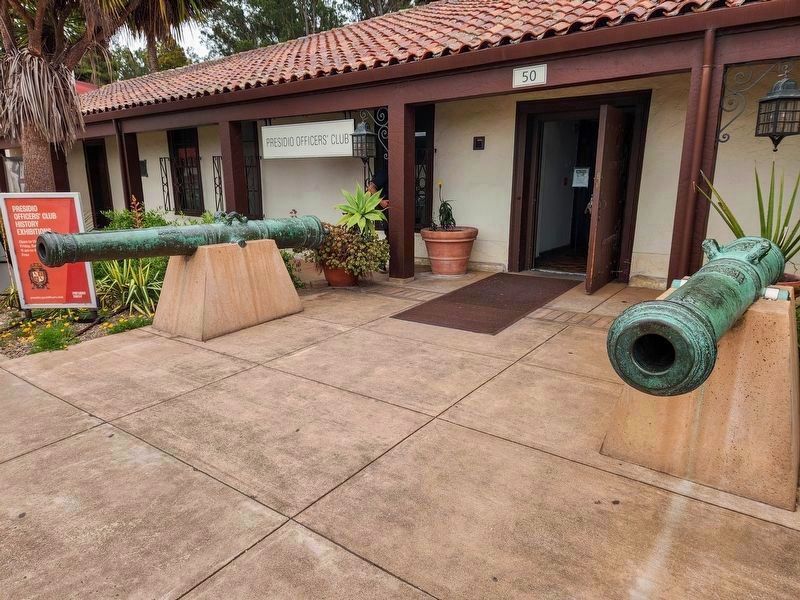
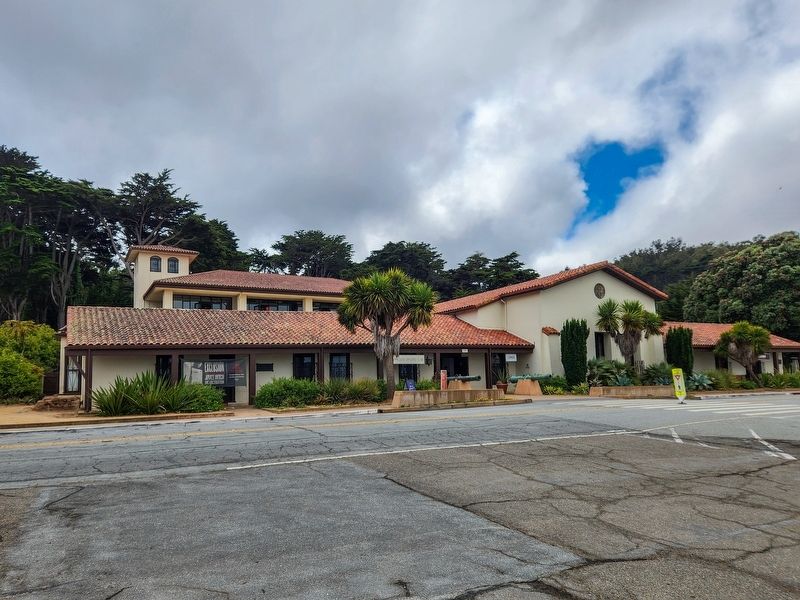
The front wings of the Presidio Officers' Club incorporate portions of the Spanish presidio's adobe walls that may date as far back as 1776. When U.S. troops occupied the post in 1847, they rebuilt the roof of the Spanish-Mexican-era adobe. In 1884-1885 a projecting central pavilion-like"assembly room" of wood construction was added to the structure. The next proposals to "restore" the building appear to have been formulated in the early 1930s, when a prototypical work relief-type project was instigated under the planning and supervision of Quartermaster Capt. Barney L. Meeden.Photographed by Douglass Halvorsen, July 26, 20252. Oldest Adobe Building in San Francisco MarkerTwo historic cannons reside in front of the Officers' Club. The marker can be seen in the background, partially hidden by the portico's wooden post.
The form and significance of today's Officers' Club pertains most directly to this remodeling and to the 1930s-era development of the Main Post. The 1933-1934 remodels removed some additions and transformed the building into a "Spanish Colonial Revival" edifice. Works Progress Administration (WPA) funds became available for additional improvements in 1936 and 1939, though none of these improvements seems to have directly involved the old adobe walls fronting the structure.
The building today stands as a complex series of interconnected adobe, concrete, wood-frame, and steel frame partitions. The appearance of the existing building, with its rustic Spanish-tile gable roofs, heavy rough timber lintels and beams, and decorative iron work, was determined in the remodel by Captain Meeden's perceptions of the possible appearance of the Spanish-eraadobe building. In the course of the 1930s construction, substantial remnants of early adobe walls were enclosed in metal lath and plaster and still form much of the front portion of the building. A massive 1972 rear addition that towers over the historic building considerably compromised the integrity of the historic building as a whole.Photographed by Douglass Halvorsen, July 26, 20253. Oldest Adobe Building in San Francisco MarkerThe marker can be seen under the portico.
The Presidio Trust rehabilitated the building from 2011 to 2014, removing some of the later additions and bringing it up to modern codes. The rehabilitation fully repaired the historic front portion as well as the large rear addition, added by the U.S. Army in 1972. A new structure connects the two, enabling the building to function as one seamless space. A new basement was also added for mechanical, electrical, and storage. The Officers' Club now houses the Presidio Heritage Center exhibits, a restaurant, and event facilities.
2. Adobe Wall Re-Discovered in San Francisco's Oldest Building.
The first adobe building on the site that is now the Officers’ Club was constructed by Spanish colonists in 1776. It is believed that the building was destroyed during a devastating storm in 1779. It was rebuilt, only to suffer major damage during a series of earthquakes in the summer of 1808, and then again in the quake of 1812. The existing adobe walls are remnants of the second building. When originally constructed, they would have been coated with a lime wash to protect them from moisture. The original adobe bricks were made with soil from the nearby El Polín Spring site, which was also home to families of Spanish settlers.(Submitted on September 18, 2025, by Douglass Halvorsen of Klamath Falls, Oregon.)
Credits. This page was last revised on September 19, 2025. It was originally submitted on September 18, 2025, by Douglass Halvorsen of Klamath Falls, Oregon. This page has been viewed 221 times since then and 48 times this year. Photos: 1, 2, 3. submitted on September 18, 2025, by Douglass Halvorsen of Klamath Falls, Oregon. • Andrew Ruppenstein was the editor who published this page.
