Rione VI Parione in Roma in Città metropolitana di Roma Capitale, Latium, Rome, Italy — Central Italy (Tyrrhenian Coast)
Parione
Rione VI
Photographed by Sean P. Flynn, August 4, 2025
1. Parione Marker
this page online
Photographed by Sean P. Flynn, August 4, 2025
2. Parione Marker
Photographed by Lalupa (CC BY-SA 4.0), via Wikimedia Commons, March 10, 2007
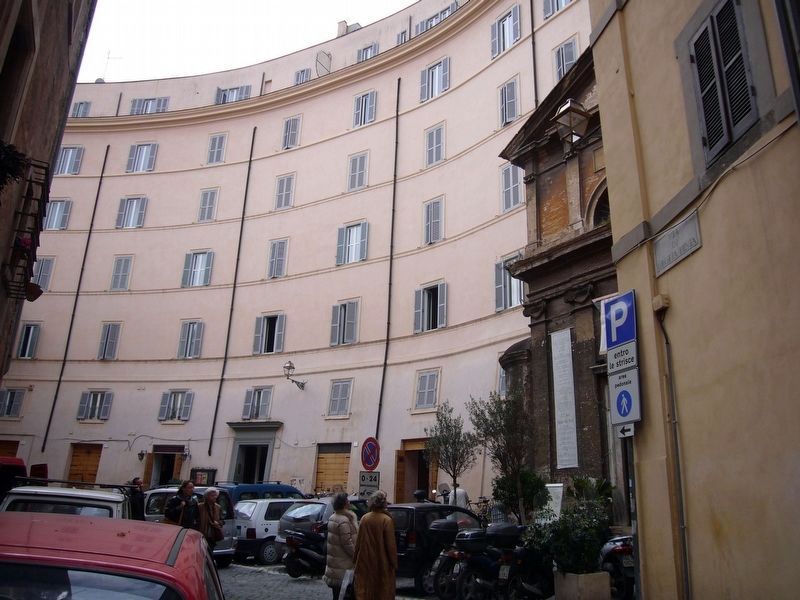
3. Building in Largo del Pallaro in Parione
The street and buildings in the section of Parione near this historical marker curve in line with the original semicircle of the Theatre of Pompey.
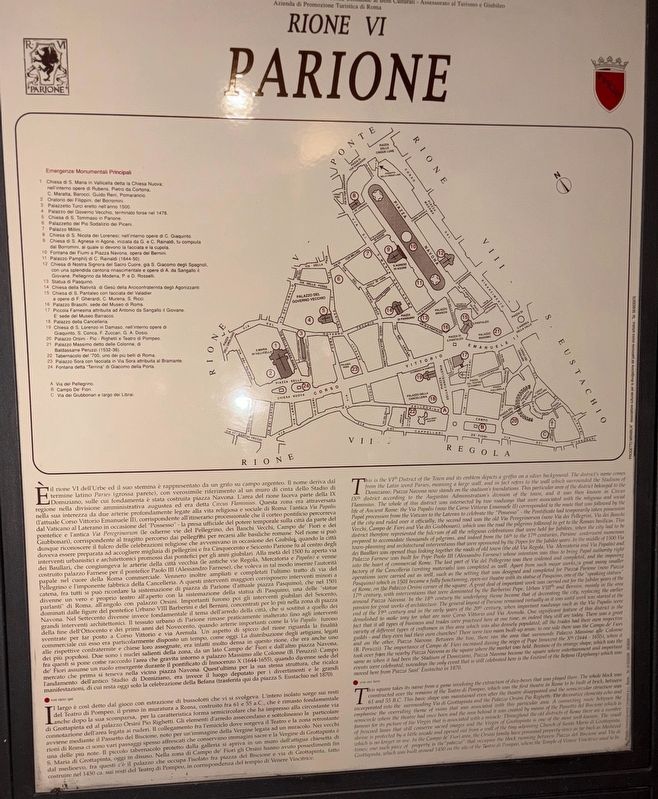
Il largo è cosi detto dal gioco con estrazione di bussolotti che vi si svolgeva. L'intero isolato sorge sui reti del Teatro di Pompen, il primo in muratura a Roma, costruito fra 61 e 55 aC, che è rimasto fondamentale nche dopo la sua scomparsa, per la caratteristica forma semicircolare che ha impresso alla circostante viz di Grottapinta ed al palazzo Orsini Pho Righetti Gli elementi d'arredo assecondano e sottolineane la particolare otarione dell area legata ai ruderi. Il collegamento fra l'emiciclo dove sorgeva il Teatro e la zona retrostante ene mediante il Passetto del Biscione, noto per un'immagine della Vergine legata ad un miracolo. Nes wechi honi di Roma ci sono vari passaggi spesser affrescati che conservano immagini sacre e la Vergine di Grottapintse una delle peu note fi piccolo tabernacolo protetto dalia galleria su apriva in un muro dell'attigua chiesetta di 5. Maria di Grottapinta, oggi in disuso. Nella zona di Campo di Fiore gli Orsini hanno avuto possedimenti dal Medioevo, fra questi c'è il palazzo che occupa Puolato fra piazza dei Biscioni e via di Gavottapunta, Lato costruire nel 1430 ca, sui nesti del Teatro di Pompeu, in corrispondenza del tempio di Venere Vinotrice.
This is the VI District of the Town and its emblem depicts a griffin on a silver background. The district's name comes from the Latin word Paries, meaning a large wall, and in fact refers to the wall which surrounded the Stadium of Domiziano, Piazza Navona now stands on the stadium's foundations. This particular area of the district belonged to the IXth district according to the Augustan Administration's division of the town, and it was then known as Circus Flaninius. The whole of this district was intersected by two roadways that were associated with the religious and social life of Ancient Rome: the Via Papalis (now the Corso Vittorio Emanuele II) corresponded to the route that was followed by the Papal Procession from the Vatican to the Lateran to celebrate the "Possesso" - the Pontificate had temporarily taken possession of the city and ruled over it officially; the second road was the old Via Peregrinorum (now Via dei Pelligrini, Via dei Banchi Vecchi, Campo de' Fiori and Via dei Giubbonari), which was the road the pilgrims followedto get to the Roman basilicas. This district therefore represented the fulcrum of all the religious celebrations that were held for Jubilees, when the city had to be prepared to accommodate thousands of pilgrims, and indeed from the 16th to the 17th centuries, Parione underwent numerous town-planning and architectural interventions that were sponsored by the Popes for the Jubilee years. In the middle of 1500 Via dei Baullari was opened thus linking together the roads of old town (the old Via Regola, Via Mercatoria and Via Papalis) and Palazzo Farnese was built for Pope Paolo II (Alessandro Farnese) whose intention was thus to bring Papal authority right into the heart of commercial Rome. The last part of Via del Pellegrino was then widened and completed, and the imposing factory of the Cancelleria (writing materials) was completed as well. Apart from such major works, a great many smaller operations were carried out as well, such as the setting that was designed and completed for Piazza Parione (now Piazza Pasquino) which in 1501 became a fully functioning, open-air theatre with its statue of Pasquino, one of the "speaking statues" of Rome, on the Palazzo Orsini of the square. A great deal of important work was carried out for the Jubilee years of the 17th century, with interventions that were dominated by the Barberini Pope, Urban VIIIth, and Bernini, mainly in the area around Piazza Navona. In the 18th century the underlying theme became that of decorating the city, replacing the earlier passion for great works of architecture. The general layout of Parione remained virtually as it was until work was started at the end of the 19th century and in the early years of the 20th century, when important roadways such as the Via Papalis were demolished to make way for what are now Corso Vittorio and Via Aremula. One significant feature of this district is the fact that all types of business and trades were practised here at one time, as indeed they still are today. There was a great variety of different types of craftsmen in this area which was also densely populated; all the trades had their own respective guilds - and they even had their own churches! There were two main built-up areas: to one side there was the Campo de' Fiori and on the other, Piazza Navona. Between the two, there ran the area that surrounds Palazzo Massimo alle Colonne (B. Peruzzi). The importance of Campo de' Fiori increased during the reign of Pope Innocent the Xth (1644-1655), when it took over from the nearby Piazza Navona as the square where the market was held. Because of its strange shape, which was the same as when it had been the Stadium of Domiziano, Piazza Navona became the square where entertainment and important events were celebrated, nowadays the only event that is still celebrated here is the Festival of the Befana (Epiphany) which was moved here from Piazza Sant' Eustachio in 1870.
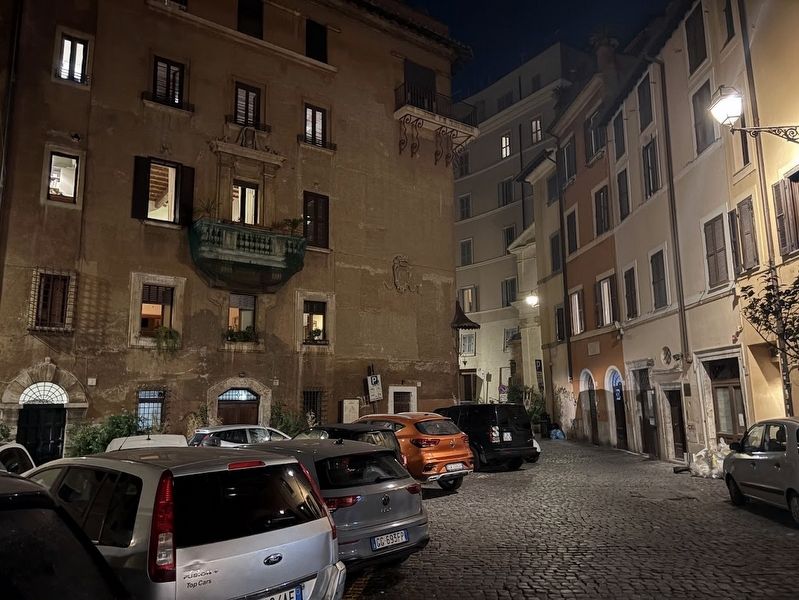
This square takes its name from a game involving the extraction of dice-boxes that was played there. The whole block was constructed over the remains of the Teatro di Pompeo, which was the first theatre in Rome to be built of brick, between 61 and 55 BC. This basic shape was us maintained even after the theatre disappeared and the semicircular structure was incorporated into the surrounding Via di Grottapinta and the Palazzo Orsini Pio Righetti. The decorative elements echo and emphasise the overriding theme of ruins that was associated with this particular area. A connecting route between the semicircle tolere the theatre had once been and the street behind it was created by means of the Passetto del Biscione which is famous for its picture of the Virgin that is associated with a miracle. Throughout the old districts of Rome there are a number of frescoed lanes that still conserve sacred images and the Virgin of Grottapinta is one of the most well-known. The small shrine is protected by a little arcade and opened out from a wall of the tiny adjoining Church of Santa Maria di Grottapinta, which is no longer in use. In the Campo de' Fiori area, the Orsini family have possessed property since as far back as Medieval times; one such piece of property is the "palazzo" that occupies the block running between Piazza del Biscione and Via di Grottapinta, which uses built around 1450 on the side of the Teatro de Pompey, where the Temple of Venere Vincitrice used to be.
Topics. This historical marker is listed in these topic lists: Arts, Letters, Music • Industry & Commerce • Religion & Religious Structures • Roads & Vehicles. A significant historical year for this entry is 1500.
Location. 41° 53.727′ N, 12° 28.429′ E. Marker is in Roma, Lazio (Latium, Rome), in Città metropolitana di Roma Capitale. It is in Rione VI Parione. It is at the intersection of Largo del Pallaro and Via di Grotta Pinta on Largo del Pallaro. Touch for map. Marker is in this post office area: Roma, Lazio 00186, Italy. Touch for directions.

Regionally, it is in Europe, the European Union, the Schengen Area, a coastal Mediterranean country, and the Western World. Historically, it finds itself in what was once the Roman Empire.
Other nearby markers. At least 8 other markers are within walking distance of this marker: Hotel Teatro di Pompeo (here, next to this marker); Guido Rattoppatore (about 90 meters away, measured in a direct line); Pio Papa IX / Pope Pius IX (about 90 meters away); Chiesa di Sant'Andrea della Valle / Church of Saint Andrew of the Valley (about 90 meters away); Campo dei Fiori (about 90 meters away); Piazza Massimo Alle Colonne (about 120 meters away); Giordano Bruno (about 120 meters away); Libreria Croce (about 150 meters away). Touch for a list and map of all markers in Roma.
More about this marker. At least one other marker with the same title can be found in this section of Rome. The top paragraph (in both Italian and English) is identical on both signs; the bottom text is unique to each sign and corresponds to the immediate area nearby.
Credits. This page was last revised on September 19, 2025. It was originally submitted on September 19, 2025, by Sean P. Flynn of Oak Park, Illinois. This page has been viewed 62 times since then and 11 times this year. Photos: 1, 2, 3. submitted on September 19, 2025, by Sean P. Flynn of Oak Park, Illinois.
