
Southampton Township near Shippensburg in Cumberland County, Pennsylvania — The American Northeast (Mid-Atlantic)
Confederate Invasion of the Cumberland Valley
Cumberland Valley Rail Trail
Photographed by William Pope, March 3, 2024
1. Confederate Invasion of the Cumberland Valley Marker
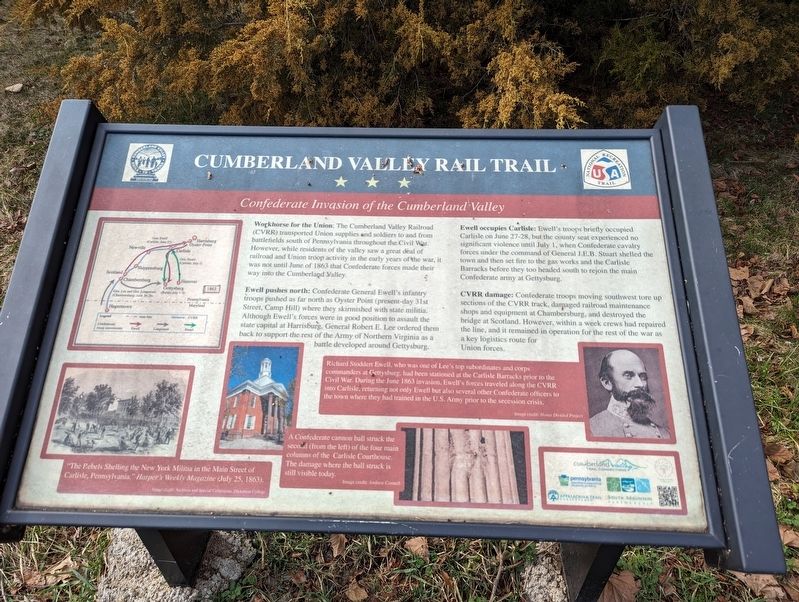
Ewell pushes north: Confederate General Ewell's infantry troops pushed as far north as Oyster Point (present-day 31st Street, Camp Hill) where they skirmished with state militia. Although Ewell's forces were in good position to assault the state capital at Harrisburg, General Robert E. Lee ordered them back to support the rest of the Army of Northern Virginia as a battle developed around Gettysburg.
Ewell occupies Carlisle: Ewell's troops briefly occupied Carlisle on June 27-28, but the county seat experienced no significant violence until July 1, when Confederate cavalry forces under the command of General J.E.B. Stuart shelled the town and then set fire to the gas works and the Carlisle Ba⁵rracks before they too headed
this page online
CVRR damage: Confederate troops moving southwest tore up sections of the CVRR track, damaged railroad maintenance shops and equipment at Chambersburg, and destroyed the bridge at Scotland. However, within a week crews had repaired the line, and it remained in operation for the rest of the war as a key logistics route for Union forces.
(captions)
"The Rebels Shelling the New York Militia in the Main Street of Carlisle, Pennsylvania." Harper's Weekly Magazine (July 25, 1863). Image credit: Archives and Special Collections, Dickenson College
Richard Stoddert Ewell, who was one of Lee's top subordinates and corps commanders at Gettysburg, had been stationed at the Carlisle Barracks prior to the Civil War. During the June 1863 invasion, Ewell's forces traveled along the CVRR into Carlisle, returning not only Ewell but also several other Confederate officers to the town where they had trained in the U.S. Army prior to the secession crisis. Image Credit: House Divided Project
A Confederate cannon ball struck the second (from the left) of the four main columns of the Carlisle Courthouse. The damage where the ball struck is still visible today. Image Credit: Andrew Connell
Topics.
Photographed by William Pope, March 3, 2024
2. Confederate Invasion of the Cumberland Valley Marker
Location. 40° 5.875′ N, 77° 29.244′ W. Marker is near Shippensburg, Pennsylvania, in Cumberland County. It is in Southampton Township. It is at the intersection of Duncan Road and Cumberland Valley Rail Trail, on the right when traveling west on Duncan Road. This marker is along the Cumberland Valley Rail Trail where it meets Duncan Road. Touch for map. Marker is at or near this postal address: 90 Duncan Road, Shippensburg PA 17257, United States of America. Touch for directions.

Regionally, this marker is in South-Central Pennsylvania and in Greater Harrisburg. It is also in the American Northeast, in the Mid-Atlantic, in Appalachia, and specifically in Northern Appalachia. Globally, it is in North America, the Western Hemisphere, the Western World, and the Anglosphere. Historically, it finds itself in what was once the Haudenosaunee (Iroquois) Confederacy and also one of the original Thirteen Colonies.
Other nearby markers. At least 8 other markers are within 3 miles of this marker, measured as the crow flies: Roadside and Farmers' Markets (here, next to this marker); Farmland Preservation (approx. 1½ miles away); Forbes Road - Raystown Path (approx. 1.9 miles away); Agriculture in the Cumberland Valley (approx. 2.6 miles away); Cumberland Valley Railroad and the Battle of Antietam (approx. 2.6 miles away); High-Speed Ammunition Run on the Cumberland Valley Railroad (approx. 2.7 miles away); Hagerstown Silt Loam (approx. 2.7 miles away); Shippensburg (approx. 2.9 miles away). Touch for a list and map of all markers in Shippensburg.
Credits. This page was last revised on September 24, 2025. It was originally submitted on March 7, 2024, by William Pope of Marietta, Pennsylvania. This page has been viewed 378 times since then and 41 times this year. Last updated on September 19, 2025, by Carl Gordon Moore Jr. of North East, Maryland. Photos: 1, 2. submitted on March 7, 2024, by William Pope of Marietta, Pennsylvania. • Bernard Fisher was the editor who published this page.
