Truckee in Nevada County, California — The American West (Pacific Coastal)
Donner Summit - The Chinese Laborers
Photographed by William Thievon, July 15, 2025
1. Donner Summit - The Chinese Laborers Marker
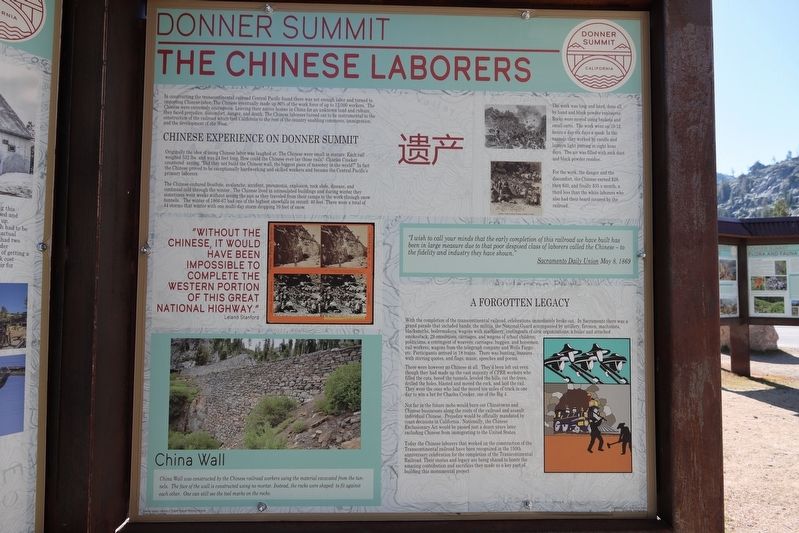
In constructing the transcontinental railroad Central Pacific found there was not enough labor and turned to importing Chinese labor. The Chinese eventually made up 80% of the work force of up to 12,000 workers. The Chinese were extremely courageous. Leaving their native homes in China for an unknown land and culture, they faced prejudice, discomfort, danger, and death. The Chinese laborers turned out to be instrumental to the construction of the railroad which tied California to the rest of the country enabling commerce, immigration, and the development of the West.
Chinese Experience on Donner Summit
Originally the idea of using Chinese labor was laughed at. The Chinese were small in stature. Each rail weighed 532 lbs. and was 24 feet long. How could the Chinese ever lay those rails? Charles Crocker countered saying, “Did they not build the Chinese wall, the biggest piece of masonry in the world?” In fact the Chinese proved to be exceptionally hardworking and skilled workers and became the Central Pacific’s primary laborers.
The Chinese endured frostbite, avalanche, accident, pneumonia, explosion, rock slide,
this page online
China Wall
China Wall was constructed by the Chinese railroad workers using the material excavated from the tunnels. The face of the wall is constructed using no mortar. Instead, the rocks were shaped to fit against each other. One can still see the tool marks on the rocks.
The work was long and hard, done all by hand and black powder explosives. Rocks were moved using baskets and small carts. The work went on 10-12 hours a day six days a week. In the tunnels they worked by candle and lantern light putting in eight hour days. The air was filled with rock dust and black powder residue.
For the work, the danger and the discomfort, the Chinese earned $28, then $30, and finally $35 a month, a third less than the white laborers who also had their board covered by the railroad.
A Forgotten Legacy
With the completion of the transcontinental railroad, celebrations immediately broke out. In Sacramento there was a grand parade that included bands; the militia, the National Guard accompanied by artillery, firemen, machinists, blacksmiths, boilermakers, wagons with machinery; contingents of civic organizations; a boiler and attached smokestack; 29 omnibuses, carriages, and wagons of school children; politicians; a contingent of weavers; carriages, buggies, and horsemen, rail workers; wagons from the telegraph company and Wells Fargo; etc. Participants arrived in 18 trains. There was bunting, banners with stirring quotes, and flags; music, speeches and poems.
There were however no Chinese at all. They’d been left out even though they had made up the vast majority of CPRR workers who filled the cuts, bored the tunnels, leveled the hills, cut the trees, drilled the holes, blasted and moved the rock, and laid the rail. They were the ones who laid the record ten miles of track in one day to win a bet for Charles Crocker, one of the Big 4.
Not far in the future mobs would burn out Chinatowns and Chinese businesses along the route of the railroad and assault individual Chinese. Prejudice would be officially mandated by court decisions in California. Nationally, the Chinese Exclusionary Act would be passed just a dozen years later excluding Chinese from immigrating to the United States.
Today the Chinese laborers that worked on the construction of the Transcontinental railroad have been recognized in the 150th anniversary celebration for the completion of the Transcontinental Railroad. Their stories and legacy are being shared to honor the amazing contribution and sacrifices they made as a key part of building this monumental project
Erected by Donner Summit Historical Society.
Topics and series. This historical marker is listed in these topic lists: Asian Americans • Immigration • Railroads & Streetcars. In addition, it is included in the Donner Summit Historical Society series list.
Location. 39° 18.983′ N, 120° 19.567′ W. Marker is in Truckee, California, in Nevada County. It can be reached from Donner Pass Road. Touch for map. Marker is at or near this postal address: 19195 Donner Pass Road, Truckee CA 96161, United States of America. Touch for directions.

Regionally, this marker is in the Sierra Nevada. It is also in the American Mountain West. Globally, it is in North America, on the Ring of Fire, on the Pacific Rim, in the Western Hemisphere, in the Western World, and in the Anglosphere. Historically, it finds itself in what was once New Spain and also Mexico’s Alta California.
Other nearby markers. At least 8 other markers are within walking distance of this marker: Donner Summit - The Shed (here, next to this marker); Highway Maintenance Station (here, next to this marker); Great Summit Tunnel of the Sierra Nevada (a few steps from this marker); Sugar Bowl Academy (within shouting distance of this marker); Donner Pass Airway Station & Beacon (about 300 feet away, measured in a direct line); Summit Hotel (approx. 0.2 miles away); Tunnel 6 (approx. 0.2 miles away); Donner Ski Ranch (approx. 0.2 miles away). Touch for a list and map of all markers in Truckee.
Related marker. Click here for another marker that is related to this marker.
Credits. This page was last revised on September 21, 2025. It was originally submitted on September 19, 2025, by William Thievon of Hofheim am Taunus, Germany. This page has been viewed 102 times since then and 57 times this year. Photo 1. submitted on September 19, 2025, by William Thievon of Hofheim am Taunus, Germany. • Andrew Ruppenstein was the editor who published this page.
