Fanshawe in London in Middlesex County, Ontario — Central Canada (North America)
The W. Rigney Harness Shop
Photographed by Tim Boyd, September 14, 2025
1. The W. Rigney Harness Shop Marker
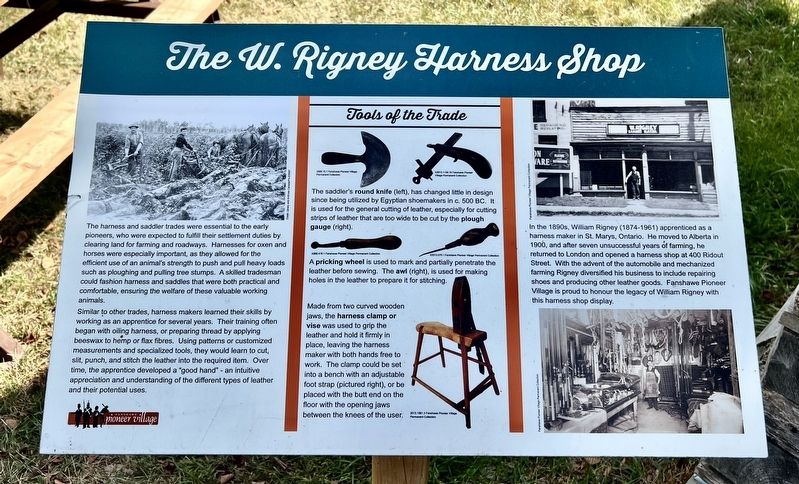
The harness and saddler trades were essential to the early pioneers, who were expected to fulfill their settlement duties by clearing land for farming and roadways. Harnesses for oxen and horses were especially important, as they allowed for the efficient use of an animal's strength to push and pull heavy loads such as ploughing and pulling tree stumps. A skilled tradesman could fashion harness and saddles that were both practical and comfortable, ensuring the welfare of these valuable working animals.
Similar to other trades, harness makers learned their skills by working as an apprentice for several years. Their training often began with oiling harness, or preparing thread by applying beeswax to hemp or flax fibres. Using patterns or customized measurements and specialized tools, they would learn to cut, slit, punch, and stitch the leather into the required item. Over time, the apprentice developed a "good hand" - an intuitive appreciation and understanding of the different types of leather and their potential uses.
In the 1890s, William Rigney (1874-1961) apprenticed as a harness maker in St. Marys, Ontario.
this page online
Erected by Fanshawe Pioneer Village.
Topics. This historical marker is listed in these topic lists: Agriculture • Industry & Commerce. A significant historical year for this entry is 1900.
Location. 43° 3.269′ N, 81° 10.83′ W. Marker is in London, Ontario, in Middlesex County. It is in Fanshawe. It can be reached from Fanshawe Park Road East. The marker is on the grounds of the Fanshawe Pioneer Village, accessibility subject to its operating hours and requiring paid admission. The Village is accessed by driving east from the intersection of Clark Road and Veterans’ Parkway. Admission is paid at the entrance to the Fanshawe Conservation Area, and then follow signposts for approx. 2km to the Village. Touch for map. Marker is at or
Photographed by Tim Boyd, September 14, 2025
2. The W. Rigney Harness Shop Marker
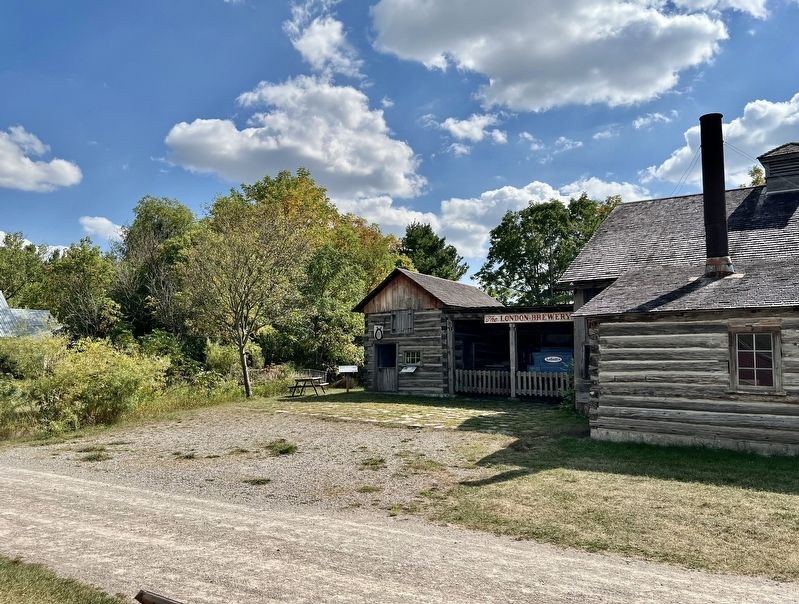
To the left of the building

Regionally, this marker is in the Southwest Ontario Area and in Southwestern Ontario. It is also in Central Canada. Globally, it is in North America, the Western Hemisphere, the Western World, and the Anglosphere. Historically, it finds itself in what was once a British colony, the Viceroyalty of New France, the Haudenosaunee (Iroquois) Confederacy, and Rupert’s Land.
Other nearby markers. At least 8 other markers are within walking distance of this marker: The Cobbling Trade (here, next to this marker); Print Shop (a few steps from this marker); Denfield General Store (a few steps from this marker); London Brewery (within shouting distance of this marker); Village Hall (within shouting distance of this marker); Trinity Church (within shouting distance of this marker); Harmer Sawmill (within shouting distance of this marker); Peel House (within shouting distance of this marker). Touch for a list and map of all markers in London.
Credits. This page was last revised on September 21, 2025. It was originally submitted on September 21, 2025, by Tim Boyd of Hamilton, Ontario. This page has been viewed 78 times since then and 19 times this year. Photos: 1, 2. submitted on September 21, 2025, by Tim Boyd of Hamilton, Ontario. • Andrew Ruppenstein was the editor who published this page.
