Main Post in San Francisco City and County, California — The American West (Pacific Coastal)
War in the Philippines
The Spanish-American War, the Philippine-American War, and the Presidio
| — | 1898 – 1902 | — |
Photographed by Syd Whittle, November 3, 2007
1. War in the Philippines Marker
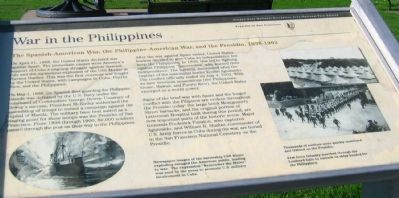
On April 21, 1898, the United States declared war against Spain. The immediate causes were America’s support of Cuba’s ongoing struggle against Spanish rule and the mysterious explosion of the USS Maine in Havana Harbor. This was the first overseas war fought by the United States, with campaigns in Cuba, Puerto Rico, and the Philippines.
On May 18, 1898, the Spanish fleet guarding the Philippine Islands was defeated by the U.S. Navy under the command of Commodore George Dewey. Unaware of Dewey’s success, President McKinley authorized the assembling of troops to mount a campaign against the capital of Manila. The military base best suited the as a staging point for these troops was the Presidio of San Francisco. From 1898 through 1900, 80,000 soldiers passed through the post on their way to the Philippines.
After the was against Spain ended, United States leaders decided to give Cuba its independence but keep the Philippines. In 1899, this led to fighting against Philippine “Insurrectos” who wanted their independence. The fighting diminished after the capture of the nationalist leader Emilio Aguinaldo. The conflict officially
this page online
Signs of the brief war with Spain and the longer conflict with the Filipinos are evident throughout the Presidio today: the large brick Montgomery Street barracks, and the original portion of Letterman Hospital built during that period, are now important parts of the historic scene. Major Generals Frederick Funston, who captured Aguinaldo, and William R. Shafter, commander of U.S. Army forces in Cuba during the war, are buried in the San Francisco National Cemetery on the Presidio.
Erected by National Park Service, U.S. Department of the Interior.
Topics and series. This historical marker is listed in these topic lists: Military • Notable Events • Notable Places • War, Spanish-American. In addition, it is included in the Former U.S. Presidents: #25 William McKinley series list. A significant historical date for this entry is April 21, 1898.
Location. Marker has been reported permanently removed. It was located near 37° 47.986′ N, 122° 27.47′ W. Marker was in San Francisco, California,
Photographed by Syd Whittle, November 3, 2007
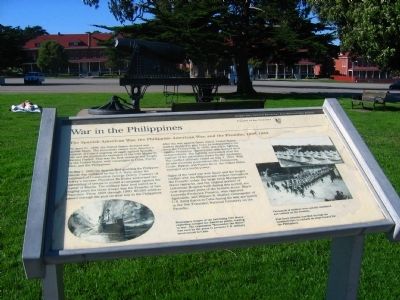
2. War in the Philippines Marker with Ordonez Gun in Background
We have been informed that this marker is no longer there and will not be replaced. This page is an archival view of what was.
Regionally, this marker was on the Coast Ranges. It was also on the American Pacific Coast. Globally, it was in North America, on the Ring of Fire, on the Pacific Rim, in the Western Hemisphere, in the Western World, and in the Anglosphere. Historically, it found itself in what was once New Spain and also Mexico’s Alta California.

Other nearby markers. At least 8 other markers are within walking distance of this location: A different marker also named Ordoñez Gun (here, next to this marker); Centennial Tree (within shouting distance of this marker); Bicentennial Tree (within shouting distance of this marker); Sixth United States Army (within shouting distance of this marker); Sixth Army Headquarters (about 300 feet away, measured
Photographed by Syd Whittle, November 3, 2007
3. Close-Up of Photo on Marker
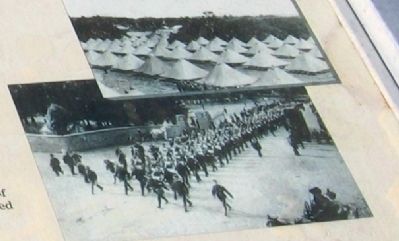
Thousands of soldiers were quickly mobilized and trained at the Presidio.
51st Iowa Infantry marched through the Lombard Gate to embark on ships headed for the Philippines.
51st Iowa Infantry marched through the Lombard Gate to embark on ships headed for the Philippines.
Another marker is no longer nearby. The Ordoñez Gun (was here, next to this marker but has been permanently removed).
More about this marker. The marker has been permanently removed, based on the photo uploaded from July 26, 2025.
Regarding War in the Philippines. Also see: The Ordonez Gun marker for additional information.
Also see . . .
1. The Spanish American War “A Splendid Little War”. (Submitted on October 18, 2008.)
2. The Philippine War - A Conflict of Conscience for African Americans. (Submitted on March 25, 2009, by Richard E. Miller of Oxon Hill, Maryland.)
Additional keywords. "Philippine Insurrection"
Photographed by Syd Whittle, November 3, 2007
4. Close-Up of Photo on Marker
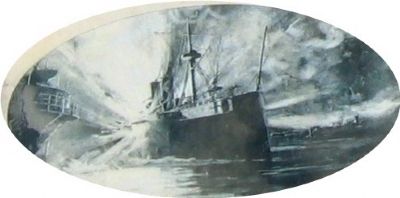
Newspaper images of the battleship USS Maine exploding enraged the American public, leading to war. The expression "Remember the Maine" was used by the press to promote U.S. military involvement in Cuba.
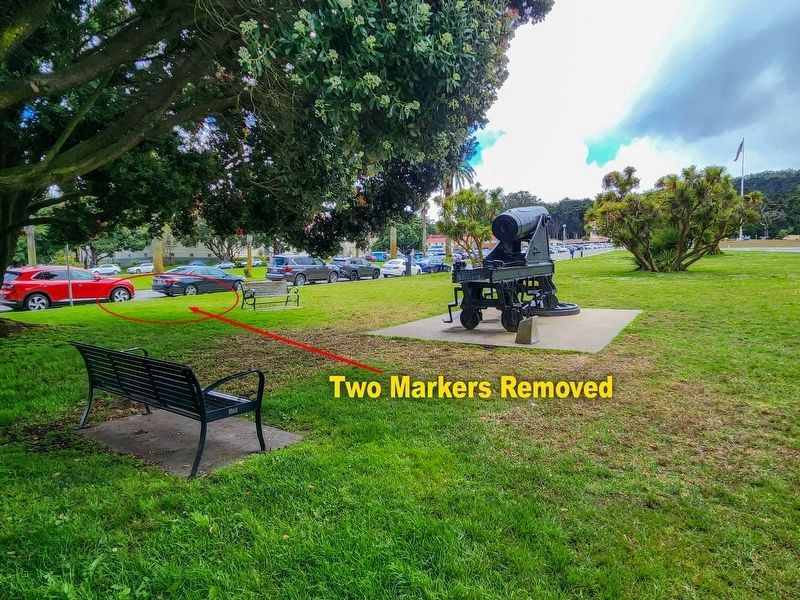
Photographed by Douglass Halvorsen, July 26, 2025
5. War in the Philippines Marker MISSING
This is one of two markers that have been removed, based on the submission photos from 2007. The markers were located in the circled area.
Credits. This page was last revised on September 29, 2025. It was originally submitted on October 18, 2008, by Syd Whittle of Mesa, Arizona. This page has been viewed 2,423 times since then and 37 times this year. Last updated on September 21, 2025, by Douglass Halvorsen of Klamath Falls, Oregon. Photos: 1, 2, 3, 4. submitted on October 18, 2008, by Syd Whittle of Mesa, Arizona. 5. submitted on September 21, 2025, by Douglass Halvorsen of Klamath Falls, Oregon. • Devry Becker Jones was the editor who published this page.
