Near Canadian in Pittsburg County, Oklahoma — The American South (West South Central)
Welcome to Lake Eufaula, Oklahoma's Largest Lake

Photographed by James Hulse, September 10, 2025
1. Welcome to Lake Eufaula, Oklahoma's Largest Lake Marker
Construction began on Lake Eufaula in 1956; the dam was completed in 1964. At normal pool level, this lake has over 600 miles of shoreline and covers about 102,000 acres. It is Oklahoma's largest lake. At normal pool, the average depth of the lake is about 23 feet, with the deepest water being about 87 feet.
Most of the inflow into this lake comes from three principal sources: the Deep Fork River and the North and South Canadian Rivers.
The initial recreational facilities on Lake Eufaula were constructed by the Corps of Engineers. On January 1, 1963, Arrowhead State Park was established. This state park is 2,202 acres in size. Arrowhead State Park remains the property of the federal government and is
this page online
© US Army Corps of Engineers
2nd Panel
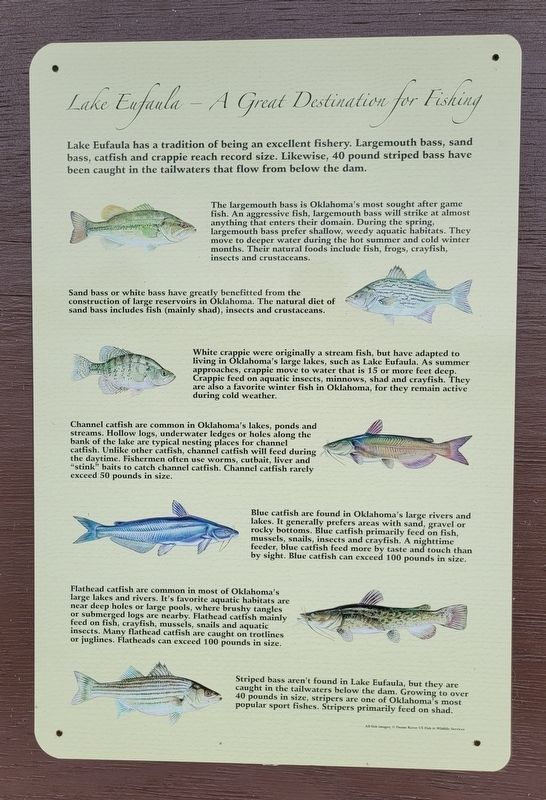
Lake Eufaula – A Great Destination for Fishing
Lake Eufaula has a tradition of being an excellent fishery. Largemouth bass, sand bass, catfish and crappie reach record size. Likewise, 40 pound striped bass have been caught in the tailwaters that flow from below the dam.
The largemouth bass is Oklahoma's most sought after game fish. An aggressive fish, largemouth bass will strike at almost anything that enters their domain. During the spring, largemouth bass prefer shallow, weedy aquatic habitats. They move to deeper water during the hot summer and cold winter months. Their natural foods include fish, frogs, crayfish, insects and crustaceans.
Sand bass or white bass have greatly benefitted from the construction of large reservoirs in Oklahoma. The natural diet of sand bass includes fish (mainly shad), insects and crustaceans.
White crappie were originally a stream fish, but have adapted to living in Oklahoma's large lakes, such as Lake Eufaula. As summer approaches, crappie move to water that is 15 or more feet deep. Crappie feed on aquatic insects, minnows, shad and crayfish. They are also a favorite winter fish in Oklahoma, for they remain active during cold weather.
Channel catfish are common in Oklahoma's lakes, ponds and streams. Hollow logs, underwater ledges or holes along the bank of the lake are typical nesting places for channel catfish. Unlike other catfish, channel catfish will feed during the daytime. Fishermen often use worms, cutbait, liver and "stink" baits to catch channel catfish. Channel catfish rarely exceed 50 pounds in size.
Blue catfish are found in Oklahoma's large rivers and lakes. It generally prefers areas with sand, gravel or rocky bottoms. Blue catfish primarily feed on fish, mussels, snails, insects and crayfish. A nighttime feeder, blue catfish feed more by taste and touch than by sight. Blue catfish can exceed 100 pounds in size.
Flathead catfish are common in most of Oklahoma's large lakes and rivers. It's favorite aquatic habitats are near deep holes or large pools, where brushy tangles or submerged logs are nearby. Flathead catfish mainly feed on fish, crayfish, mussels, snails and aquatic insects. Many flathead catfish are caught on trotlines or juglines. Flatheads can exceed 100 pounds in size.
Striped bass aren't found in Lake Eufaula, but they are caught in the tailwaters below the dam. Growing to over 40 pounds in size, stripers are one of Oklahoma's most popular sport fishes. Stripers primarily feed on shad.
All fish images, © Duane Raver US Fish & Wildlife
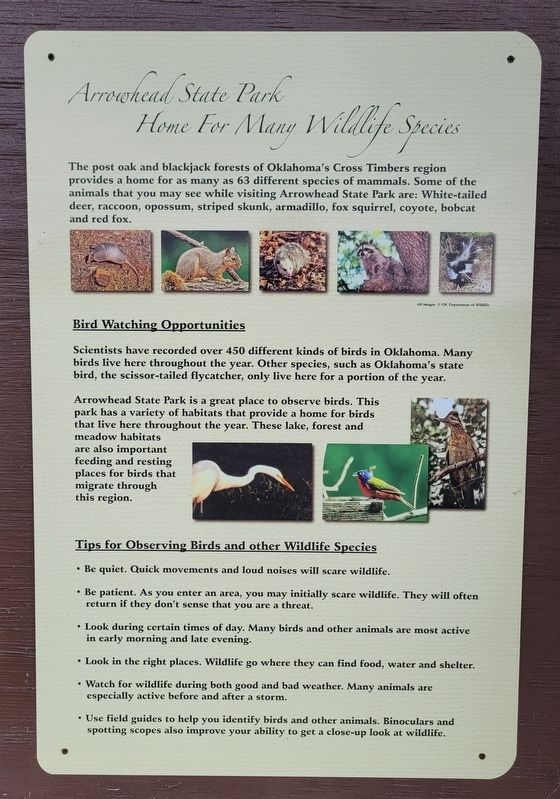
Arrowhead State Park
Home For Many Wildlife Species
The
Photographed by James Hulse, September 10, 2025
2. Welcome to Lake Eufaula, Oklahoma's Largest Lake Marker - Second Panel
All images © OK Department of Wildlife
Bird Watching Opportunities
Scientists have recorded over 450 different kinds of birds in Oklahoma. Many birds live here throughout the year. Other species, such as Oklahoma's state bird, the scissor-tailed flycatcher, only live here for a portion of the year.
Arrowhead State Park is a great place to observe birds. This park has a variety of habitats that provide a home for birds that live here throughout the year. These lake, forest and meadow habitats are also important feeding and resting places for birds that migrate through this region.
Tips for Observing Birds and other Wildlife Species
• Be quiet. Quick movements and loud noises will scare wildlife.
• Be patient. As you enter an area, you may initially scare wildlife. They will often return if they don't sense that you are a threat.
• Look during certain times of day. Many birds and other animals are most active in early morning and late evening.
• Look in the right places. Wildlife go where they can find food, water and shelter.
• Watch for wildlife during both good and bad weather. Many animals are especially active before and after a storm.
• Use field guides to help you identify birds and other animals. Binoculars and spotting scopes also improve your ability to get a close-up look at wildlife.
Topics. This historical marker is listed in these topic lists: Animals • Parks & Recreational Areas. A significant historical date for this entry is January 1, 1963.
Location. 35° 8.872′ N, 95° 36.71′ W.
Photographed by James Hulse, September 10, 2025
3. Welcome to Lake Eufaula, Oklahoma's Largest Lake Marker - Third Panel

Regionally, this marker is in the Choctaw Nation and in Southeast Oklahoma—Choctaw Country. It is also in the American South, specifically on the prairies, and on the Southern Plains. Globally, it is in North America, the Western Hemisphere, the Western World, and the Anglosphere. Historically, it finds itself in what was once the territory of the Mississippian Culture and also the Louisiana Purchase.
Other nearby markers. At least 8 other markers are within 11 miles of this marker, measured as the crow flies: In Honor of those who served their Country (approx. 4.3 miles away); J.R. Hughes Ranch (approx. 8.3 miles away); Green Corn Dance (approx. 9.4 miles away); Veterans Memorial (approx. 9.8 miles away); Mr. and Mrs. T.H. Palmer (approx.

Photographed by James Hulse, September 10, 2025
4. Welcome to Lake Eufaula, Oklahoma's Largest Lake Marker

Photographed by James Hulse, September 10, 2025
5. The view of the marker along the road
Credits. This page was last revised on September 22, 2025. It was originally submitted on September 22, 2025, by James Hulse of Medina, Texas. This page has been viewed 195 times since then and 138 times this year. Photos: 1, 2, 3, 4, 5. submitted on September 22, 2025, by James Hulse of Medina, Texas.
