Regierungsvierte in Berlin in Mitte, Germany — Northeast German Plain (The European Plain)
Dieter Beilig
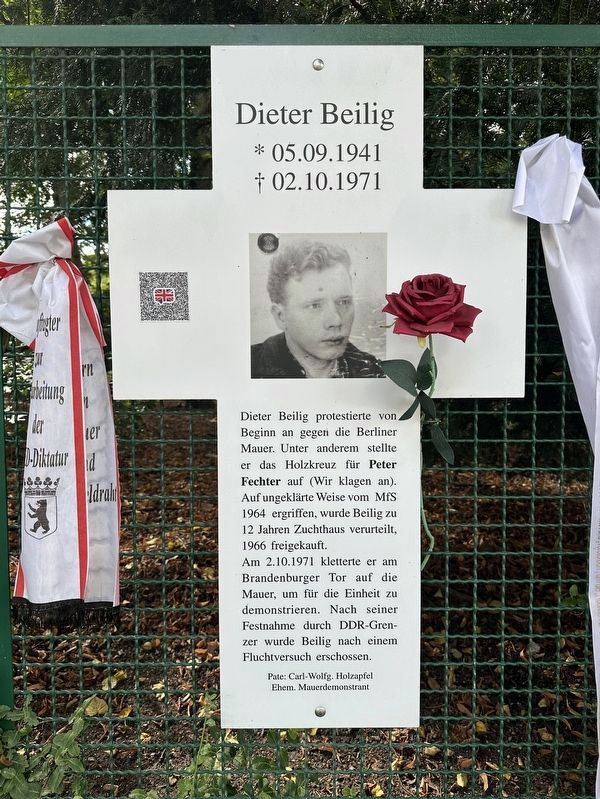
Photographed by Andrew Ruppenstein, September 3, 2025
1. Dieter Beilig white cross memorial

*05.09.1941
†02.10.1971
Dieter Beilig protestierte von Beginn an gegen die Berliner Mauer. Unter anderem stellte er das Holzkreuz für Peter Fechter auf (Wir klagen an). Auf ungeklärte Weise vom MfS 1964 ergriffen, wurde Beilig zu 12 Jahren Zuchthaus verurteilt, 1966 freigekauft.
Am 2.10.1971 kletterte er am Brandenburger Tor auf die Mauer, um für die Einheit zu demonstrieren. Nach seiner Festnahme durch DDR-Grenzer wurde Beilig nach einem Fluchtversuch erschossen.
Dieter Beilig
Born September 5, 1941
Died October 2, 1971
Dieter Beilig protested against the Berlin Wall from its very beginning. Among other things, he erected the wooden cross for Peter Fechter (“We Accuse”). Arrested by the Stasi in 1964 under mysterious circumstances, Beilig was sentenced to 12 years in prison and ransomed in 1966.
On October 2, 1971, he climbed the Wall at the Brandenburg Gate to demonstrate for reunification. After being arrested by East German border guards, Beilig was shot dead after attempting to escape.
Erected 2021 by Berliner Bürgerverein 1970.
Topics and series.
this page online
Location. 52° 31.058′ N, 13° 22.606′ E. Memorial is in Berlin, in Mitte. It is in Regierungsvierte. It is at the intersection of Ebertstraße and Scheidemannstraße, on the right when traveling south on Ebertstraße. Touch for map. Memorial is in this post office area: Berlin 10117, Germany. Touch for directions.

Regionally, it is in Europe, the European Union, Atlantic Europe, Central Europe, the Schengen Area, Western Europe, and the Western World. Historically, it finds itself in what was once the Holy Roman Empire.
Other nearby markers. At least 8 other markers are within walking distance of this marker: Peter Fechter (here, next to this marker); Chris Gueffroy (here, next to this marker); Axel Hannemann (here, next to this marker); Dieter Wohlfahrt (here, next to this marker); Lutz Haberlandt (here, next to this marker); Philipp Held (here, next to this marker); Ingo Krüger (here, next to this marker); Den Toten des Volkaufstandes vom 17. Juni 1953 (here, next to

Photographed by Andrew Ruppenstein, September 3, 2025
2. Dieter Beilig white cross memorial - wide view
The white cross for Dieter Beilig is the second from the right. These plus an additional eight crosses on the Reichstag-side of the Spree River comprise the Weisse Kreuze (“White Crosses”) memorial, erected to commemorate those killed while trying to escape into West Berlin during the Cold War. White crosses were originally installed (as early as 1971) at the point nearest where the victims were killed, but over time their location was consolidated (albeit relocated one or more times, depending on the cross). The 2021 date given here for this memorial is the year given by a nearby sign for their “renewal”.
Also see . . . How a simple wooden cross provoked a state power (Axel Springer). Long before Dieter Beilig got his cross, he confronted the GDR with the first cross to memorialize victims of the wall. Excerpt:
A simple gesture sometimes has a meaningful impact. For example, a cross in remembrance of someone who has died – or so that a crime is not forgotten. On the first anniversary of the building of the Berlin Wall, the security agencies in East Berlin were on high alert. On this August the 13th of 1962, people were protesting against the division of the city and separation of family members caused by the Wall.(Submitted on September 22, 2025.)
One of them, 20-year-old Dieter Beilig, came up with an unusual idea. Dozens had already died at the hands of the GDR regime since the building of the Wall. Beilig, a laborer who worked at the “Bundesdruckerei” (the Federal Printing Press), got hold of some wood, nailed two pieces of it together to make a cross, stained it dark and used white paint to write the following words on it: “Wir klagen an” (We denounce you). With the cross on his shoulders, he walked from the Brandenburg Gate in the direction of Kreuzberg. At one point, Beilig held the black cross up above the barbed wire with the help of some young men...
Credits. This page was last revised on September 22, 2025. It was originally submitted on September 22, 2025, by Andrew Ruppenstein of Lamorinda, California. This page has been viewed 84 times since then and 35 times this year. Photos: 1, 2. submitted on September 22, 2025, by Andrew Ruppenstein of Lamorinda, California.
