Central Oklahoma City in Oklahoma County, Oklahoma — The American South (West South Central)
C.G. "Gristmill" Jones
Oklahoma City 1889-1903
| — | The '89er Trail | — |
Photographed by James Hulse, September 18, 2025
1. C.G. "Gristmill" Jones Marker
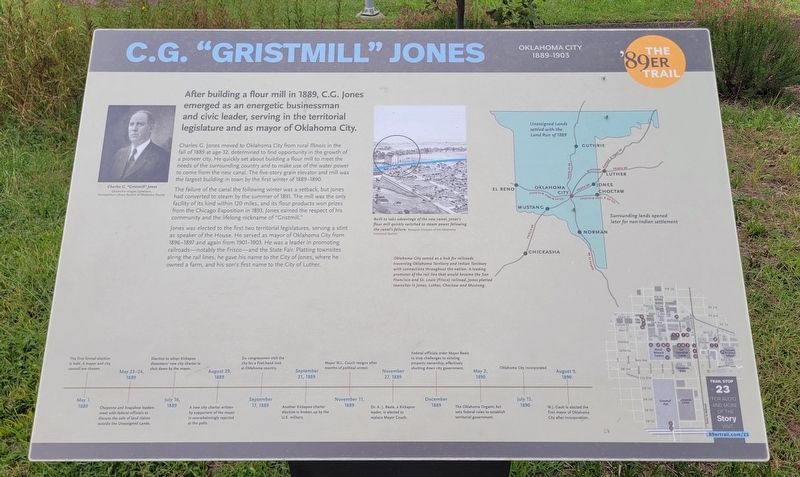
Charles G. Jones moved to Oklahoma City from rural Illinois in the fall of 1889 at age 32, determined to find opportunity in the growth of a pioneer city. He quickly set about building a flour mill to meet the needs of the surrounding country and to make use of the water power to come from the new canal. The five-story grain elevator and mill was the largest building in town by the first winter of 1889-1890.
The failure of the canal the following winter was a setback, but Jones had converted to steam by the summer of 1891. The mill was the only facility of its kind within 120 miles, and its flour products won prizes from the Chicago Exposition in 1893. Jones earned the respect of his community and the lifelong nickname of "Gristmill."
Jones was elected to the first two territorial legislatures, serving a stint as speaker of the House. He served as mayor of Oklahoma City from 1896-1897 and again from 1901-1903. He was a leader in promoting railroads-notably
this page online
Captions
(Photo #1) Charles G. "Gristmill" Jones, Oklahoma Images Collection, Metropolitan Library System of Oklahoma County
(Photo #2) Built to take advantage of the new canal, Jones's flour mill quickly switched to steam power following the canel's failure. Research Division of the Oklahoma Historical Society
(Photo #3) Oklahoma City served as a hub for railroads traversing Oklahoma Territory and Indian Territory with connections throughout the nation. A leading promoter of the rail line that would become the San Francisco and St. Louis (Frisco) railroad, Jones plotted townsites in Jones, Luther, Choctaw and Mustang.
(Map Diagram) Surrounding lands opened later for non-Indian settlement
Timeline
May 1, 1889 - The first formal election is held. A mayor and city council are chosen.
May 23-24, 1889 - Cheyenne and Arapahoe leaders meet with federal officials to discuss the sale of land claims outside the Unassigned Lands.
July 16, 1889 - Election to adopt Kickapoo dissenters new city charter is shut down by the mayor.
August 29, 1889 - A new city charter written by supporters of the mayor is overwhelmingly rejected at the polls.
September 17, 1889 - Six congressmen visit the city for a first-hand look at Oklahoma country.
September 21, 1889 - Another Kickapoo charter election is broken up by the U.S. military.
November 11, 1889 - Mayor W.L. Couch resigns after months of political unrest.
November 27, 1889 - Dr. A. J. Beale, a Kickapoo leader, is elected to replace Mayor Couch.
December - 1889 - Federal officials order Mayor Beale to stop challenges to existing property ownership, effectively shutting down city government.
May 2, 1890 - The Oklahoma Organic Act sets federal rules to establish territorial government.
July 15, 1890 - Oklahoma City incorporated
August 9, 1890 - W.J. Gault is elected the first mayor of Oklahoma City after incorporation.
Erected by The
Photographed by James Hulse, September 18, 2025
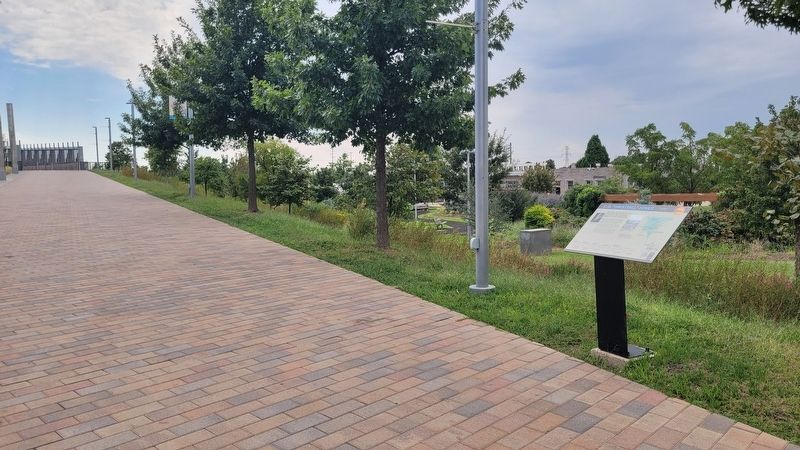
2. The view of the C.G. "Gristmill" Jones Marker along the trail way
Topics and series. This historical marker is listed in these topic lists: Industry & Commerce • Parks & Recreational Areas. In addition, it is included in the The '89er Trail series list. A significant historical year for this entry is 1889.
Location. 35° 27.464′ N, 97° 31.03′ W. Marker is in Oklahoma City, Oklahoma, in Oklahoma County. It is in Central Oklahoma City. It is on S Robinson Ave west of SW 7th St. The marker is located in the Scissortail Park. Touch for map. Marker is in this post office area: Oklahoma City OK 73109, United States of America. Touch for directions.

Regionally, this marker is in Central Oklahoma—Frontier Country. It is also in the American South, specifically on the prairies, and on the Southern Plains. Globally, it is in North America, the Western Hemisphere, the Western World, and the Anglosphere. Historically, it finds itself in what was once the territory of the Mississippian Culture and also the Louisiana Purchase.
Other nearby markers. At least 8 other markers are within walking distance of this marker: The Canal (a few steps from this marker); Union Station (about 400 feet away, measured in a direct line); a different marker also named Union Station (about 400 feet away); Survivor Tree (about 500 feet away); South Oklahoma (approx. half a mile away); Hell's Half Acre (approx. half a mile away); Visit of the Congressmen (approx. 0.6 miles away); The Land Run (approx. 0.6 miles away). Touch for a list and map of all markers in Oklahoma City.
Also see . . . C.G. "Gristmill" Jones. The ‘89er Trail (Submitted on September 23, 2025, by James Hulse of Medina, Texas.)
Credits. This page was last revised on September 23, 2025. It was originally submitted on September 23, 2025, by James Hulse of Medina, Texas. This page has been viewed 70 times since then and 27 times this year. Photos: 1, 2. submitted on September 23, 2025, by James Hulse of Medina, Texas.
