Central Oklahoma City in Oklahoma County, Oklahoma — The American South (West South Central)
Tribes in Oklahoma

Photographed by James Hulse, September 18, 2025
1. Tribes in Oklahoma Marker
From the Louisiana Purchase in 1803 to Oklahoma statehood in 1907, this area was generally referred to as Indian Territory - the place where tribes were relocated to make way for non-Indian settlement and expansion. Removal of tribes to Indian Territory became known as the Trail of Tears. As a result of removal, nearly 40 federally recognized tribes now reside within the state.
Tribal nations gave way to the state of Oklahoma in 1907 as thousands of settlers streamed in to claim the land. Although they became harder to see and identify, the native tribes' culture, leadership and domains did not go away. Today, along with the land and rights that tribes retained, they have acquired small portions of land located within their former domains. The Chickasaw Nation's boundaries now encompass all or part of 13 counties in south-central Oklahoma.
Topics. This historical marker is listed in this topic list: Indigenous Peoples and Communities. A significant historical year for this entry is 1803.
Location. 35° 27.771′ N,
this page online

Regionally, this marker is in Central Oklahoma—Frontier Country. It is also in the American South, specifically on the prairies, and on the Southern Plains. Globally, it is in North America, the Western Hemisphere, the Western World, and the Anglosphere. Historically, it finds itself in what was once the territory of the Mississippian Culture and also the Louisiana Purchase.
Other nearby markers. At least 8 other markers are within walking distance of this marker: Unconquered and Unconquerable (here, next to this marker); Ancient Mississippian Symbols (here, next to this marker); Chickasaw Economic Renaissance (here, next to this marker); Life in the Southeast: Traditional Chickasaw Government (here, next to this marker); Chickasaw Warrior Statue (here, next
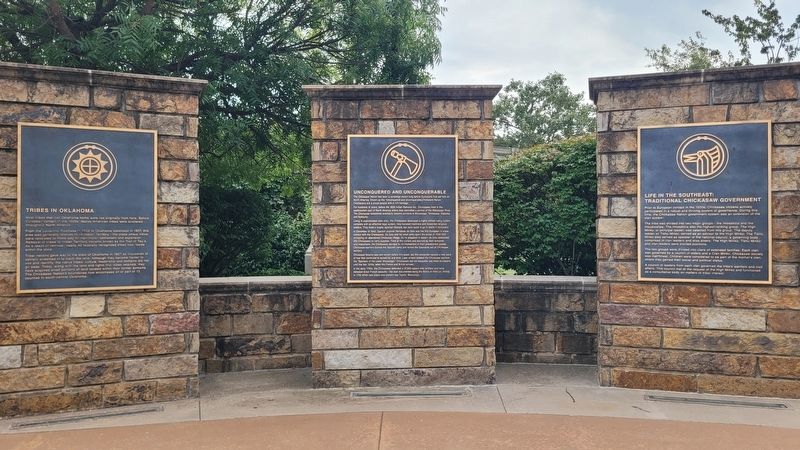
Photographed by James Hulse, September 18, 2025
2. Tribes in Oklahoma Marker (left marker)
Also see . . . Chickasaw Nation. Wikipedia (Submitted on September 23, 2025, by James Hulse of Medina, Texas.)
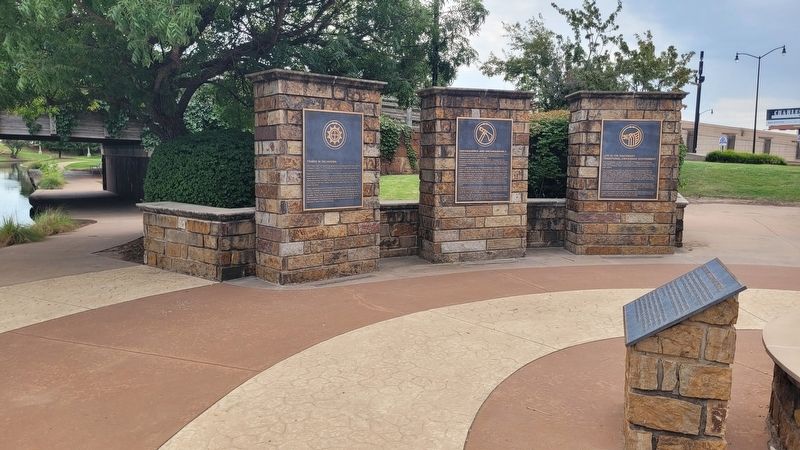
Photographed by James Hulse, September 18, 2025
3. Tribes in Oklahoma Marker (left marker)
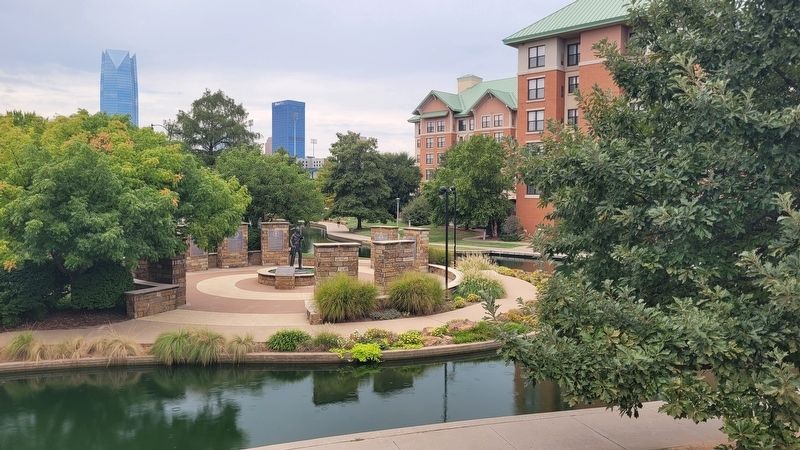
Photographed by James Hulse, September 18, 2025
4. The view of the markers from across the canal
Credits. This page was last revised on September 23, 2025. It was originally submitted on September 23, 2025, by James Hulse of Medina, Texas. This page has been viewed 65 times since then and 24 times this year. Photos: 1, 2, 3, 4. submitted on September 23, 2025, by James Hulse of Medina, Texas.
