Central Oklahoma City in Oklahoma County, Oklahoma — The American South (West South Central)
The Chickasaw Removal

Photographed by James Hulse, September 18, 2025
1. The Chickasaw Removal Marker
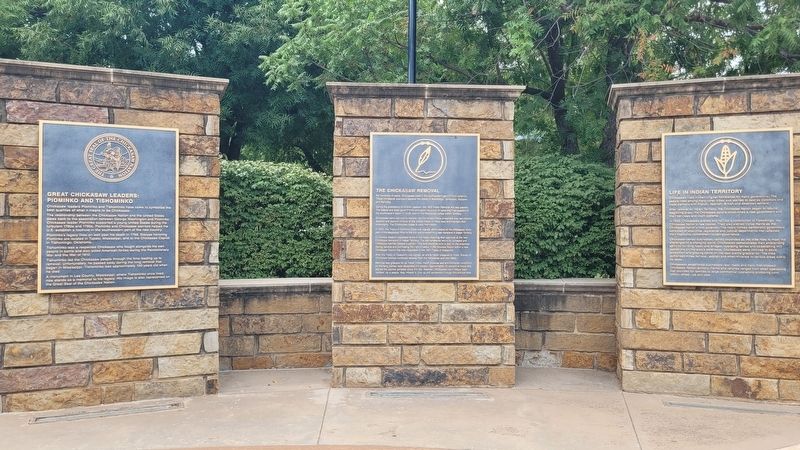
During the presidency of Andrew Jackson, the 1830 Indian Removal Act was passed. The federal and state governments embraced the policy of removing tribal peoples of the southeastern states to lands west of the Mississippi called Indian Territory.
Chickasaws were opposed to removal, but the United States presented only two choices: dissolve and become citizens of the United States or move west and maintain their sovereignty. The Chickasaws chose to save their nation.
In 1832, the Treaty of Pontotoc Creek was signed, which ceded all the Chickasaw lands east of the Mississippi River to the U.S. and provided for a new homeland in Indian Territory.
Chickasaw leaders negotiated terms in the treaty requiring their approval of the new Chickasaw homeland in Indian Territory. The old homelands would be surveyed and Chickasaw families deeded a portion. This land would be sold to pay for the expenses during removal and purchasing the right to settle
this page online
After the Treaty of Doaksville was signed, an entire nation prepared to move. Groups of Chickasaw families continued removal from the homelands until the 1890s.
Removal was grievous for all Indian tribes. Harsh physical and environmental conditions on the long journey west devastated the people. Approximately 20 percent of those who started the journey perished along the way. However, Chickasaws have always been resilient. As a people, they refused to give up and persevered through this difficult time.
Topics. This historical marker is listed in this topic list: Indigenous Peoples and Communities. A significant historical year for this entry is 1830.
Location. 35° 27.775′ N, 97° 30.324′ W. Marker is in Oklahoma City, Oklahoma, in Oklahoma County. It is in Central Oklahoma City. It is on Centennial Drive south of E Reno Ave. The marker is located at the Chickasaw Plaza along Bricktown River Walk. Touch for map. Marker is in this post office area: Oklahoma City OK 73104, United States of America. Touch for directions.

Regionally,
Photographed by James Hulse, September 18, 2025
2. The Chickasaw Removal Marker (middle marker)
Other nearby markers. At least 8 other markers are within walking distance of this marker: Life in Indian Territory (here, next to this marker); Great Chickasaw Leaders: Piominko and Tishominko (here, next to this marker); Chickasaw Warrior Statue (here, next to this marker); Life in the Southeast: Traditional Chickasaw Government (here, next to this marker); Chickasaw Cultural Renaissance (here, next to this marker); Ancient Mississippian Symbols (a few steps from this marker); Oklahoma Statehood (a few steps from this marker); Unconquered and Unconquerable (a few steps from this marker). Touch for a list and map of all markers in Oklahoma City.
Also see . . .
1. Chickasaw Nation. Wikipedia (Submitted on September 23, 2025, by James Hulse of Medina, Texas.)
2. Trail of Tears - The Encyclopedia of Oklahoma History and Culture.

Photographed by James Hulse, September 18, 2025
3. The view of the markers from across the canal
The term "Trail of Tears" refers to the difficult journeys that the Five Tribes took during their forced removal from the southeast during the 1830s and 1840s. The Cherokee, Creek, Choctaw, Chickasaw, and Seminole were all marched out of their ancestral lands to Indian Territory, or present Oklahoma. Although the removal of American Indians began long before the nineteenth century, the Trail of Tears is mostly associated with the forced removals that took place after the 1830 Indian Removal Act.(Submitted on September 23, 2025, by James Hulse of Medina, Texas.)
The Trail of Tears differed for each of the nations, but all Indians, as well as the enslaved persons accompanying them, suffered. The marches usually began when federal troops rounded up those who resisted removal. The journeys, usually more than one thousand miles, lasted several weeks. A shortage of wagons, horses, food, and other supplies made the marches difficult. Some traveled by boat, but the conditions there were usually no better. The U.S. government did not provide enough supplies to sustain the travelers during their march and after their arrival.
Credits. This page was last revised on September 23, 2025. It was originally submitted on September 23, 2025, by James Hulse of Medina, Texas. This page has been viewed 75 times since then and 30 times this year. Photos: 1, 2, 3. submitted on September 23, 2025, by James Hulse of Medina, Texas.
