Washington Township in St. Joseph in Buchanan County, Missouri — The American Midwest (Upper Plains)
Lynching in America ⎯⎯⎯ The Lynching of Lloyd Warner
Community Remembrance Project
Photographed by Shirley A Stirling, September 23, 2025
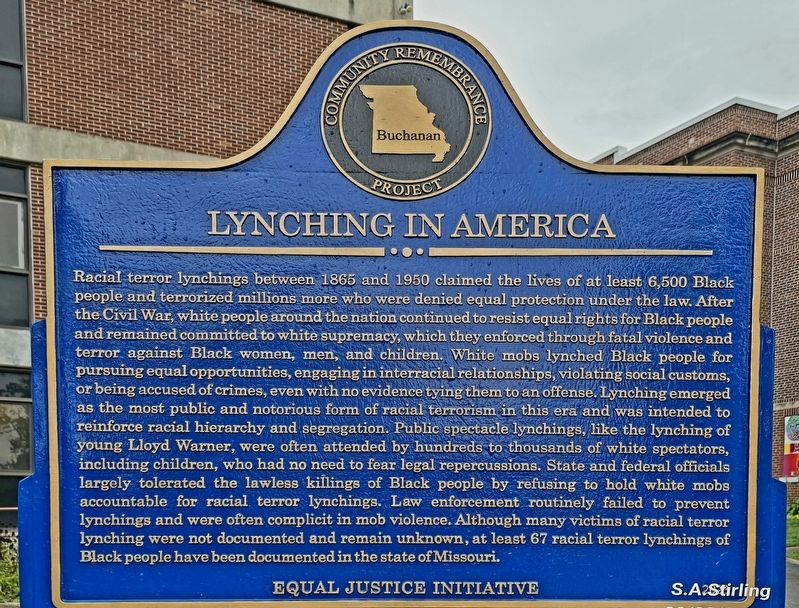
1. Lynching in America side of marker
Inscription.
Lynching in America
Racial terror lynchings between 1865 and 1950 claimed the lives of at least 6,500 Black people and terrorized millions more who were denied equal protection under the law. After the Civil War, white people around the nation continued to resist equal rights for Black people and remained committed to white supremacy, which they enforced through fatal violence and terror against Black women, men, and children. White mobs lynched Black people for pursuing equal opportunities, engaging in interracial relationships, violating social customs, or being accused of crimes, even with no evidence tying them to an offense. Lynching emerged as the most public and notorious form of racial terrorism in this era and was intended to reinforce racial hierarchy and segregation. Public spectacle lynchings, like the lynching of young Lloyd Warner, were often attended by hundreds to thousands of white spectators, including children, who had no need to fear legal repercussions. State and federal officials largely tolerated the lawless killings of Black people by refusing to hold white mobs accountable for racial terror lynchings.
Click or scan to see this page online
Law enforcement routinely failed to prevent lynchings and were often complicit in mob violence. Although many victims of racial terror lynching were not documented and remain unknown, at least 67 racial terror lynchings of Black people have been documented in the state of Missouri.
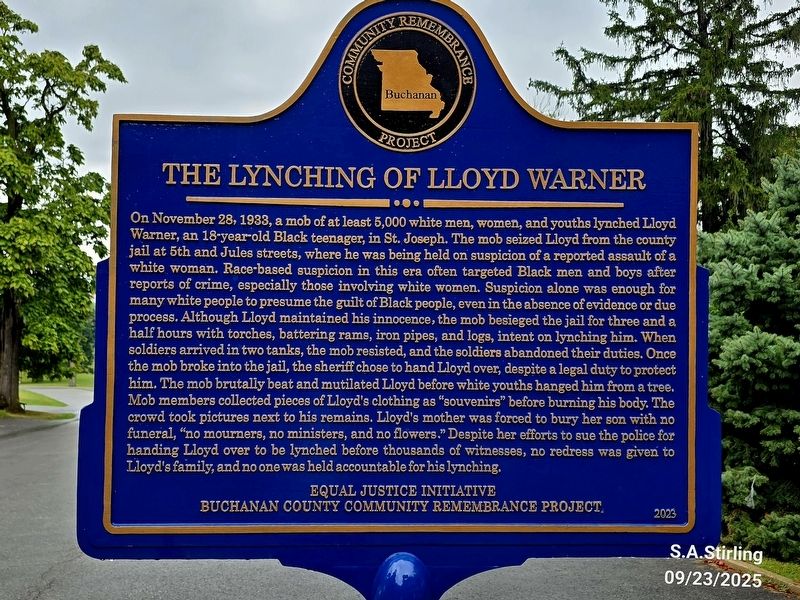
The Lynching of Lloyd Warner<
On November 28, 1933, a mob of at least 5,000 white men, women, and youths lynched Lloyd Warner, an 18-year-old Black teenager, in St. Joseph. The mob seized Lloyd from the county jail at 5th and Jules streets, where he was being held on suspicion of a reported assault of a white woman. Race-based suspicion in this era often targeted Black men and boys after reports of crime, especially those involving white women. Suspicion alone was enough for
many white people to presume the guilt of Black people, even in the absence of evidence or due process. Although Lloyd maintained his innocence, the mob besieged the jail for three and a half hours with torches, battering rams, iron pipes, and logs, intent on lynching him. When soldiers arrived in two tanks, the mob resisted, and the soldiers abandoned their duties. Once
the mob
Photographed by Shirley A Stirling, September 23, 2025
2. The Lynching of Lloyd Warner side of marker
broke into the jail, the sheriff chose to hand Lloyd over, despite a legal duty to protect him. The mob brutally beat and mutilated Lloyd before white youths hanged him from a tree. Mob members collected pieces of Lloyd's clothing as "souvenirs” before burning his body. The crowd took pictures next to his remains. Lloyd's mother was forced to bury her son with no
funeral, "no mourners, no ministers, and no flowers.” Despite her efforts to sue the police for handing Lloyd over to be lynched before thousands of witnesses, no redress was given to Lloyd's family, and no one was held accountable for his lynching.
Equal Justice Initiative
Erected 2023 by Equal Justice Initiative, Buchanan County Community Remembrance Project.
Topics and series. This historical marker is listed in these topic lists: African Americans • Civil Rights. In addition, it is included in the Lynching in America series list. A significant historical date for this entry is November 28, 1933.
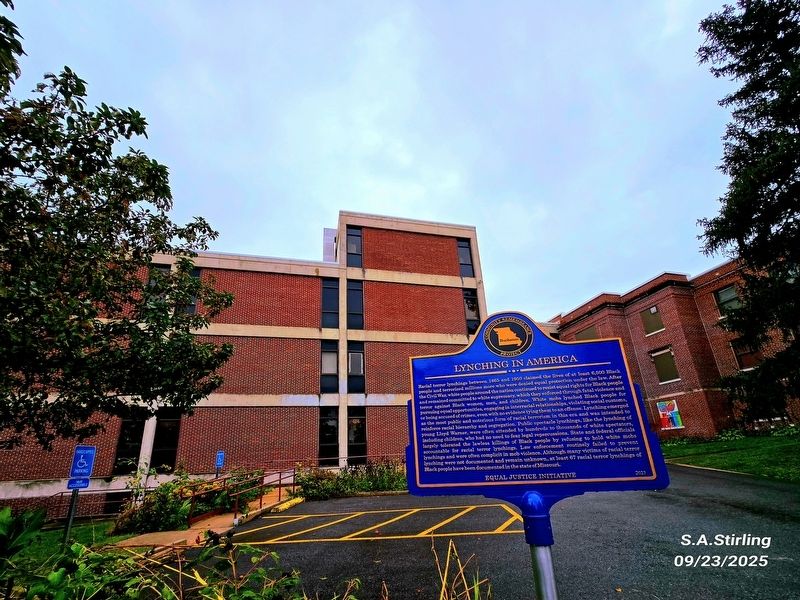
Location. 39° 46.577′ N, 94° 48.517′ W. Marker is in St. Joseph, Missouri, in Buchanan County. It is in Washington Township. It can be reached from Frederick Avenue, on the right
Photographed by Shirley A Stirling, September 23, 2025
3. Lynching in America / The Lynching of Lloyd Warner Marker
when traveling east. Immediately outside of the St Joseph Museums. Touch for map. Marker is at or near this postal address: 3406 Frederick Ave, Saint Joseph MO 64506, United States of America. Touch for directions.
Regionally, this marker is in North Missouri. It is also in the American Midwest, in the Lewis & Clark Corridor, and in the Corn Belt. Globally, it is in North America, the Western Hemisphere, the Western World, and the Anglosphere. Historically, it finds itself in what was once the territory of the Mississippian Culture, the Louisiana Purchase, and the Antebellum South.
Photographed by Shirley A Stirling, September 23, 2025
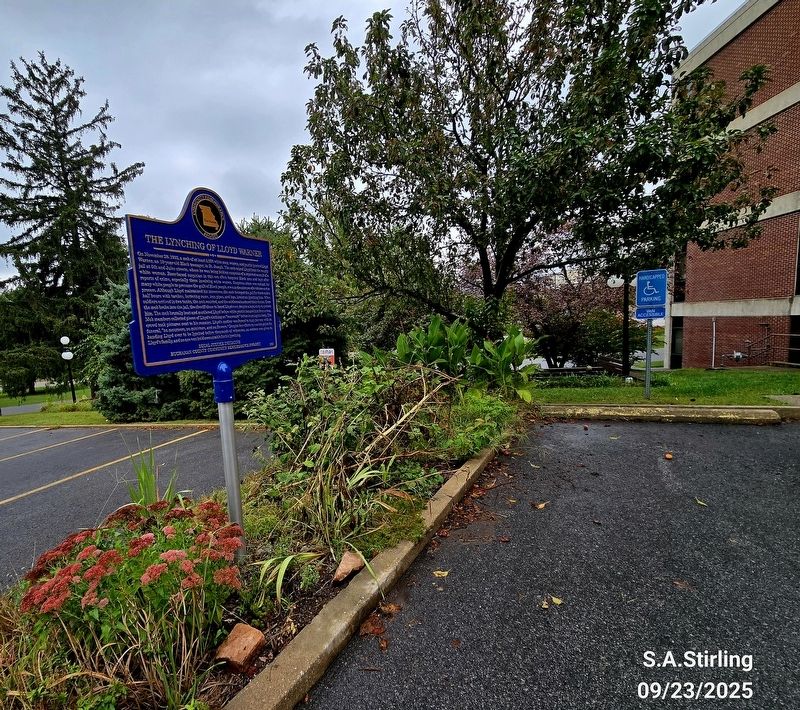
4. Lynching in America / The Lynching of Lloyd Warner Marker
The St. Joseph Museums unveiled a new memorial dedicated to the memory of Lloyd Warner. Warner, was lynched by a mob of five thousand outside of the Buchanan County Courthouse. After 90 years, Warner finally gets a proper memorial and family members as well members of the community are able to mourn him after years of waiting. The memorial plaque is finally up thanks to the Lloyd Warner Community Remembrance Coalition and the Equal Justice Institute (EJI) as they worked together to commemorate Warner in St. Joseph. (Submitted on October 2, 2025.)
Additional keywords. Community Remebrance Project
Credits. This page was last revised on March 14, 2026. It was originally submitted on September 23, 2025, by Shirley A Stirling of Lacey, Washington. This page has been viewed 171 times since then and 133 times this year. Photos:1, 2, 3, 4. submitted on September 23, 2025, by Shirley A Stirling of Lacey, Washington. • Andrew Ruppenstein was the editor who published this page.