Inner Harbor in Baltimore, Maryland — The American Northeast (Mid-Atlantic)
The Last Pearl Harbor Survivor
Coast Guard Cutter WHEC-37
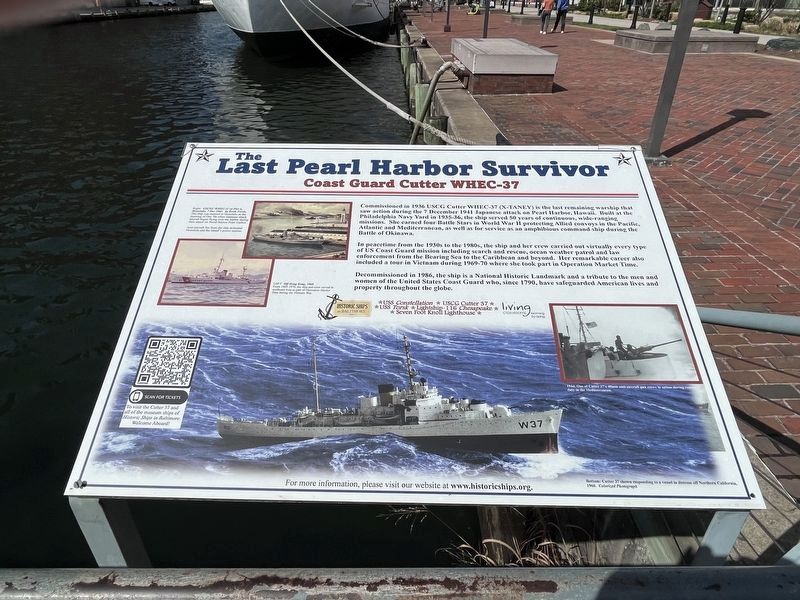
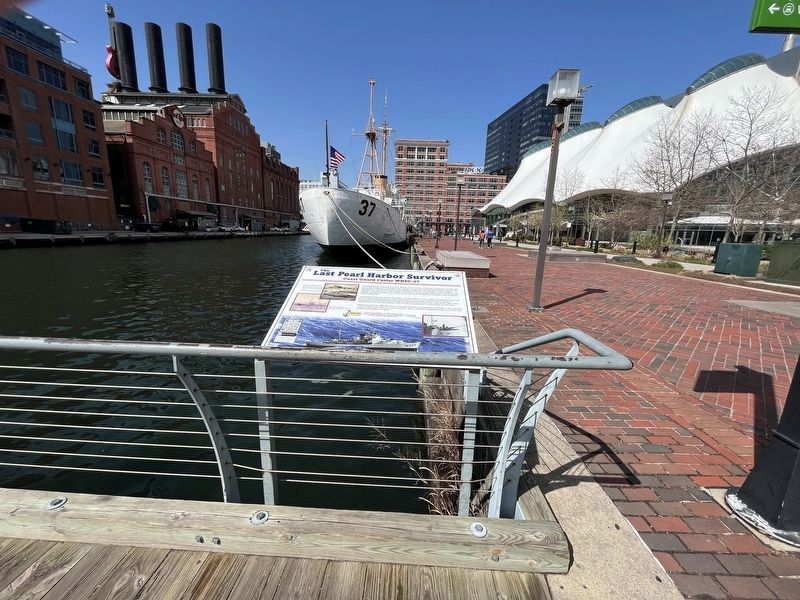
Commissioned in 1936 USCG Cutter WHEC-37 (X-TANEY) is the last remaining warship that saw action during the 7 December 1941 Japanese attack on Pearl Harbor, Hawaii. Built at the Philadelphia Navy Yard in 1935-36, the ship served 50 years of continuous, wide-ranging missions. She earned four Battle Stars in World War II protecting Allied convoys in the Pacific, Atlantic and Mediterranean, as well as for service as an amphibious command ship during the Battle of Okinawa.
In peacetime from the 1930s to the 1980s, the ship and her crew carried out virtually every type of US Coast Guard mission including search and rescue, ocean weather patrol and law enforcement from the Bearing Sea to the Caribbean and beyond. Her remarkable career also included a tour in Vietnam during 1969-70 where she took part in Operation Market Time.
Decommissioned in 1986, the ship is a National Historic Landmark and a tribute to the men and women of the United States Coast Guard who, since 1790, have safeguarded American lives and property throughout the globe.
[Captions:]
Right: USCG WHEC-37 at Pier 6, Honolulu, 7 Dec 1941, by Keith Ferris. The ship was moored in Honolulu on the morning of Dec 7th when Japanese attack aircraft began flying over the harbor during their attack on Naval Station Pearl Harbor.
Anti-aircraft fire from the ship defended Honolulu and the island's power station.
Left: Off Hong Kong, 1969. From 1969-1970, the ship and crew served in southeast Asia to part of Operation Market Time during the Vietnam War.
1944: One of Cutter 37's 40mm anti-aircraft gun crews in action during covert duty in the Mediterranean.
Bottom: Cutter 37 shown responding to a vessel in distress off Northern California, 1960. Colorized Photograph.
Erected by Historic
this page online
Topics and series. This historical marker is listed in these topic lists: War, World II • Waterways & Vessels. In addition, it is included in the National Historic Landmarks series list. A significant historical date for this entry is December 7, 1941.
Location. 39° 17.11′ N, 76° 36.37′ W. Marker is in Baltimore, Maryland. It is in the Inner Harbor. It is at the intersection of Pier 6 and Harbor Bridge Walk, on the left when traveling north on Pier 6. Touch for map. Marker is at or near this postal address: 716 Eastern Ave, Baltimore MD 21202, United States of America. Touch for directions.

Regionally, this marker is in Central Maryland. It is also in the American Mid-Atlantic, in the Chesapeake Bay Region, and on the Eastern Seaboard. Globally, it is in the North Atlantic Region, North America, the Western Hemisphere, the Western World, and the Anglosphere. Historically, it finds itself in what was once one of the original Thirteen Colonies and also the Antebellum South.
Other nearby markers. At least 8 other markers are within walking distance of this marker: Tilly's Escape (within shouting distance of this
Other markers no longer nearby. The Coast Guard Cutter Taney (was here, next to this marker but has been replaced with another marker now near it); Coast Guard Cutter Taney - WHEC-37 (was a few steps from this marker but has been replaced with another marker now near it); Seven Foot Knoll Lighthouse (was about 500 feet away but has been replaced with another marker now near it); Seven-Foot Knoll Lighthouse (was about 500 feet away but has been replaced with another marker now near it); Water Power: Baltimore's Economic Engine (was about 600 feet away but has been replaced with another marker now near it); Living Classrooms Foundation (was about 600 feet away but has been permanently removed).
Regarding The Last Pearl Harbor Survivor. Though the marker claims WHEC-37 is the "last remaining warship to see action" at Pearl Harbor, this is misleading - if not outright false. There are many superlatives that have been assigned to the ship - "last floating survivor," "last surviving combatant," "last warship afloat," etc. However, one could argue against pretty much any such superlative. At the bare minimum, WHEC-37 was at Honolulu Harbor - not Pearl Harbor - though she did fire at Japanese planes (from her berth in Honolulu) during the BATTLE of Pearl Harbor, she was never "at" Pearl Harbor during the fight. There are four ex-US Navy vessels that actually were in Pearl Harbor that are each afloat (though, it could be argued none of these are technically warships since they are not commissioned - except Hoga - into service, instead being service vessels. Some definitions of warship, however, do include service vessels and any military support craft) and of these four, three were active around the harbor in rescue efforts and two of them certainly came under fire. In addition to the four floating US Navy vessels (one of which is actually a museum, three are active in commercial service), there is a not-really-floating, cut down ex-USCG hull in use as a breakwater, two static-display Japanese midget submarines salvaged after the battle, and potentially one more commercial vessel with a murky recent history.
The most prominent floating Pearl Harbor survivor that was in Pearl Harbor proper for the attack is ex-USS Hoga (YT-146). Hoga is a museum ship at Arkansas Inland Maritime Museum in North Little Rock. She is famously depicted fighting fires in photos of USS Nevada from the attack, but she is not the only surviving tug from the event; the tug YT-153, still active in commercial service under the name Hawk (IMO D623635) out of Rhode Island, was also there and tried to ram a midget submarine leaving the harbor. Additionally, YO-43 - a US Navy yard oiler that was at Berth B 15/16 during the attack - survives in commercial service as the fishing trawler Horizon(IMO 7736232) homeported in Seattle and working in Alaskan waters; similarly employed is the former US Navy Garbage Lighter YG-21, still in use as FV Harvestor (IMO 8034875) fishing the Pacific Northwest. She was also in Pearl Harbor that day, and was active in rescue & salvage efforts. A barge, YC-699, used to survive in the San Francisco area but its continued survival in 2025 is unclear.
Another cutter, ex-USCGC Tiger (WSC-152) survives only as a cut-down, fire-damaged hulk at Tyee Marina in Tacoma, Washington. Regardless of her current condition, she was as much a "warship" as Taney. Within the past 15 years, two Pearl Harbor survivors are known to have been discarded - Yard oiler YO-44 was reefed in 2017 and the tug Nokomis was scrapped in 2010.
Finally, there are also two Japanese midget submarines from the attack that survive, and both are on display. One is at the National Museum of the Pacific War in Fredericksburg, Texas, and the other is at Etajima Naval Academy in Japan.
Credits. This page was last revised on August 24, 2026. It was originally submitted on April 3, 2023, by Devry Becker Jones of Washington, District of Columbia. This page has been viewed 260 times since then and 74 times this year. Last updated on September 23, 2025, by Evan Dwyer of Richmond, Virginia. Photos: 1, 2. submitted on April 3, 2023, by Devry Becker Jones of Washington, District of Columbia. • J. Makali Bruton was the editor who published this page.
