Greenville in Hunt County, Texas — The American South (West South Central)
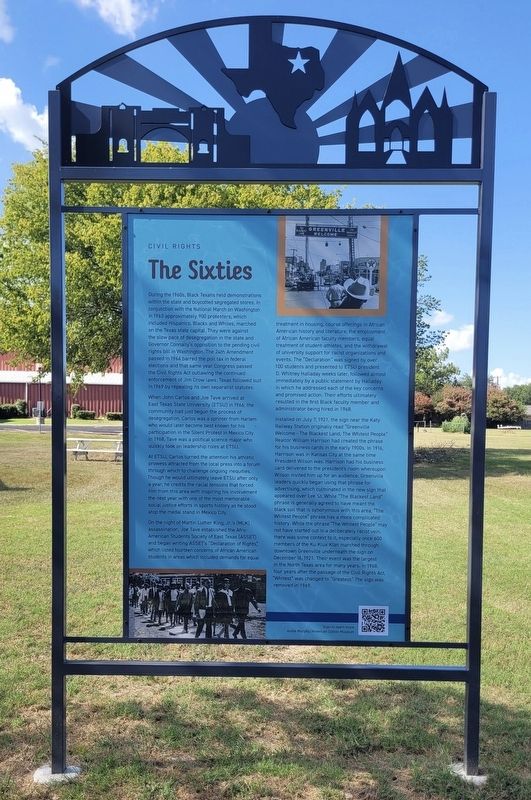
The Sixties
Civil Rights
⎯⎯⎯
People
Photographed by James Hulse, July 28, 2025
1. The Sixties Marker
When John Carlos and Joe Tave arrived at East Texas State University (ETSU) in 1966, the community had just begun the process of desegregation. Carlos was a sprinter from Harlem who would later become best known for his participation in the Silent Protest in Mexico City in 1968. Tave was a political science major who quickly took on leadership roles at ETSU.
At ETSU, Carlos turned the attention his athletic prowess attracted from the local press into a forum through which to challenge ongoing inequities. Though he would ultimately leave ETSU after only a year, he credits the racial tensions that forced him from this area with inspiring his involvement the next year with one of the most memorable social justice efforts in sports history as he stood atop the medal stand in Mexico City.
On the night of Martin Luther King, Jr.'s (MLK) assassination Joe Tave established the Afro-American Students Society of East Texas (ASSET] and began writing ASSET's “Declaration of Rights" which listed fourteen concerns of African American students in areas which included demands for equal treatment in housing, course offerings in African American history and
this page online
Installed on July 7, 1921, the sign near the Katy Railway Station originally read "Greenville Welcome-The Blackest Land, The Whitest People." Realtor William Harrison had created the phrase for his business cards in the early 1900s. In 1916. Harrison was in Kansas City at the same time President Wilson was. Harrison had his business card delivered to the president's room whereupon Wilson invited him up for an audience. Greenville leaders quickly began using that phrase for advertising, which culminated in the new sign that appeared over Lee St. While "The Blackest Land phrase is generally agreed to have meant
Photographed by James Hulse, July 28, 2025
2. The Sixties Marker
Reverse Side
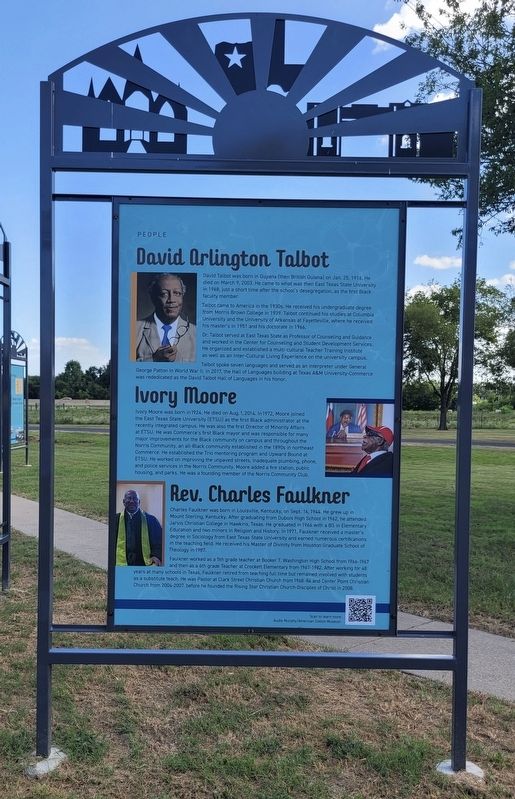
David Arlington Talbot
David Talbot was born in Guyana (then British Guiana) on Jan. 25, 1916. He died on March 9, 2003. He came to what was then East Texas State University in 1968, just a short time after the school's desegregation, as the first Black faculty member.
Talbot came to America in the 1930s. He received his undergraduate degree from Morris Brown College in 1939. Talbot continued his studies at Columbia University and the University of Arkansas at Fayetteville, where he received his master's in 1951 and his doctorate in 1966.
Dr. Talbot served at East
Photographed by James Hulse, July 28, 2025
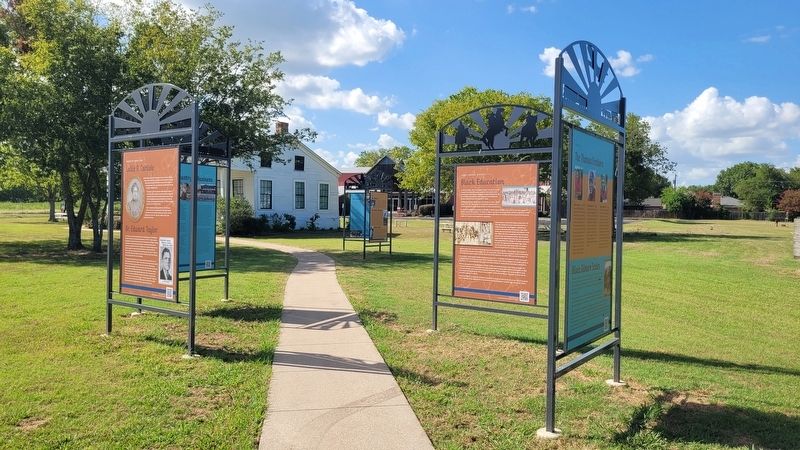
3. The view of the Sixties Marker along the pathway (far blue marker)
Talbot spoke seven languages and served as an interpreter under General George Patton in World War II. In 2017, the Hall of Languages building at Texas A&M University-Commerce was rededicated as the David Talbot Hall of Languages in his honor.
Ivory Moore
Ivory Moore was born in 1924. He died on Aug. 1, 2014. In 1972, Moore joined the East Texas State University (ETSU) as the first Black administrator at the recently integrated campus. He was also the first Director of Minority Affairs at ETSU. He was Commerce's first Black mayor and was responsible for many major improvements for the Black community on campus and throughout the Norris Community, an all-Black community established in the 1890s in northeast Commerce. He established the Trio mentoring program and Upward Bound at ETSU. He worked on improving the unpaved streets, inadequate plumbing, phone, and police services in the Norris Community. Moore added a fire station, public housing, and parks. He was a founding member of the Norris Community Club.
Rev. Charles Faulkner
Charles Faulkner was born in Louisville, Kentucky, on Sept. 16, 1944. He grew up in Mount Sterling, Kentucky. After graduating from Dubois High School in 1962, he attended Jarvis Christian College in Hawkins, Texas. He graduated in 1966 with a BS in Elementary Education and two minors in Religion and History. In 1971, Faulkner received a master's degree in Sociology from East Texas State University and earned numerous certifications in the teaching field. He received his Master of Divinity from Houston Graduate School of Theology in 1987.
Faulkner worked as a 5th grade teacher at Booker T. Washington High School from 1966-1967 and then as a 6th grade Teacher at Crockett Elementary from 1967-1982. After working for 48 years at many schools in Texas, Faulkner retired from teaching full time but remained involved with students as a substitute teach. He was Pastor at Clark Street Christian Church from 1968-84 and Center Point Christian Church from 2004-2007, before he founded the Rising Star Christian Church-Disciples of Christ in 2008.
Erected by Audie Murphy / American Cotton Museum.
Topics. This historical marker is listed in these topic lists: African Americans • Civil Rights. A significant historical date for this entry is July 7, 1921.
Location. 33° 7.518′ N, 96° 5.354′ W. Marker is in Greenville, Texas, in Hunt County. It is on Interstate 30 Frontage Road ¼ mile west of Division Street, on the right when traveling west. The marker is located on the grounds of the Audie Murphy / American Cotton Museum. Touch for map. Marker is at or near this postal address: 600 I-30 Frontage Rd, Greenville TX 75401, United States of America. Touch for directions.

Regionally, this marker is in the Prairies & Lakes Region and in the Dallas-Fort Worth Metropolitan Area. It is also in the American South. Globally, it is in North America, a Gulf of Mexico state, the Western Hemisphere, the Western World, and the Anglosphere. Historically, it finds itself in what was once New Spain, the Republic of Texas, one of the Confederate States of America, and the Antebellum South.
Other nearby markers. At least 8 other markers are within walking distance of this marker: Sports (here, next to this marker); Early Industry & Business (a few steps from this marker); a different marker also named Early Industry & Business (a few steps from this marker); Black Education (a few steps from this marker); Ende-Gaillard House (a few steps from this marker); African American Community (a few steps from this marker); Industry & Businesses (within shouting distance of this marker); Transportation / Blackland Prairie (within shouting distance of this marker). Touch for a list and map of all markers in Greenville.
Credits. This page was last revised on October 2, 2025. It was originally submitted on September 24, 2025, by James Hulse of Medina, Texas. This page has been viewed 75 times since then and 30 times this year. Photos: 1, 2, 3. submitted on October 2, 2025, by James Hulse of Medina, Texas.
