Fanshawe in London in Middlesex County, Ontario — Central Canada (North America)
Jury House
Photographed by Tim Boyd, September 14, 2025
1. Jury House Marker
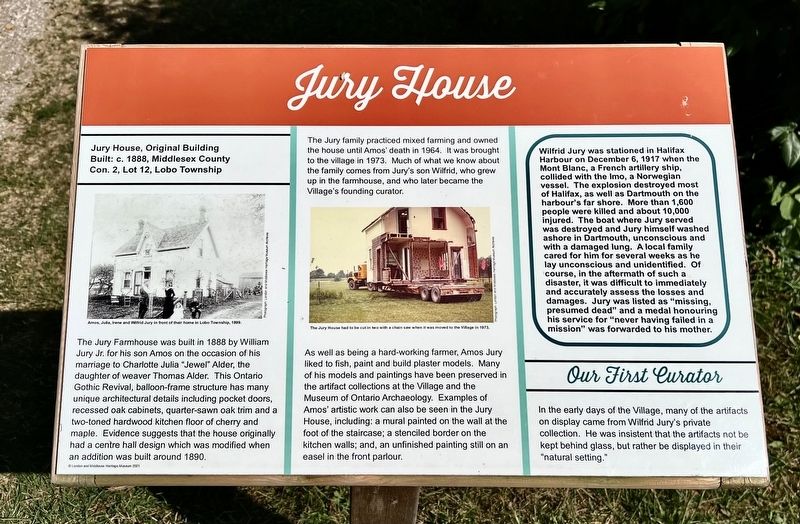
Jury House, Original Building
Built: c. 1888, Middlesex County
Con. 2, Lot 12, Lobo Township
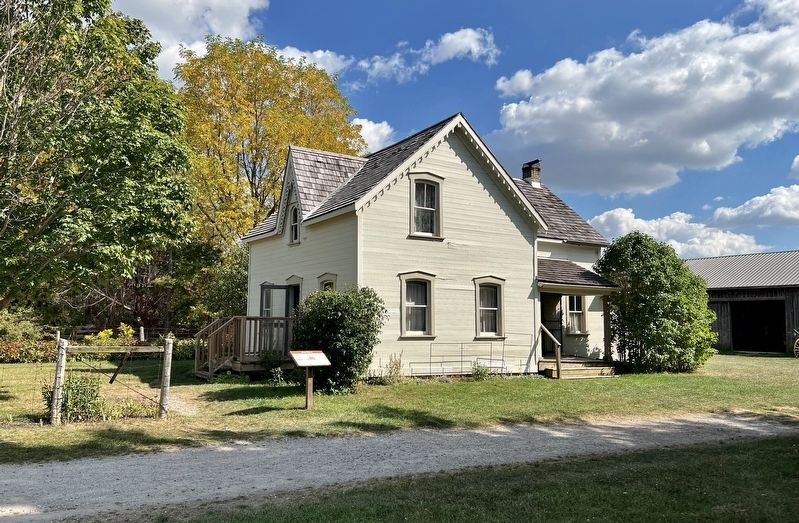
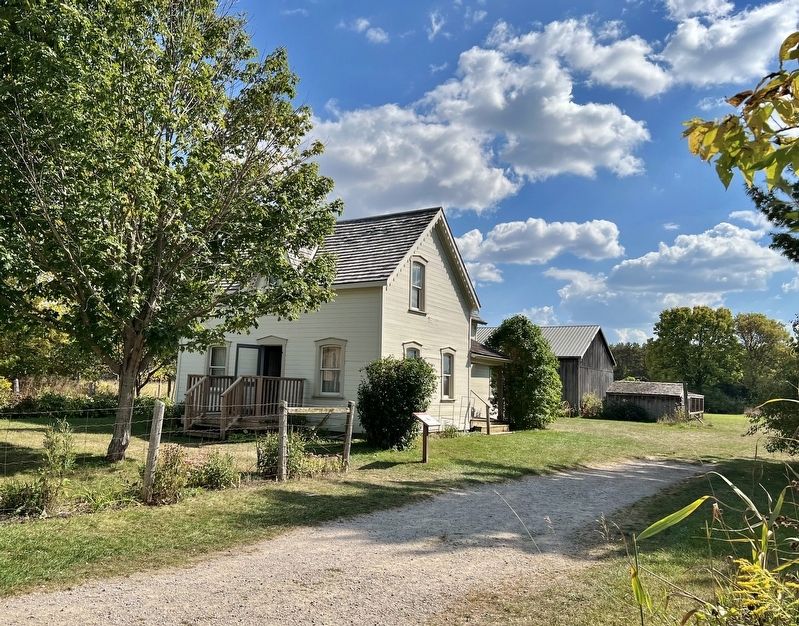
The Jury Farmhouse was built in 1888 by William Jury Jr. for his son Amos on the occasion of his marriage to Charlotte Julia "Jewel" Alder, the daughter of weaver Thomas Alder. This Ontario Gothic Revival, balloon-frame structure has many unique architectural details including pocket doors, recessed oak cabinets, quarter-sawn oak trim and a two-toned hardwood kitchen floor of cherry and maple. Evidence suggests that the house originally had a centre hall design which was modified when an addition was built around 1890.
The Jury family practiced mixed farming and owned the house until Amos' death in 1964. It was brought to the village in 1973. Much of what we know about the family comes from Jury's son Wilfrid, who grew up in the farmhouse, and who later became the Village's founding curator.
As well as being a hard-working farmer, Amos Jury liked to fish, paint and build plaster models. Many of his models and paintings have been preserved in the artifact collections at the Village and the Museum of Ontario Archaeology.
this page online
Wilfrid Jury was stationed in Halifax Harbour on December 6, 1917 when the Mont Blanc, a French artillery ship, collided with the Imo, a Norwegian vessel. The explosion destroyed most of Halifax, as well as Dartmouth on the harbour's far shore. More than 1,600 people were killed and about 10,000 injured. The boat where Jury served was destroyed and Jury himself washed ashore in Dartmouth, unconscious and with a damaged lung. A local family cared for him for several weeks as he lay unconscious and unidentified. Of course, in the aftermath of such a disaster, it was difficult to immediately and accurately assess the losses and damages. Jury was listed as "missing, presumed dead" and a medal honouring his service for "never having failed in a mission" was forwarded to his mother.
Our First Curator
In the early days of the Village, many of the artifacts on display came from Wilfrid Jury's
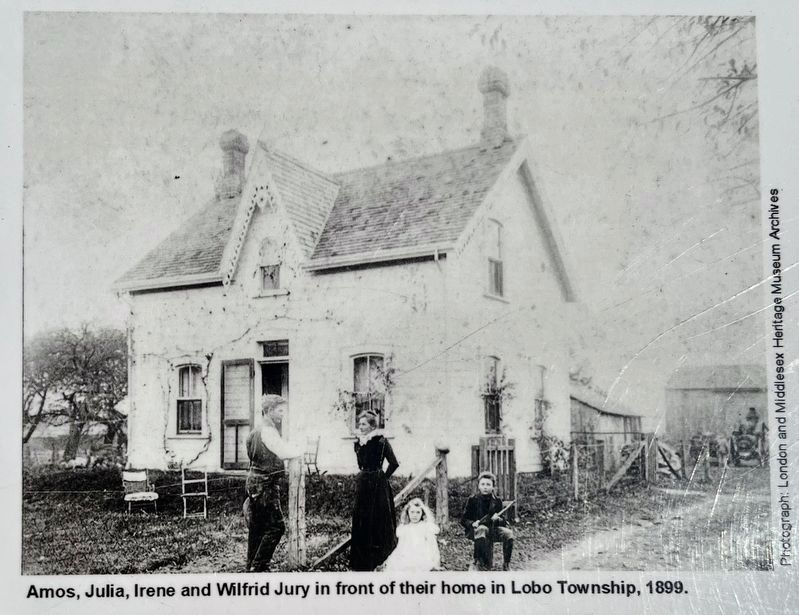
1899
2. Jury House marker photo and caption detail (left)
Topics. This historical marker is listed in these topic lists: Agriculture • Architecture. A significant historical year for this entry is 1888.
Location. 43° 3.27′ N, 81° 10.723′ W. Marker is in London, Ontario, in Middlesex County. It is in Fanshawe. It can be reached from Fanshawe Park Road East. The marker is on the grounds of the Fanshawe Pioneer Village, accessibility subject to its operating hours and requiring paid admission. The Village is accessed by driving east from the intersection of Clark Road and Veterans’ Parkway. Admission is paid at the entrance to the Fanshawe Conservation Area, and then follow signposts for approx. 2km to the Village. Touch for map. Marker is at or near this postal address: 2609 Fanshawe Park Road E, London ON N0M 2P0, Canada. Touch for directions.

Regionally, this marker is in the Southwest Ontario Area and in Southwestern Ontario. It is also in Central Canada. Globally, it is in North America, the Western Hemisphere, the Western World, and the Anglosphere.
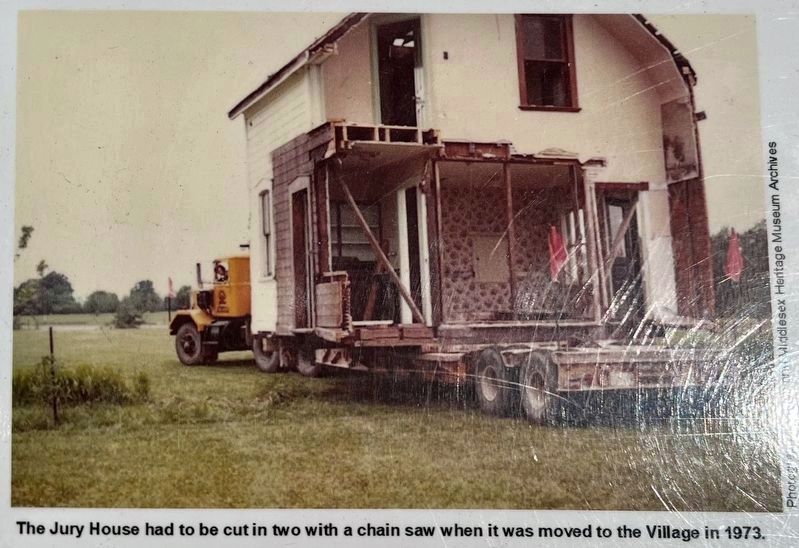
1973
3. Jury House marker photo and caption detail (centre)
Other nearby markers. At least 8 other markers are within walking distance of this marker: Fanshawe School S.S. #19 (within shouting distance of this marker); Paul Peel (1860-1892) (within shouting distance of this marker); Caverhill Woodworking Shop (within shouting distance of this marker); Peel House (within shouting distance of this marker); Alder’s Weaving Shed (about 90 meters away, measured in a direct line); Dr. Jones Frame Barn (about 90 meters away); Caverhill House (about 90 meters away); Caverhill Stable (about 90 meters away). Touch for a list and map of all markers in London.
Photographed by Tim Boyd, September 14, 2025
4. Jury House Marker
Photographed by Tim Boyd, September 14, 2025
5. Jury House Marker
Credits. This page was last revised on September 28, 2025. It was originally submitted on September 25, 2025, by Tim Boyd of Hamilton, Ontario. This page has been viewed 54 times since then and 24 times this year. Photos: 1, 2, 3, 4, 5. submitted on September 25, 2025, by Tim Boyd of Hamilton, Ontario. • Andrew Ruppenstein was the editor who published this page.
