
Rock Hill in York County, South Carolina — The American South (South Atlantic)
Freedom Walkway
Honoring Rock Hill's Heroes for Justice and Equality
Photographed by Mark Parker, September 25, 2025
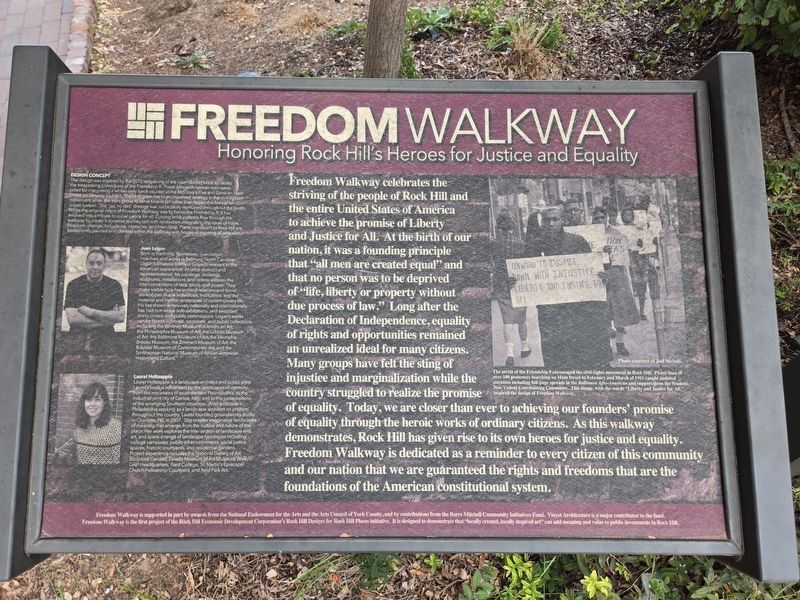
1. Freedom Walkway Marker
Design Concept
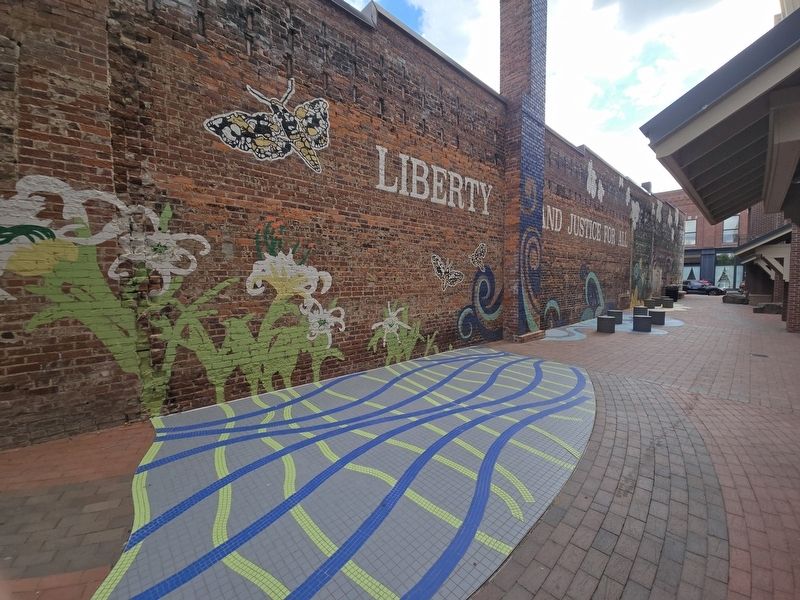
The design was inspired by the 2015 reopening of the court docket book to vacate the trespassing convictions of the Friendship 9. These African American men were jailed for integrating a whites-only lunch counter at the McCrory's Five and Dime on Main Street on January 31, 1961. The sit-in gave rise to an important strategy in the civil rights movement when they chose to serve time in jail rather than to pay the fines of an unjust system. The "jail, no bail" strategy was successfully replicated throughout the South. While the original intent of freedom walkway was to honor the Friendship 9, it has evolved into a tribute to social justice for all. Curving a brick patterns flow through the walkway to create a dynamic journey rich with symbolism, integrating the ideas of hope, Freedom, change, turbulence, obstacles, and friendship. Plants significant to Rock Hill are exuberantly painted and planted within the walkway with hopes of inspiring all who visit.
Juan Logan
Born in Nashville. Tennessee, Juan Logan now lives and works in Belmont, North Carolina. Logan's artworks address subjects relevant to the American experience. At once abstract and representational, his paintings, drawings, sculptures, installations, and videos address the interconnections of race, place and power. They make visible how hierarchical relations and social stereotypes shape individuals, institutions, and the material and mental landscapes of contemporary life. "He has shown extensively nationally and internationally, has had numerous solo exhibitions, and many private and public commissions. Logan's works can be found in private, corporate and public collections, including the Whitney Museum of American Art, the Philadelphia Museum of Art, the Gibbes Museum of Art, the Baltimore Museum of Art, the Memphis Brooks Museum, the Zimmerli Museum of Art, the Boulder Museum of Contemporary Art and the Smithsonian National Museum of African American History and Culture.
Laurel Holtzapple
Laurel Holzapple is a landscape architect and public artist. Laurel's work is influenced by the landscapes of memory, from the mountains of southwestern Pennsylyania, to the industrial port city of Genoa, Italy, and to the juxtapositions of the emerging Southern cityscape. After a decade in Philadelphia working as a landscape architect on projects throughout the country, Laurel founded groundworks studio in Charlotte NC in 2007. She creates imaginative landscapes of meaning that emerge from the culture and nature of the place. Her work explores the intersection of landscape and art, and spans a range of landscape typologies including college campuses, public art environments, social justice spaces, historic courtyards, and residential gardens. Project experience includes the National Gallery af Art Sculpture Garden, Toledo Museum of Art, Sculpture Walk, GAP Headquarters, Bard College, St Martin's Episcopal Church Fellowship Courtyard, and Reid Park Art.
(footer)
Freedom Walkway is supported in part by awards from the National Endowment for the Arts and the Arts Council of York County, and by contributions from the Barre Mitchell Community Initiatives Fund. Vinyet Architecture is a major contributor to the fund. Freedom Walkway Is the first project of the Rock Hill Economic Development Corporation's Rock Hill designs for Rock Hill Places Initiative. It is designed to demonstrate that "locally created, locally inspired art" can add meaning and value to public investments in Rock Hill.
(caption)
The arrest of the Friendship 9 encouraged the civil rights movement in Rock Hill. Picket lines of over 100 protesters marching on Main Street in February and March of 1961 caught national attention including full page spreads in the Baltimore Afro-American and support from the Student Non-Violent Coordinating Committee. This image, with the words "Liberty and Justice for All", inspired the design of Freedom Walkway. Photo courtesy of Joel Nichols.
Topics.
this page online
Location. 34° 55.544′ N, 81° 1.571′ W. Marker is in Rock Hill, South Carolina, in York County. It can be reached from East Main Street west of Hampton Street, on the right when traveling west. This marker is situated on the rear side of the East Main Street building, next to a large parking lot shared by local businesses. Touch for map. Marker is at or near this postal address: 141 E Main St, Rock Hill SC 29730, United States of America. Touch for directions.

Regionally, this marker is in the Midlands and in the Olde English District. It is also in the American South and specifically in the Deep South. Globally, it is in North America, the Western Hemisphere, the Western World, and the Anglosphere. Historically, it finds itself in what was once the original Cherokee Nation, the territory of the Mississippian Culture, one of the original Thirteen Colonies, one of the Confederate States of America, and the Antebellum South.
Other nearby markers. At
Photographed by Mark Parker, September 25, 2025
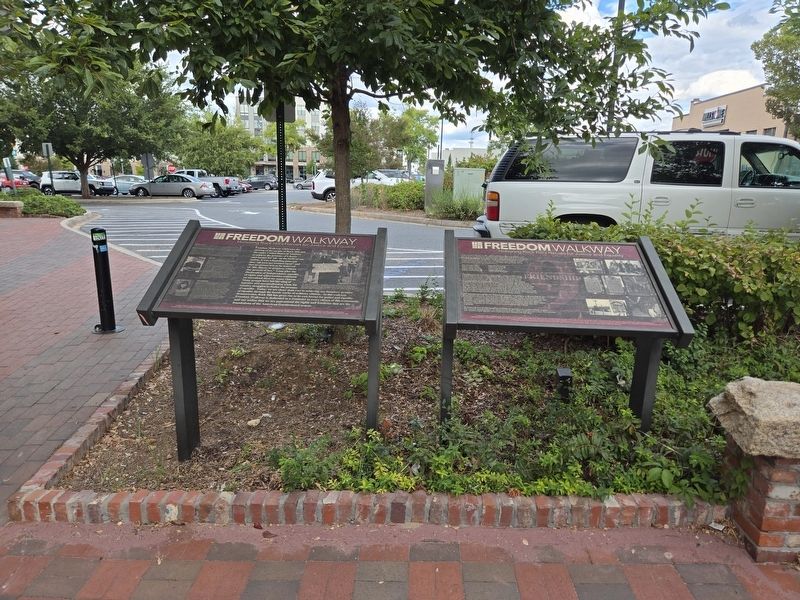
2. Freedom Walkway Marker on the left of the two markers in front parking lot
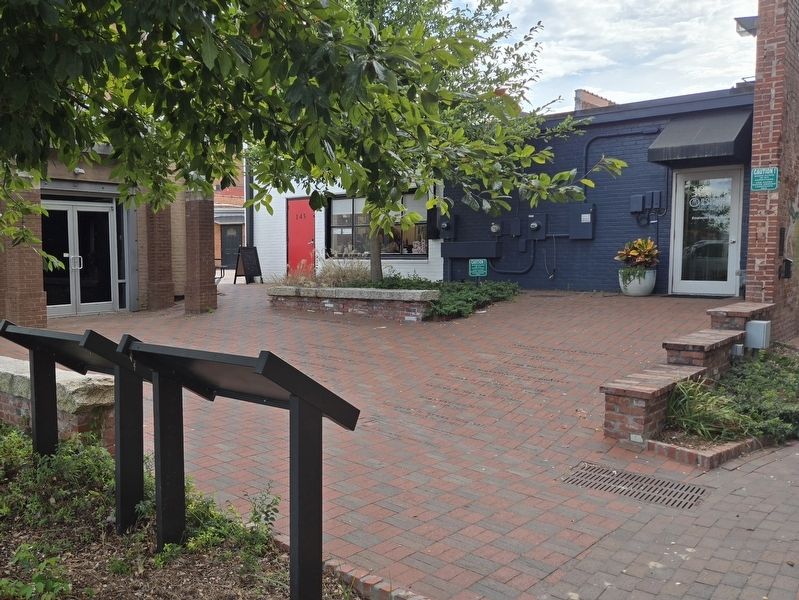
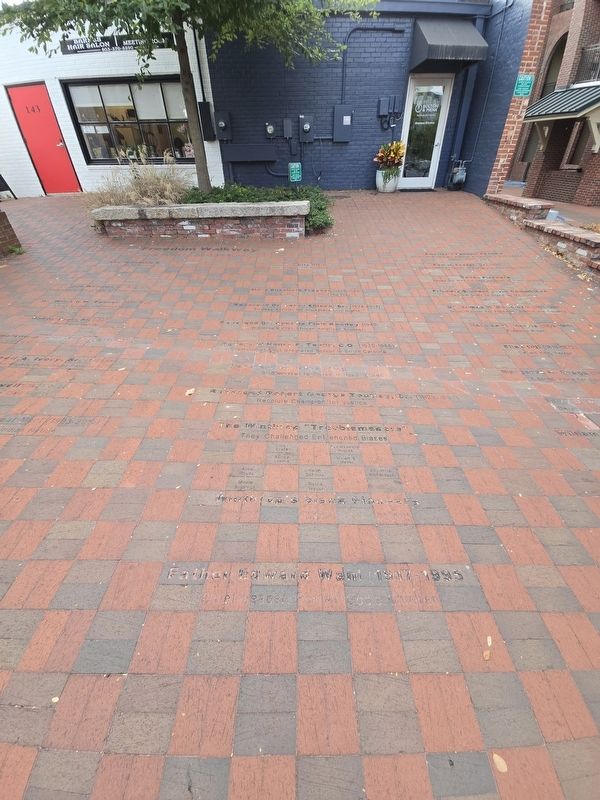
More about this marker. It is one of four markers incorporated into the Freedom Walkway along the brick sidewalk in this parking area. Nearby, the Friendship 9 group is also honored with an engraving on the brickwork of the Walkway. A large Freedom Walkway mural is prominently displayed in the pocket park that connects East Main Street to the parking lot.
Photographed by Mark Parker, September 25, 2025
3. Rear view Freedom Walkway Marker, located on the right of the two markers
Photographed by Mark Parker, September 25, 2025
4. Freedom Walkway honorees
Photographed by Mark Parker, September 25, 2025
5. Freedom Walkway Mural looking towards East Main Street
Credits. This page was last revised on September 26, 2025. It was originally submitted on September 25, 2025, by Mark Parker of Hickory, North Carolina. This page has been viewed 87 times since then and 49 times this year. Photos: 1, 2, 3, 4, 5. submitted on September 25, 2025, by Mark Parker of Hickory, North Carolina. • Bernard Fisher was the editor who published this page.
