
Rock Hill in York County, South Carolina — The American South (South Atlantic)
Father Edward Wahl
⎯⎯⎯
Rev. James Spratt White
Freedom Walkway
| — | Honoring Rock Hill's Heroes for Justice and Equality | — |
Photographed by Mark Parker, September 25, 2025
1. Father Edward Wahl / Rev. James Spratt White Marker
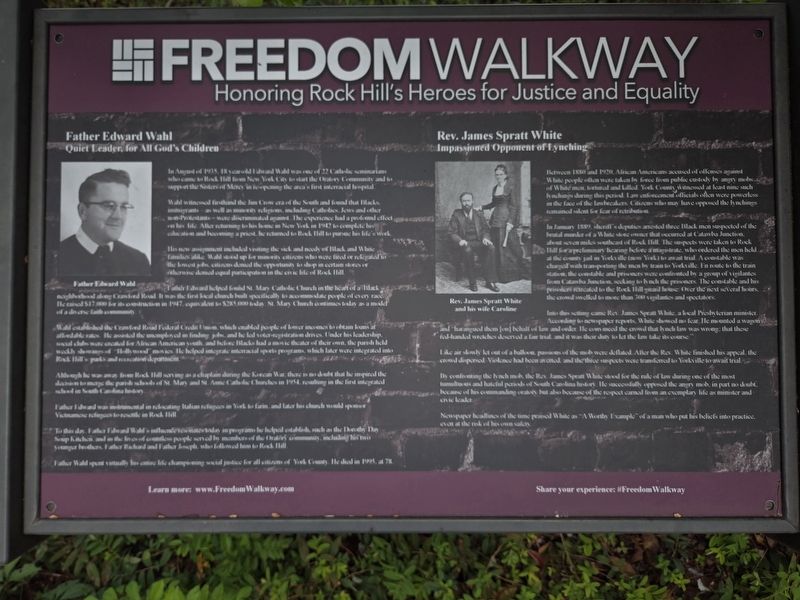
Father Edward Wahl
Quiet Leader, for All God's Children
In August of 1935, 18-year-old Edward Wahl Was one of 22 Catholic seminarians who came to Rock Hill from New York City to start the Oratory Community and to support the Sisters of Mercy and reopening the areas first interracial hospital.
Wahl witnessed firsthand with Jim Crow era of the South and found that Blacks, immigrants — as well as minority relations, including Catholic, Jews, and other non-Protestants — or discriminated against. The experience had a profound effect on his life. After returning to his home in New York in 1942 to complete his education and becoming a priest, he returned to Rock Hill to pursue his life's work.
His new assignments included visiting the sick and needy of Black and White families alike. Wahl stood up for minority citizens who were fired or relegated to the lowest jobs, citizens denied the opportunity to shop in certain stores or otherwise denied equal participation in the civic life of Rock Hill.
Father Edward help found St. Mary's Catholic Church in the heart of a Black neighborhood along Crawford Road. It was the
this page online
Wahl established a Crawford Road Federal Credit Union, French enabled people of lower incomes to obtain loans at portable rates. He assisted the unemployment and finding jobs, and he led voter-registration drives. Under his leadership, social clubs for created for African American youth, and before Blacks had a movie theater of their own, held weekly showings of "Hollywood" movies. He helped integrate interracial support programs, which later were integrated into Rock Hill parks and recreation department.
Although he was away from Rock Hill serving as a chaplain during the Korean War, There was no doubt that he inspired the decision to merge the parish schools of St. Mary and St. Anne Catholic churches in 1954, resulting in the first interracial school in South Carolina history.
Father Edward was instrumental and relocating Italian refugees in York to farm, and later his church would sponsor Vietnamese refugees
Photographed by Mark Parker, September 25, 2025
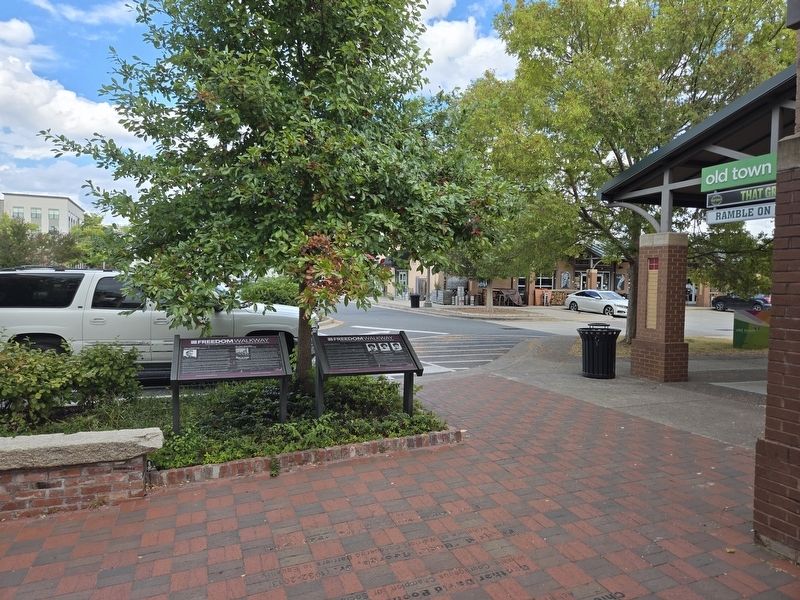
2. Father Edward Wahl / Rev. James Spratt White Marker in front of the shopping center parking lot.
Subject marker on the left
To this day, Father Edward Wahl's influence resonates today and programs he helped establish, such as the Dorothy Day Soup Kitchen and in the lives of countless people served by members of the Oratory Community, including his two younger brothers, Father Richard and Father Joseph, who followed ham to Rock Hill.
Father Wahl spent virtually his entire life championing social justice for all citizens of your county. He died in 1995, at 78.
Rev. James Spratt White
Impassioned Opponent of Lynching
Between 1880 and 1920, African Americans accused of offenses against White people often were taken by force from public custody by angry mobs of White men, tortured and killed. York County witnessed at least nine such lynchings during this period law enforcement officials often were powerless in the face of the lawbreakers. Citizens who may have opposed the lynchings remain silent for fear of retribution.
In January 1889, sheriff's deputies arrested three Black men suspected of the brutal murder of a White store owner that occurred at Catawba Junction, about 7 miles southeast of Rock Hill. Suspects were
Photographed by Mark Parker, September 25, 2025
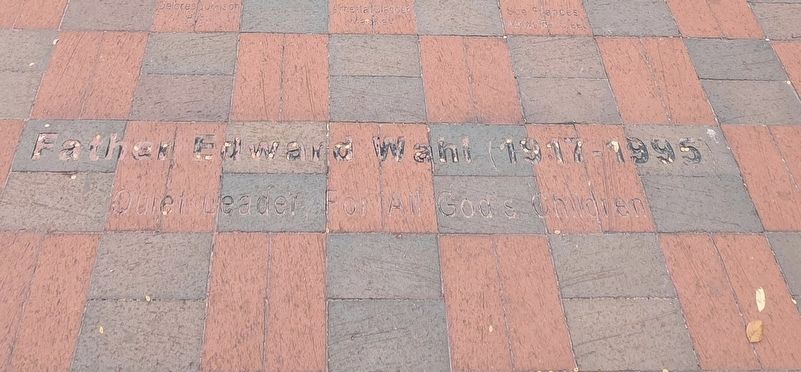
3. Father Edward Wahl 1917-1995, Quiet Leader, for all God's Children
Inscribed on the Freedom Walkway
Into this setting came Rev. James Spratt White, a local Presbyterian minister. According to newspaper reports. White showed no fear. He mounted a wagon and "harangued them [on] behalf of law and order. He convinced the crowd that lynch law was wrong; that these red-handed wretches deserved a fair trial, and it was there duty to let the law take its course."
Like air slowly let out of a balloon, passions of the mob were deflated. After the Rev. White finished his appeal, the crowd dispersed. Violence had been averted, and the three suspects were transferred to Yorkville to await trial.
By confronting
Photographed by Mark Parker, September 25, 2025
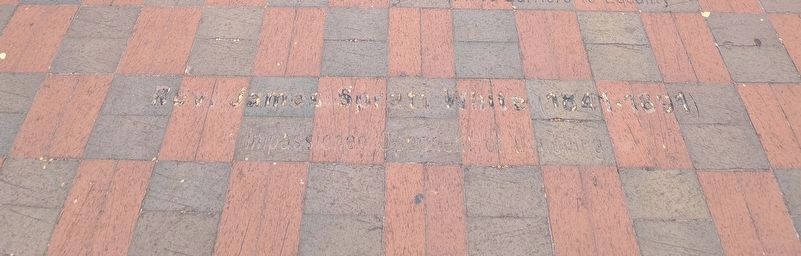
4. Rev. James Spratt White (1841-1891) Impassioned Opponent of Lynching
Name inscribed on the Freedom Walkway
Newspaper headlines of the time praised White as "A Worthy Example" of a man who put his beliefs into practice, even at the risk of his own safety period.
Learn more: www.freedomwalkway.com
Topics. This historical marker is listed in these topic lists: African Americans • Civil Rights • Religion & Religious Structures. A significant historical month for this entry is January 1889.
Location. 34° 55.543′ N, 81° 1.568′ W. Marker is in Rock Hill, South Carolina, in York County. It can be reached from East Main Street west of Hampton Street, on the right when traveling west. This marker is situated on the rear side of the East Main Street building, next to a large parking lot shared by local businesses. Touch for map. Marker is at or near this postal address: 141 E Main St, Rock Hill SC 29730, United States of America. Touch for directions.

Regionally, this marker is in the Midlands and in the Olde English District. It is also in the American South and specifically in the Deep South. Globally, it is in North America, the Western Hemisphere, the Western World, and the Anglosphere. Historically, it finds itself in what was once the original Cherokee Nation, the territory of the Mississippian Culture, one of the original Thirteen Colonies, one of the Confederate States of America, and the Antebellum South.
Other nearby markers. At least 8 other markers are within walking distance of this marker: Friendship 9 (here, next to this marker); Winthrop's Black Pioneers (here, next to this marker); Freedom Walkway (here, next to this marker); Old Town Fact (within shouting distance of this marker); Rock Hill's Civil Rights Giant (within shouting distance of this marker); Jail, No Bail! (within shouting distance of this marker); Rock Hill's Sit-in Movement (within shouting distance of this marker); McCrory's Civil Rights Sit-ins / "Friendship Nine" (within shouting distance of this marker). Touch for a list and map of all markers in Rock Hill.
More about this marker. It is one of four markers incorporated into the Freedom Walkway along the brick sidewalk in this parking area. Nearby, the Friendship 9 group is also honored with an engraving on the brickwork of the Walkway. A large Freedom Walkway mural is prominently displayed in the pocket park that connects East Main Street to the parking lot.
Credits. This page was last revised on September 26, 2025. It was originally submitted on September 25, 2025, by Mark Parker of Hickory, North Carolina. This page has been viewed 127 times since then and 81 times this year. Photos: 1. submitted on September 25, 2025, by Mark Parker of Hickory, North Carolina. 2, 3, 4. submitted on September 26, 2025, by Mark Parker of Hickory, North Carolina. • Bernard Fisher was the editor who published this page.
