Roswell in Fulton County, Georgia — The American South (South Atlantic)
Roswell's Historic Founders' Cemetery

Photographed by Darren Jefferson Clay, August 29, 2025
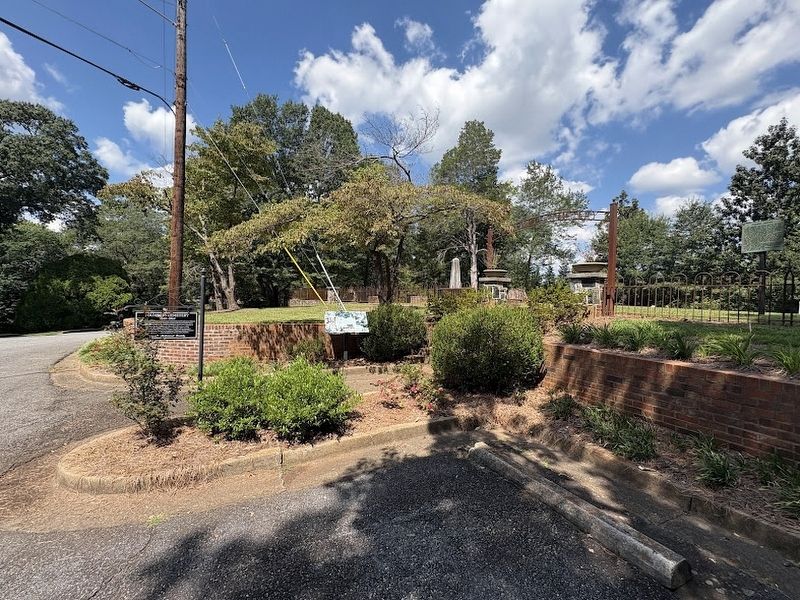
1. Roswell's Historic Founders' Cemetery Marker
Active from 1840 until the early 20th century, Founders' Cemetery served as Roswell's first municipal burial ground. Perhaps first used as a burial place for mill workers, in 1841, an outbreak of scarlet fever caused the death of many in the newly established mill village, especially children, including young Charles Irvine Bulloch, the son of Martha and James S. Bulloch.
Originally, the cemetery's boundaries encompassed more property than its current 2.5 acres. According to an 1874 plat, the original west boundary ran from the corner of today's Walnut and Sloan Streets north to Vickery Creek. The southern boundary traveled from this intersection along Sloan Street down to the creek, making Vickery Creek its northern and eastern borders.
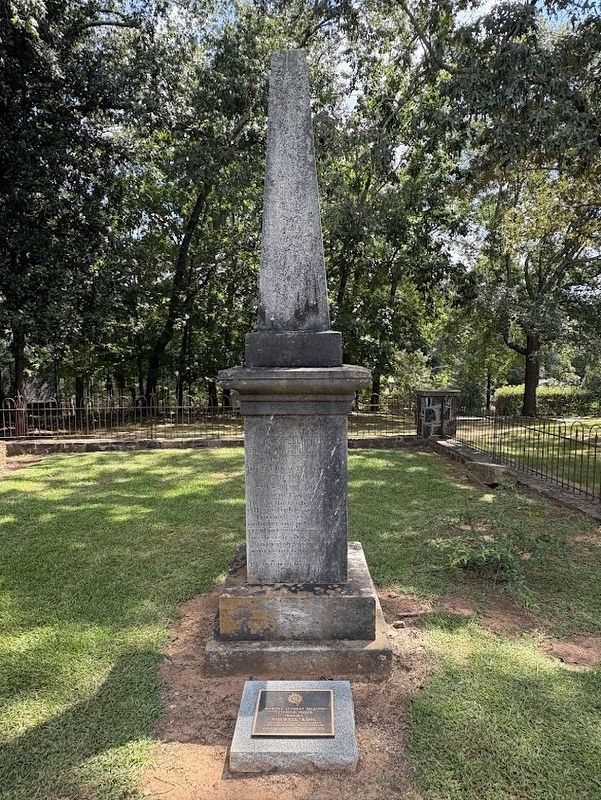
Founders Cemetery contains at least 67 field stone marked (added in 1984), unidentified graves and 28 marked with formal headstones. Among those in marked graves are Roswell King; James S. Bulloch and Georgia A. Elliott, his stepdaughter; members of the Dunwody family including James Stobo, Ruth Marion, John and Jane; Ralph King Hand; Bayard Quintard; and Horace Southworth Pratt.
this page online
Roswell's mill village is represented by the marked graves of five Hudlow family members, Adam Sawyer, a native of Scotland, and the majority of the unmarked graves. A now broken obelisk once stood as a monument to William Smith and Eric Parker, assistants to Henry Merrell, superintendent of the Roswell Manufacturing Company. Its remains can be found near Roswell King's grave.
(captions)
This 1874 Plat shows the boundaries of the cemetery once extended much further than they do today. (Map courtesy of the Roswell Historical Society)
br> This pre-1990 photograph shows the house that once stood in the now vacant lot to the west of the cemetery. Several of the fieldstones used to identify unmarked graves can also be seen in this photograph. (Photograph courtesy of the Roswell Historical Society)
Founders' Cemetery has among its unmarked graves that of "Daddy Luke," the former slave of Major James Bulloch. Sometime before 1905, Daddy Luke died at 105 years of age and was laid to rest near Major Bulloch according to his descendants. In the Atlanta Constitution on 8 October 1905, he was described by his great granddaughter as a "mighty man, large and muscular; he was strong. He was respectful, polite and a man of good-native sense...... He was the butler, carriage driver, hostler, servant about the yard and foreman on the farm." Daddy Luke could read and write and remained on the family's grounds (Bulloch Hall) long after Martha Bulloch had moved north to be with her daughters. Martha and then her daughters continued to support Daddy Luke and Maum Charlotte, his wife, years after emancipation.
In the Spring of 2007, members of the Roswell Historical Society recorded gravestone information for a database that will contain data for all of Roswell's historic district cemeteries. They also created a map of Founders' Cemetery. While probing for unmarked graves, they discovered and exposed this line of handmade bricks. Its purpose is as yet unknown.
Founders' Cemetery has gone through periods of neglect. In the early 1940s, the Mittie Bulloch Chapter of the United Daughters of the Confederacy restored the cemetery and put up stone posts and chains to keep out automobiles. Time and time again, civic groups had to step up and take over its care and maintenance. In 1983, the Roswell Historic Preservation Commission funded a study for its restoration and preservation. At that time, the City of Roswell became active in the cemetery's preservation.
In 1984, the City purchased the lot directly east (behind the Dunwody plot) in order to protect the cemetery from encroachment on that side. That same year, ground penetrating radar studies identified 67 unmarked graves (including two outside city-owned property). These were later marked with the fieldstones seen today. In 1991, the City purchased the lot to the west, further protecting the cemetery from development. Today, the City maintains the grounds at Founders' Cemetery; however, volunteers often undertake additional beautification of this tiny piece of Roswell's history.
Topics.
Photographed by Darren Jefferson Clay, August 29, 2025
2. Roswell's Historic Founders' Cemetery Marker
Location. 34° 0.865′ N, 84° 21.366′ W. Marker is in Roswell, Georgia, in Fulton County. It is on Sloan Street east of Walnut Lane, on the left when traveling east. Touch for map. Marker is at or near this postal address: 200 Sloan St, Roswell GA 30075, United States of America. Touch for directions.

Regionally, this marker is in the Piedmont and in Metro Atlanta. It is also in the American South and specifically in the Deep South. Globally, it is in North America, the Western Hemisphere, the Western World, and the Anglosphere. Historically, it finds itself in what was once the territory of the Mississippian Culture, one of the original Thirteen Colonies, one of the Confederate States of America, and the Antebellum South.
Other nearby markers. At least 8 other markers are within walking distance of this marker: Founders Cemetery (here, next to this marker); a different marker also named Founders' Cemetery (a few steps from this marker); Mechanics of a Mill (about 400 feet away, measured in a direct
Photographed by Darren Jefferson Clay, August 29, 2025
3. Roswell King's monument
Credits. This page was last revised on October 5, 2025. It was originally submitted on September 26, 2025, by Darren Jefferson Clay of Duluth, Georgia. This page has been viewed 72 times since then and 32 times this year. Photos: 1, 2, 3. submitted on September 26, 2025, by Darren Jefferson Clay of Duluth, Georgia. • Bernard Fisher was the editor who published this page.
