Fanshawe in London in Middlesex County, Ontario — Central Canada (North America)
Caverhill House
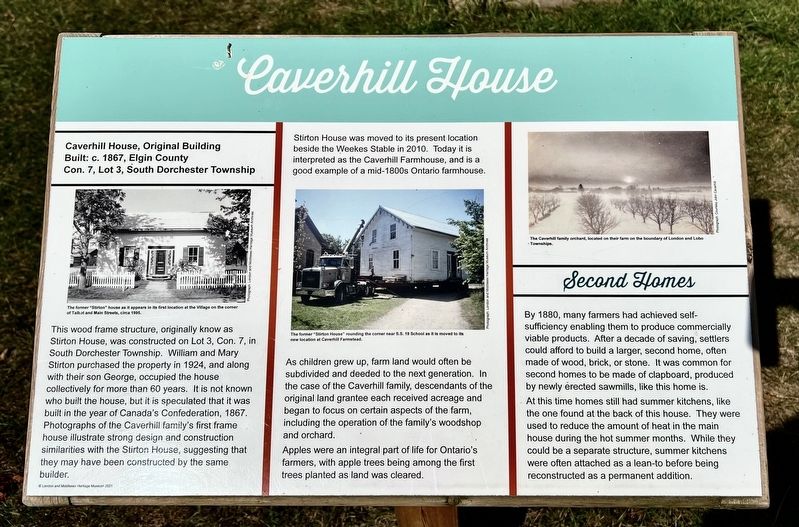
Photographed by Tim Boyd, September 14, 2025
1. Caverhill House Marker
Caverhill House, Original Building
Built: c. 1867, Elgin County
Con. 7, Lot 3, South Dorchester Township
This wood frame structure, originally know as Stirton House, was constructed on Lot 3, Con. 7, in South Dorchester Township. William and Mary purchased the property in 1924, and along with their son George, occupied the house collectively for more than 60 years. It is not known who built the house, but it is speculated that it was built in the year of Canada's Confederation, 1867. Photographs of the Caverhill family's first frame house illustrate strong design and construction similarities with the Stirton House, suggesting that they may have been constructed by the same builder.
Stirton House was moved to its present location beside the Weekes Stable in 2010. Today it is interpreted as the Caverhill Farmhouse, and is a good example of a mid-1800s Ontario farmhouse.
As children grew up, farm land would often be subdivided and deeded to the next generation. In the case of the Caverhill family, descendants of the original land grantee each received acreage and began to focus on certain aspects of the farm,
this page online
Second Homes
By 1880, many farmers had achieved self-sufficiency enabling them to produce commercially viable products. After a decade of saving, settlers could afford to build a larger, second home, often made of wood, brick, or stone. It was common for second homes to be made of clapboard, produced by newly erected sawmills, like this home is. At this time homes still had summer kitchens, like the one found at the back of this house. They were used to reduce the amount of heat in the main house during the hot summer months. While they could be a separate structure, summer kitchens were often attached as a lean-to before being reconstructed as a permanent addition.
Topics. This historical marker is listed in these topic lists: Agriculture • Architecture. A significant historical year for this entry is 1867.
Location. 43° 3.319′ N, 81° 10.705′ W. Marker is in London, Ontario, in Middlesex County. It is in Fanshawe. It can be reached

circa 1995
2. Caverhill House marker photo and caption detail (left)

Regionally, this marker is in the Southwest Ontario Area and in Southwestern Ontario. It is also in Central Canada. Globally, it is in North America, the Western Hemisphere, the Western World, and the Anglosphere. Historically, it finds itself in what was once a British colony, the Viceroyalty of New France, the Haudenosaunee (Iroquois) Confederacy, and Rupert’s Land.
Other nearby markers. At least 8 other markers are within walking distance of this marker: Caverhill Woodworking Shop (within shouting distance of this marker); Caverhill Stable (within shouting distance of this marker); Mount Moriah Masonic Lodge

3. Caverhill House marker photo and caption detail (centre)

4. Caverhill House marker photo and caption detail (right)

Photographed by Tim Boyd, September 14, 2025
5. Caverhill House Marker
Credits. This page was last revised on September 27, 2025. It was originally submitted on September 27, 2025, by Tim Boyd of Hamilton, Ontario. This page has been viewed 38 times since then and 15 times this year. Photos: 1, 2, 3, 4, 5. submitted on September 27, 2025, by Tim Boyd of Hamilton, Ontario. • Andrew Ruppenstein was the editor who published this page.
