Fanshawe in London in Middlesex County, Ontario — Central Canada (North America)
Caverhill Stable

Photographed by Tim Boyd, September 14, 2025
1. Caverhill Stable Marker
Caverhill Stable, Original Building
Built: c. 1860, Middlesex County
West Nissouri Township
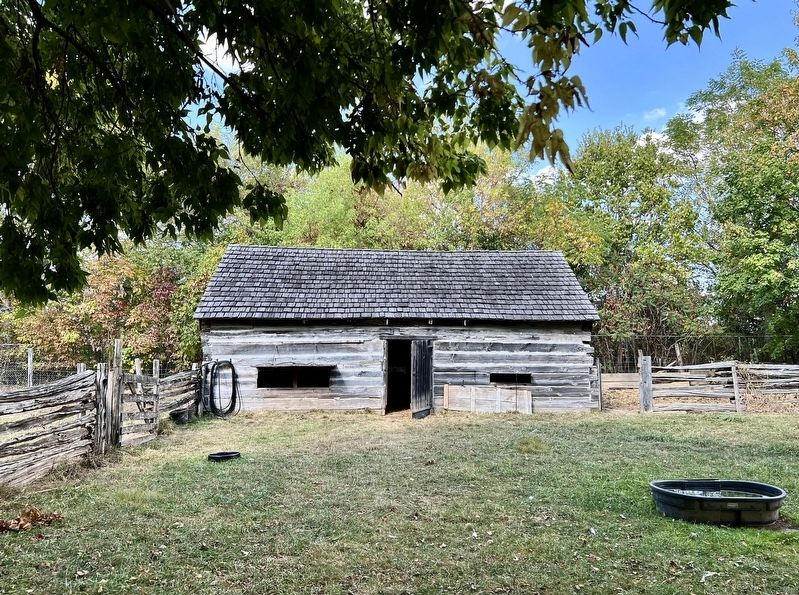
Originally the log home of the Weekes family, this building was used as a granary for many years after the family constructed a new frame house. Today it represents a stable on the Caverhill Farmstead and is home to the Village's sheep, pigs, and ducks each season.
Once a family had successfully established their farm, it was common practice to replace their basic log home by constructing a new frame house on their land. The original log home could then be used as a granary or a stable for their farm animals.
Mixed Farming
Farming was a well established industry by the 1830s with wheat being the main crop and source of income. By the mid-1850s wheat production began to decline due to crop disease and soil exhaustion. However, the "wheat boóm" of the 1850s and the American Civil War in the 1860s increased demand for both wheat and barley (as well as livestock). Unfortunately, an economic depression followed the American Civil War, and changes to the Corn Laws, which regulated grain exports to Britain, drove wheat prices
this page online
The declining income from wheat sales forced experimentation with mixed farming. This form of farming continued in Ontario for almost 100 years.
By the 1870s the average farm consisted of 100 acres, with between 60 to 80 acres cleared. Of the cleared land 10 to 15 acres were planted in oats, 10 to 15 acres in wheat, and 4 to 10 acres in corn. The rest of the workable acreage was split between hay and pasture. The remainder may have been cleared, but was often kept as a woodlot.
The 1871 Ontario census, the first census taken after Confederation, showed oats were the largest crop, sheep were the main farmstock, and horses had become the most used working animal.
Topics. This historical marker is listed in this topic list: Agriculture. A significant historical year for this entry is 1860.
Location. 43° 3.321′ N, 81° 10.73′ W. Marker is in London, Ontario, in Middlesex County. It is in Fanshawe. It can be reached from Fanshawe Park Road East. The marker is on the grounds of the Fanshawe Pioneer Village, accessibility subject to its operating hours and requiring paid admission. The Village is accessed by driving east from the
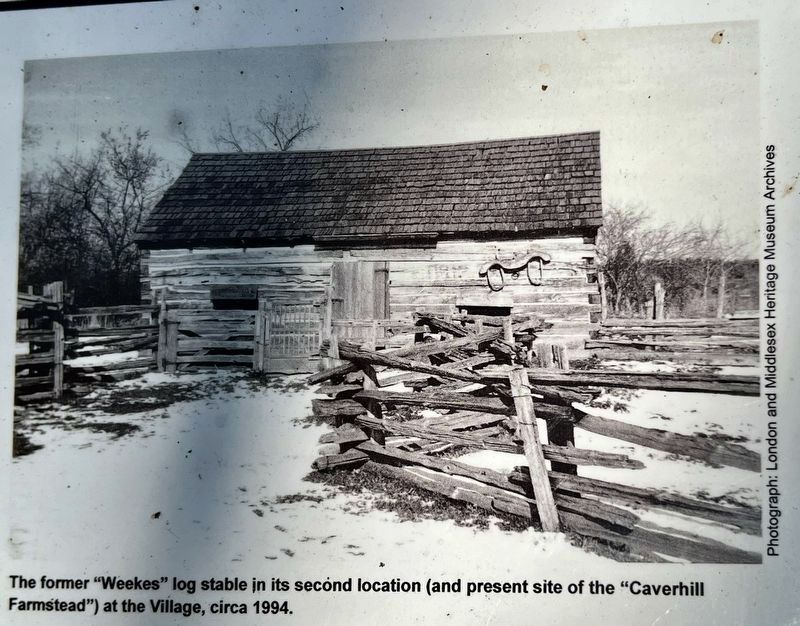
circa 1994
2. Caverhill Stable marker photo and caption detail (left)

Regionally, this marker is in the Southwest Ontario Area and in Southwestern Ontario. It is also in Central Canada. Globally, it is in North America, the Western Hemisphere, the Western World, and the Anglosphere. Historically, it finds itself in what was once a British colony, the Viceroyalty of New France, the Haudenosaunee (Iroquois) Confederacy, and Rupert’s Land.
Other nearby markers. At least 8 other markers are within walking distance of this marker: Caverhill House (within shouting distance of this marker); Mount Moriah Masonic Lodge (within shouting distance of this marker); Tavern Carriage Shed (within shouting distance of this marker); Caverhill Woodworking Shop (within shouting distance of this marker); Lochaber Church (within shouting distance of this marker); Lochaber Carriage Shed (within shouting
Photographed by Tim Boyd, September 14, 2025
3. Caverhill Stable, 2025
Photographed by Tim Boyd, September 14, 2025
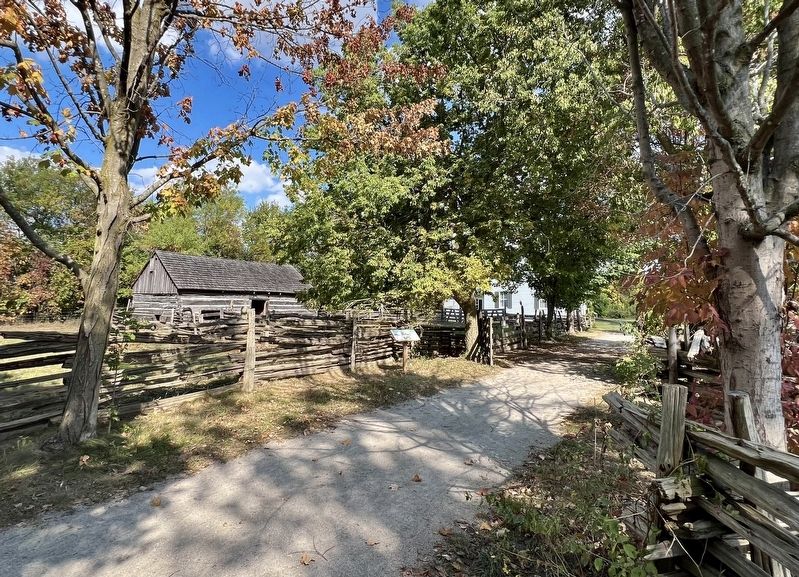
4. Caverhill Stable Marker
Credits. This page was last revised on September 27, 2025. It was originally submitted on September 27, 2025, by Tim Boyd of Hamilton, Ontario. This page has been viewed 40 times since then and 18 times this year. Photos: 1, 2, 3, 4. submitted on September 27, 2025, by Tim Boyd of Hamilton, Ontario. • Andrew Ruppenstein was the editor who published this page.
