Fanshawe in London in Middlesex County, Ontario — Central Canada (North America)
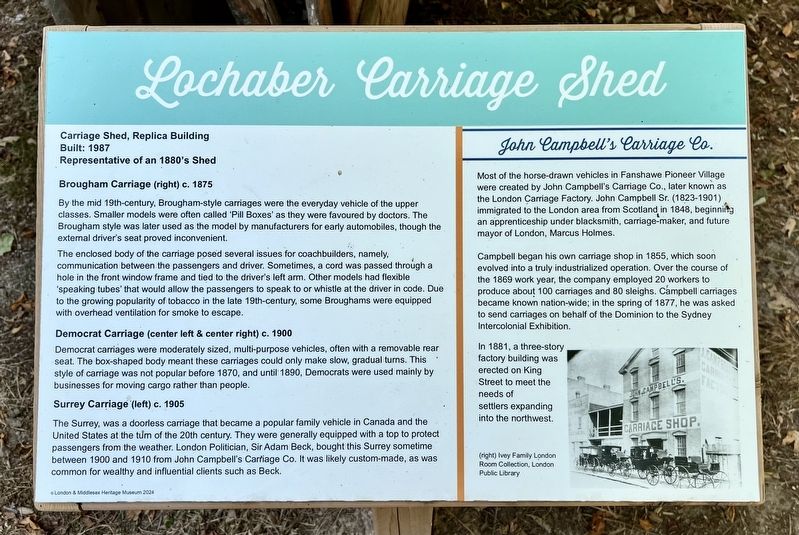
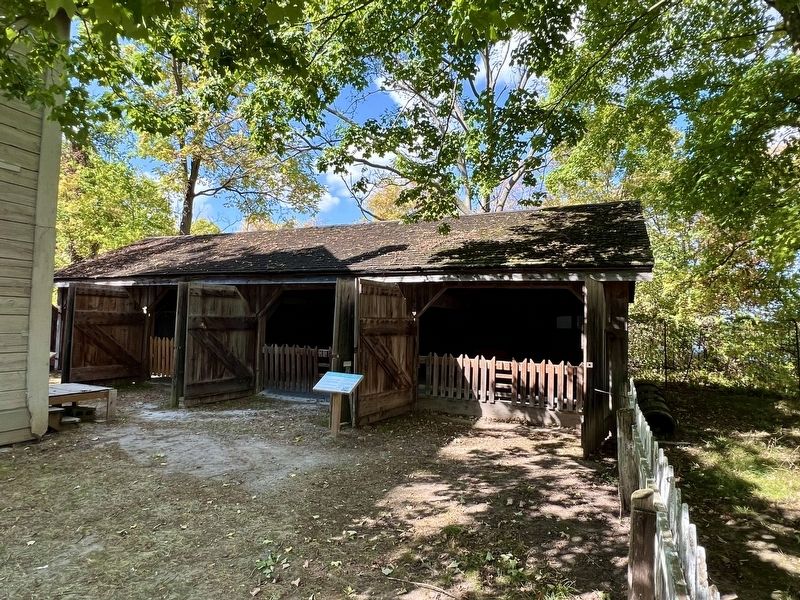
Lochaber Carriage Shed
Photographed by Tim Boyd, September 14, 2025
1. Lochaber Carriage Shed Marker
Carriage Shed, Replica Building
Built: 1987
Representative of an 1880's Shed
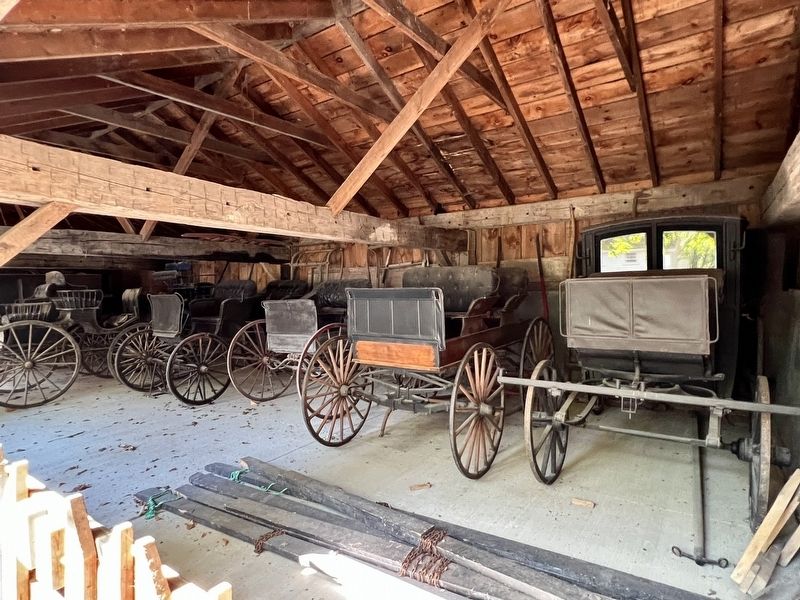
Brougham Carriage (right) c. 1875
By the mid 19th-century, Brougham-style carriages were the everyday vehicle of the upper classes. Smaller models were often called 'Pill Boxes' as they were favoured by doctors. The Brougham style was later used as the model by manufacturers for early automobiles, though the external driver's seat proved inconvenient.
The enclosed body of the carriage posed several issues for coachbuilders, namely, communication between the passengers and driver. Sometimes, a cord was passed through a hole in the front window frame and tied to the driver's left arm. Other models had flexible 'speaking tubes' that would allow the passengers to speak to or whistle at the driver in code. Due to the growing popularity of tobacco in the late 19th-century, some Broughams were equipped with overhead ventilation for smoke to escape.
Democrat Carriage (center left & center right) c. 1900
Democrat carriages were moderately sized, multi-purpose vehicles, often with a removable rear seat. The box-shaped body meant these carriages
this page online
Surrey Carriage (left) c. 1905
The Surrey, was a doorless carriage that became a popular family vehicle in Canada and the United States at the turn of the 20th century. They were generally equipped with a top to protect passengers from the weather. London Politician, Sir Adam Beck, bought this Surrey sometime between 1900 and 1910 from John Campbell's Carriage Co. It was likely custom-made, as was common for wealthy and influential clients such as Beck.
John Campbell's Carriage Co.
Most of the horse-drawn vehicles in Fanshawe Pioneer Village were created by John Campbell's Carriage Co., later known as the London Carriage Factory. John Campbell Sr. (1823-1901) immigrated to the London area from Scotland in 1848, beginning an apprenticeship under blacksmith, carriage-maker, and future mayor of London, Marcus Holmes.
Campbell began his own carriage shop in 1855, which soon evolved into a truly industrialized operation. Over the course of the 1869

2. Lochaber Carriage Shed Marker Photo detail
John Campbell’s Carriage Factory
In 1881, a three-story factory building was erected on King Street to meet the needs of settlers expanding into the northwest.
Topics. This historical marker is listed in these topic lists: Industry & Commerce • Roads & Vehicles. A significant historical year for this entry is 1875.
Location. 43° 3.333′ N, 81° 10.764′ W. Marker is in London, Ontario, in Middlesex County. It is in Fanshawe. It can be reached from Fanshawe Park Road East. The marker is on the grounds of the Fanshawe Pioneer Village, accessibility subject to its operating hours and requiring paid admission. The Village is accessed by driving east from the intersection of Clark Road and Veterans’ Parkway. Admission is paid at the entrance to the Fanshawe Conservation Area, and then follow signposts for approx. 2km to the Village. Touch for map. Marker is at or near this postal address: 2609 Fanshawe Park Road E, London
Photographed by Tim Boyd, September 14, 2025
3. Carriages in the Lochaber Carriage Shed

Regionally, this marker is in the Southwest Ontario Area and in Southwestern Ontario. It is also in Central Canada. Globally, it is in North America, the Western Hemisphere, the Western World, and the Anglosphere. Historically, it finds itself in what was once a British colony, the Viceroyalty of New France, the Haudenosaunee (Iroquois) Confederacy, and Rupert’s Land.
Other nearby markers. At least 8 other markers are within walking distance of this marker: Lochaber Church (a few steps from this marker); Mount Moriah Masonic Lodge (a few steps from this marker); Corbett Tavern (within shouting distance of this marker); Tavern Carriage Shed (within shouting distance of this marker); Purple Hill Loyal Orange Lodge (within shouting distance of this marker); Blacksmith Shop (within shouting distance of this marker); African Methodist Episcopal Church (within shouting distance of this marker); Caverhill Stable (within shouting distance of this marker). Touch for a list and map of all markers in London.
Photographed by Tim Boyd, September 14, 2025
4. Lochaber Carriage Shed Marker
Credits. This page was last revised on September 27, 2025. It was originally submitted on September 27, 2025, by Tim Boyd of Hamilton, Ontario. This page has been viewed 48 times since then and 20 times this year. Photos: 1, 2, 3, 4. submitted on September 27, 2025, by Tim Boyd of Hamilton, Ontario. • Andrew Ruppenstein was the editor who published this page.
