Fanshawe in London in Middlesex County, Ontario — Central Canada (North America)
Dr. Jones House
Photographed by Tim Boyd, September 14, 2025
1. Dr. Jones House Marker
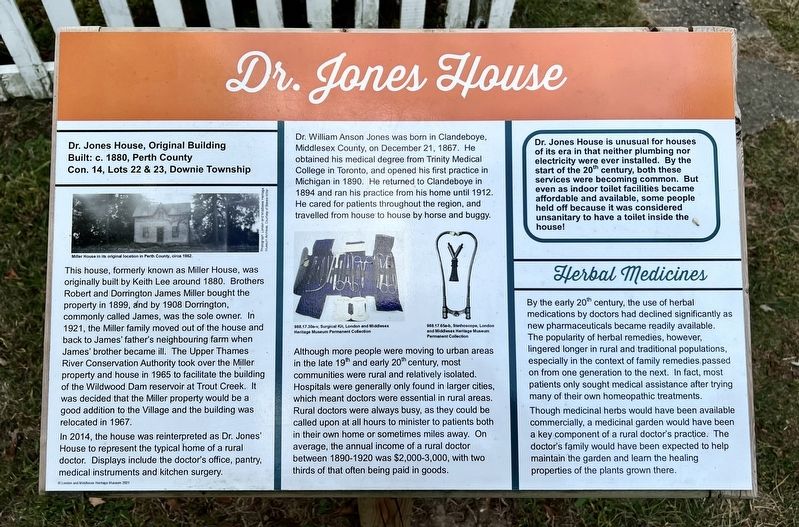
Dr. Jones House, Original Building
Built: c. 1880, Perth County
Con. 14, Lots 22 & 23, Downie Township
This house, formerly known as Miller House, was originally built by Keith Lee around 1880. Brothers Robert and Dorrington James Miller bought the property in 1899, and by 1908 Dorrington, commonly called James, was the sole owner. In 1921, the Miller family moved out of the house and back to James' father's neighbouring farm when James' brother became ill. The Upper Thames River Conservation Authority took over the Miller property and house in 1965 to facilitate the building of the Wildwood Dam reservoir at Trout Creek. It was decided that the Miller property would be a good addition to the Village and the building was relocated in 1967.
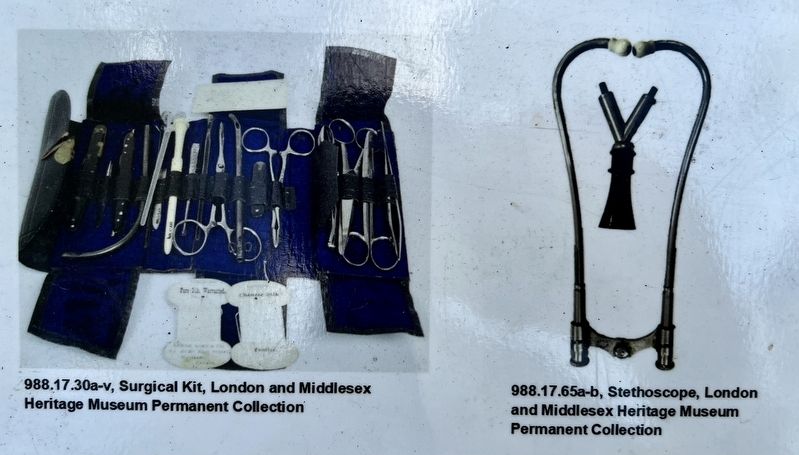
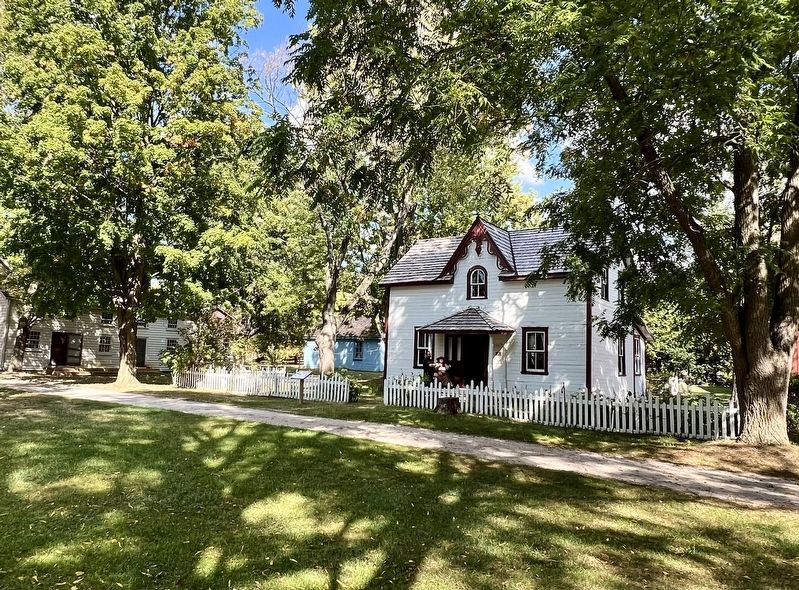
In 2014, the house was reinterpreted as Dr. Jones' House to represent the typical home of a rural doctor. Displays include the doctor's office, pantry, medical instruments and kitchen surgery.
Dr. William Anson Jones was born in Clandeboye, Middlesex County, on December 21, 1867. He obtained his medical degree from Trinity Medical College in Toronto, and opened his first practice in Michigan in 1890. He returned to Clandeboye in 1894 and ran his practice from his home until 1912. He cared
this page online
Although more people were moving to urban areas in the late 19th and early 20 century, most communities were rural and relatively isolated. Hospitals were generally only found in larger cities, which meant doctors were essential in rural areas. Rural doctors were always busy, as they could be called upon at all hours to minister to patients both in their own home or sometimes miles away. On average, the annual income of a rural doctor between 1890-1920 was $2,000-3,000, with two- thirds of that often being paid in goods.
Dr. Jones House is unusual for houses of its era in that neither plumbing nor electricity were ever installed. By the start of the 20th century, both these services were becoming common. But even as indoor toilet facilities became affordable and available, some people held off because it was considered unsanitary to have a toilet inside the house!
Herbal Medicines
By the early 20 century, the use of herbal medications by doctors had declined significantly as new pharmaceuticals became readily available. The popularity of herbal remedies, however, lingered longer in rural and traditional populations, especially in the context
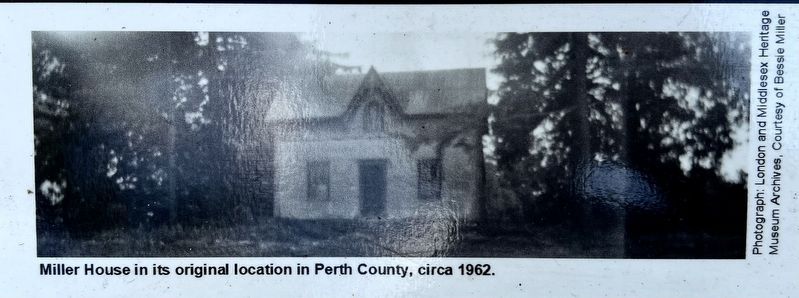
circa 1962
2. Dr. Jones House marker photo and caption detail (left)
Topics and series. This historical marker is listed in this topic list: Science & Medicine. In addition, it is included in the If You've Got to Go... series list. A significant historical year for this entry is 1880.
Location. 43° 3.303′ N, 81° 10.779′ W. Marker is in London, Ontario, in Middlesex County. It is in Fanshawe. It can be reached from Fanshawe Park Road East. The marker is on the grounds of the Fanshawe Pioneer Village, accessibility subject to its operating hours and requiring paid admission. The Village is accessed by driving east from the intersection of Clark Road and Veterans’ Parkway. Admission is paid at the entrance to the Fanshawe Conservation Area, and then follow signposts for approx. 2km to the Village. Touch for map. Marker is at or near this postal address: 2609 Fanshawe Park Road
Photographed by Tim Boyd, September 14, 2025
3. Dr. Jones House marker photo and caption detail (centre)

Regionally, this marker is in the Southwest Ontario Area and in Southwestern Ontario. It is also in Central Canada. Globally, it is in North America, the Western Hemisphere, the Western World, and the Anglosphere. Historically, it finds itself in what was once a British colony, the Viceroyalty of New France, the Haudenosaunee (Iroquois) Confederacy, and Rupert’s Land.
Other nearby markers. At least 8 other markers are within walking distance of this marker: Dr. Jones’ House: (here, next to this marker); Dr. Jones Frame Barn (a few steps from this marker); Blacksmith Shop (within shouting distance of this marker); Corbett Tavern (within shouting distance of this marker); Alder’s Weaving Shed (within shouting distance of this marker); African Methodist Episcopal Church (within shouting distance of this marker); Purple Hill Loyal Orange Lodge (within shouting distance of this marker); Lochaber Church (within shouting distance of this marker). Touch for a list and map of all markers in London.
Photographed by Tim Boyd, September 14, 2025
4. Dr. Jones House Marker
To the left of the house
Credits. This page was last revised on September 30, 2025. It was originally submitted on September 28, 2025, by Tim Boyd of Hamilton, Ontario. This page has been viewed 49 times since then and 24 times this year. Photos: 1, 2, 3, 4. submitted on September 28, 2025, by Tim Boyd of Hamilton, Ontario. • Andrew Ruppenstein was the editor who published this page.
