Near Petersburg in Dinwiddie County, Virginia — The American South (Mid-Atlantic)
The Hart House
The Breakthrough Trail
| — | [Pamplin Historical Park] | — |
Photographed by Bill Coughlin, April 23, 2007
1. The Hart House Marker
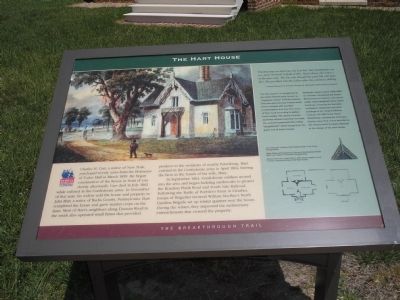
Charles H. Carr, a native of New York, purchased twenty acres from the Boisseaus of Tudor Hall in March 1859. He began construction of the house in front of you shortly afterwards. Carr died in July 1862 while enlisted in the Confederate army. In November of that year, his widow sold the house and property to John Hart, a native of Bucks County, Pennsylvania. Hart completed the house and grew market crops on the farm. Most of Hart’s neighbors along Duncan Road to the south also operated small farms that provided produce to the residents of nearby Petersburg. Hart enlisted in the Confederate army in April 1864, leaving the farm in the hands of his wife, Mary.
In September 1864, Confederate soldiers moved into the area and began building earthworks to protect the Boydton Plank Road and South Side Railroad. Following the Battle of Peebles’s Farm in October, troops of Brigadier General William MacRae’s North Carolina Brigade set up winter quarters near the house. During the winter, they improved the rudimentary entrenchments that crossed the property.
The fruit trees are blooming very fast here. Our encampments are in a large ‘Orchard’ in front of Mrs. Hart’s house. Her house is in the same camp. The line runs through her yard. She still stays here. She goes down into the Cellar when they commence shelling.
- Corporal Benjamin H. Freeman, Company K, 44th North Carolina Infantry Regiment
[Sidebar:]
The Hart House is a cottage built in the Gothic Revival style, known as “Carpenter Gothic” in North America. This new style adorned modest wood frame cottages with scrolled ornamentation and lacy trim, many of them built according to pattern-book models. The newly invented scroll-saw allowed carpenters to create the delicate bargeboard trim called “gingerbread,” which hangs from the gable end of these houses.
Alexander Jackson Davis (1803-1892), an architect, introduced the Gothic Revival form to America. During his career, Davis designed many public buildings, including the barracks, professors’ residences and other buildings at the Virginia Military Institute. His 1837 book, Rural Residences, included the Dutchess County, New York, home depicted at left. Notice that it is nearly identical to the design of the Hart House.
Erected by Pamplin
this page online
Topics. This historical marker is listed in these topic lists: Architecture • Settlements & Settlers • War, US Civil. A significant historical month for this entry is March 1859.
Location. 37° 10.626′ N, 77° 28.607′ W. Marker is near Petersburg, Virginia, in Dinwiddie County. It can be reached from Duncan Road (Virginia Route 670), on the left when traveling south. Marker is in Pamplin Historical Park, on the Hart Farm loop off the Breakthrough Trail. Touch for map. Marker is at or near this postal address: 6125 Boydton Plank Road, Petersburg VA 23803, United States of America. Touch for directions.

Regionally, this marker is in the Piedmont, in Southside Virginia, and specifically in Central Virginia. It is also in the American South and specifically in the Upper South. Globally, it is in North America, the Western Hemisphere, the Western World, and the Anglosphere. Historically, it finds itself in what was once the territory of the Mississippian Culture, one of the original Thirteen Colonies, one of the Confederate States of America, and the Antebellum South.
Other nearby markers. At least 8 other
Photographed by Bill Coughlin, April 23, 2007
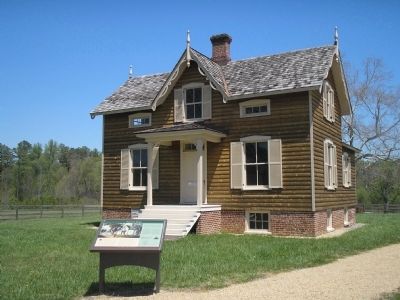
2. Marker on the Breakthrough Trail
More about this marker. The upper left of the marker contains a picture from the book of “Alexander Jackson Davis, Gate-House in the Rustic Cottage Style.” Below the sidebar is a detailed picture of a “Gable with bargeboard. Homes in Carpenter Gothic style have highly ornamented bargeboards.” Below this is a “Floor-plan, taken from a 19th century pattern book [which] is nearly identical to that of the Hart House.”
Also see . . .
1. Breakthrough at Petersburg. The American Civil War website.
Photographed by Bill Coughlin, April 23, 2007
3. The Hart House
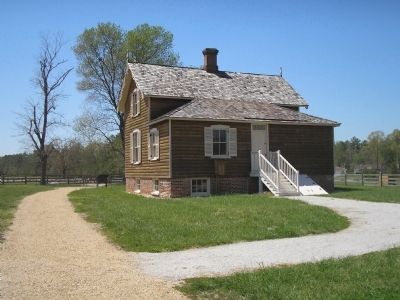
The marker can be seen to the left in this photo of the back side of the Hart House.
2. Pamplin Historical Park. (Submitted on January 18, 2009, by Bill Coughlin of Woodland Park, New Jersey.)
3. The Final Assault. Siege of Petersburg online (Submitted on January 18, 2009, by Bill Coughlin of Woodland Park, New Jersey.)
Photographed by Bill Coughlin, April 23, 2007
4. The Hart House
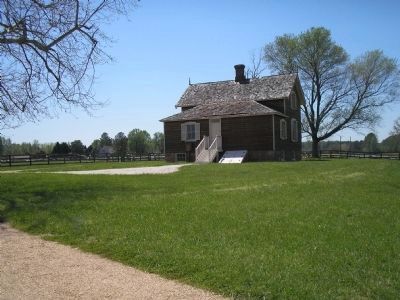
The entrance to the cellar, where Mary Hart sought refuge during the shelling, can be seen next to the house.
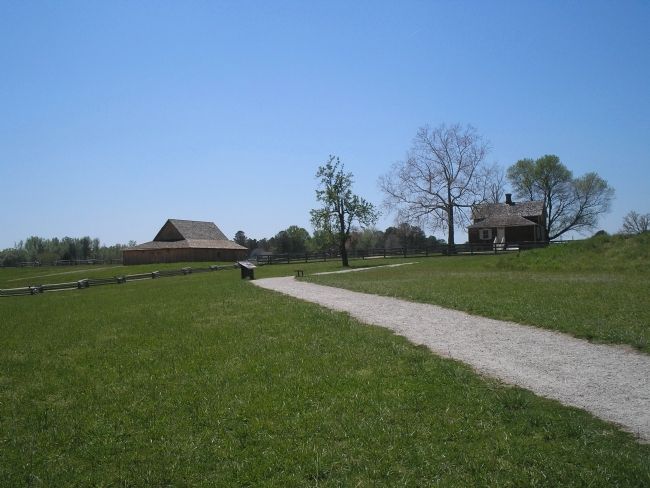
Photographed by Bill Coughlin, April 23, 2007
5. The Hart Farm
The Hart House (right) and barn can be seen here along the Breakthrough Trail in Pamplin Historical Park.

Photographed by Evan Dwyer, July 4, 2025
6. The Hart House Marker
In its "new" location in the rear of the house.
Credits. This page was last revised on October 3, 2025. It was originally submitted on January 18, 2009, by Bill Coughlin of Woodland Park, New Jersey. This page has been viewed 1,697 times since then and 70 times this year. Last updated on September 30, 2025, by Evan Dwyer of Richmond, Virginia. Photos: 1, 2, 3, 4, 5. submitted on January 18, 2009, by Bill Coughlin of Woodland Park, New Jersey. 6. submitted on September 30, 2025, by Evan Dwyer of Richmond, Virginia. • Devry Becker Jones was the editor who published this page.
