Near Petersburg in Dinwiddie County, Virginia — The American South (Mid-Atlantic)
The Attack Begins
The Breakthrough Trail
| — | Pamplin Historical Park | — |
Photographed by Bill Coughlin, April 23, 2007
1. The Attack Begins Marker
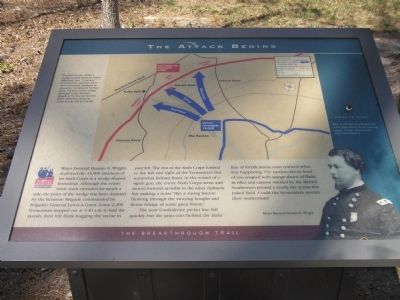
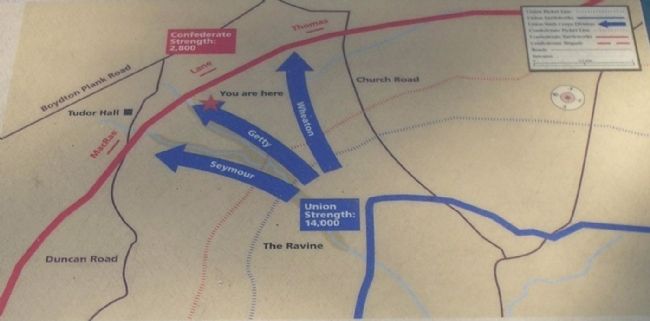
Major General Horatio G. Wright deployed the 14,000 attackers of his Sixth Corps in a wedge-shaped formation. Although the entire battle front extended for nearly a mile, the point of the wedge was here, manned by the Vermont Brigade commanded by Brigadier General Lewis A. Grant. Some 2,200 Vermonters stepped out at 4:40 a.m. to lead the assault, their left flank hugging the ravine to your left. The rest of the Sixth Corps formed to the left and right of the Vermonters but somewhat behind them. At the sound of a signal gun, the entire Sixth Corps arose and moved forward, invisible in the misty darkness but making a noise “like a strong breeze blowing through the swaying boughs and dense foliage of some great forest.”
The new Confederate picket line fell quickly, but the graycoats behind the main line of fortifications soon realized what was happening. The earthworks in front of you erupted with orange sheets of flame as rifles and cannon wielded by the alerted Southerners poured a deadly fire across this naked field. Could the Vermonters sustain their momentum?
Erected by Pamplin Historical Park.
Topics.
this page online
Location. 37° 10.84′ N, 77° 28.256′ W. Marker is near Petersburg, Virginia, in Dinwiddie County. It can be reached from Duncan Road (Virginia Route 670), on the left when traveling south. Marker is in Pamplin Historical Park, on the Breakthrough Trail's Main Loop. Touch for map. Marker is at or near this postal address: 6588 Duncan Rd, Petersburg VA 23803, United States of America. Touch for directions.

Regionally, this marker is in the Piedmont, in Southside Virginia, and specifically in Central Virginia. It is also in the American South and specifically in the Upper South. Globally, it is in North America, the Western Hemisphere, the Western World, and the Anglosphere. Historically, it finds itself in what was once the territory of the Mississippian Culture, one of the original Thirteen Colonies, one of the Confederate States of America, and the Antebellum South.
Other nearby markers. At least 8 other markers are within walking distance of this marker: The Breakthrough (within shouting distance of this
Photographed by Bill Coughlin, April 23, 2007
2. Field of Attack
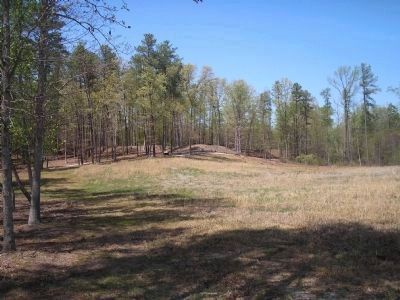
On the morning of April 2, 1865, Soldiers of the Sixth Corps attacked across this field toward the fortifications seen at the top of the photo. This photo was taken from near the marker.
More about this marker. The bottom right of the marker features a photograph of Major General Horatio G. Wright. The top of the marker contains a battle map of the April 2 action. It includes the caption “The Sixth Corps utilized a wedge-shaped attack formation with their units ‘in echelon’ to create the maximum drive and momentum necessary to pierce the Confederate fortifications. The point of the wedge belonged to the Vermont Brigade of the Second Division, which advanced using the ravine to your left as a guide.”
Also see . . .
1. Breakthrough at Petersburg. The American Civil War website. (Submitted on January 14, 2009, by Bill Coughlin of Woodland Park, New Jersey.)
2. The Final Assault.
Photographed by Bill Coughlin, April 23, 2007
3. Inside the Confederate Fortifications
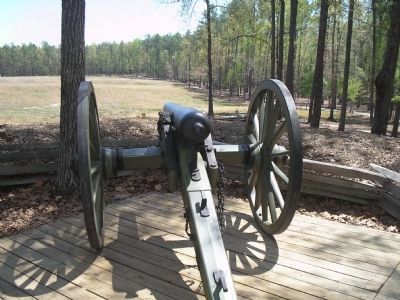
This photo looks out of the Confederate fortifications in the direction of the Union advance.
Photographed by Bill Coughlin, April 23, 2007
4. Battle Map from the Marker
Credits. This page was last revised on October 2, 2025. It was originally submitted on January 14, 2009, by Bill Coughlin of Woodland Park, New Jersey. This page has been viewed 1,397 times since then and 21 times this year. Last updated on October 2, 2025, by Evan Dwyer of Richmond, Virginia. Photos: 1, 2, 3, 4. submitted on January 14, 2009, by Bill Coughlin of Woodland Park, New Jersey. • Devry Becker Jones was the editor who published this page.
