
Tipton in Moniteau County, Missouri — The American Midwest (Upper Plains)
Harrison School
Photographed by Cosmos Mariner, September 24, 2025
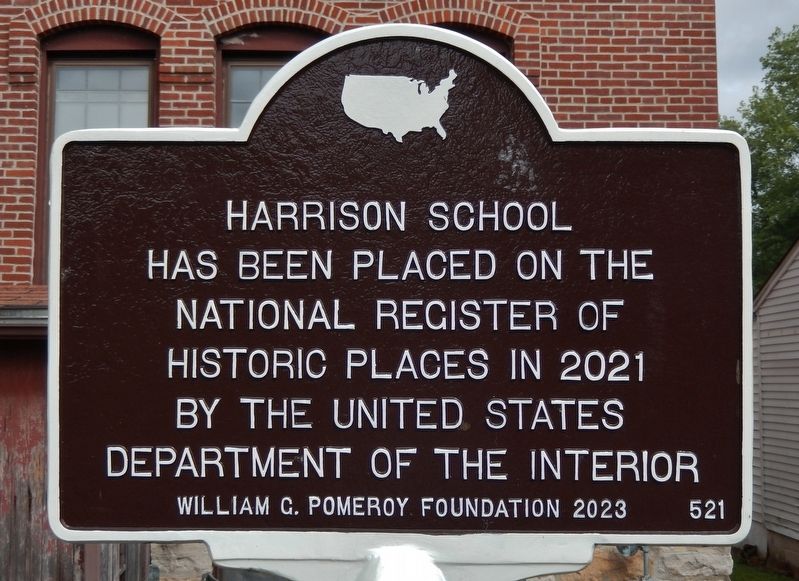
1. Harrison School Marker
Has been placed on the
National Register of Historic Places
in 2021 by the United States Department of the Interior
Erected 2023 by William G. Pomeroy Foundation. (Marker Number 521.)
Topics and series. This historical marker is listed in these topic lists: African Americans • Architecture • Civil Rights • Education. In addition, it is included in the National Register of Historic Places (NRHP), and the William G. Pomeroy Foundation series lists. A significant historical year for this entry is 1890.
Location. 38° 39.505′ N, 92° 46.515′ W. Marker is in Tipton, Missouri, in Moniteau County. It is on Howard Street just west of Auglaize Avenue, on the right when traveling west. The marker is located directly in front of the subject school building. Touch for map. Marker is at or near this postal address: 235 Howard Street, Tipton MO 65081, United States of America. Touch for directions.

Regionally, this marker is in the Missouri River Corridor. It is also in the American Ozarks, in the Lewis & Clark Corridor, and in the Corn Belt. Globally, it is in North America, the Western Hemisphere, the Western
this page online
Other nearby markers. At least 7 other markers are within 6 miles of this marker, measured as the crow flies: William Tipton Seely (approx. ¼ mile away); First Presbyterian Church (approx. 0.3 miles away); The Maclay Home (approx. 0.4 miles away); Tipton Methodist Church Bell (approx. half a mile away); Tipton (approx. 0.7 miles away); Site of First St. Andrew Catholic Church (approx. 1.4 miles away); Butterfield Overland Mail in Missouri - 1858-1861 (approx. 5.4 miles away).
Regarding Harrison School. National Register of Historic Places № 100006080.
From the National Register Nomination prepared by Douglas S. Shipley and Michelle Diedriech, 9/4/2020:
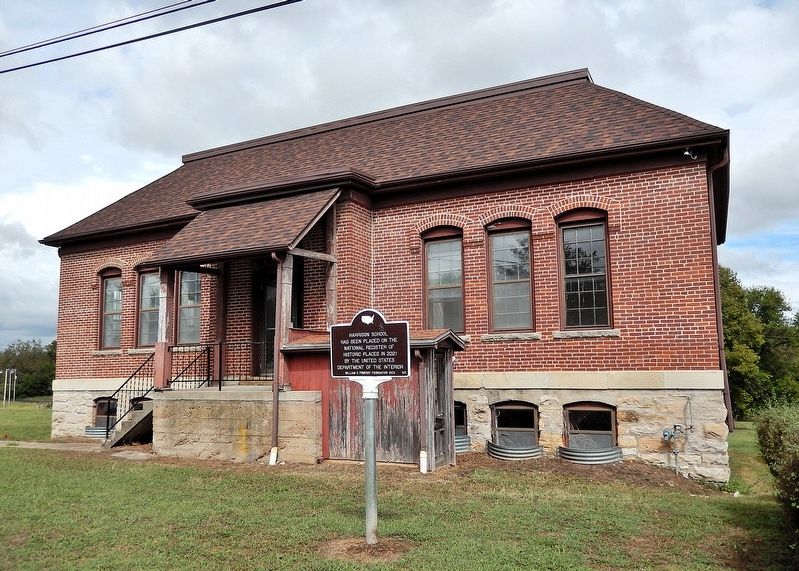
Harrison School was the first and only Tipton school ever constructed with public funds for black students' educations. Following the Civil War, Tipton officials had neither complied with Missouri's revised Constitution nor the State Board of Education's directives to have Tipton fund education for blackstudents. However, after considerable external pressures, Tipton finally sought the services of W.F. Schrage to design not only Tipton High School (non-extant) for white students but also Harrison School. Constructed between 1888 and 1890, Harrison School served grades one through eight and in 1936 offered a two-year high school program. Prior to this, students would have to travel using their own funding to receive upper-level education at a handful of other cities in the state, which was often cost prohibitive. The school served as the only means for African Americans to receive an education and was an incredibly important cornerstone of the black community.Photographed by Cosmos Mariner, September 24, 20252. Harrison School MarkerThe marker is located directly in front of the former school building.
In 1957, after sixty-seven consecutive years providing education to the black residents of Tipton and the surrounding area, Harrison School was closed when Tipton desegregated students. This was three years after the United States Supreme Court ruled in Brown v Topeka Board of Education that it was not constitutional to have an educational system in the United States that was separate, and not equal.
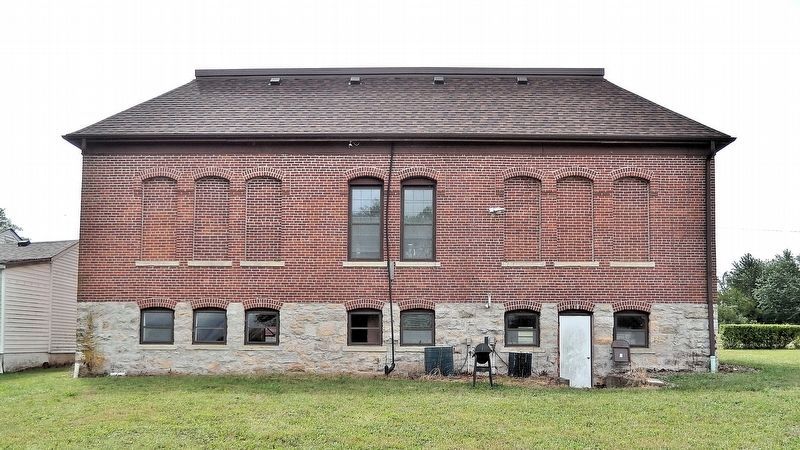
From 1890 until 1957, Harrison School operated as the only school that blackstudents in Tipton could attend, and when it closed, it was the last school for African Americans operating in Moniteau County, Missouri. It is the only extant black property from the 19th century and one of only four non-residential black resources in Tipton. Although the architect was not black, Harrison School was built and operated by African Americans. Black voters helped in its creation and since then every aspect from teaching to janitorial duties were coordinated by the local black community. Harrison School’s success was dependent on this support given the lack of financial aid and resources from local government officials. Although some alterations have taken place, the property is able to convey its educational and cultural importance to the community.Photographed by Cosmos Mariner, September 24, 20253. Harrison School (southwest elevation)From the National Register Nomination: Harrison School is in its original location and the setting is much the same as it was historically aside from the addition of a sidewalk and the loss of the water pump and outhouses. The brick façade, covered basement entry, and fenestration pattern is retained. The windows are modern but they are set within the original openings and still retain the decorative brick hoods on the primary floor and the arched openings at the basement level.
Also see . . .
1. Harrison School (National Park Service).
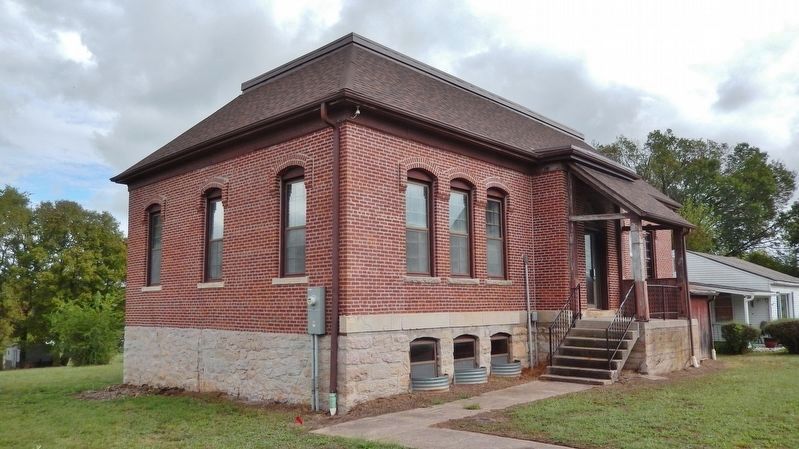
Excerpt: Tipton School District was organized in 1869 after the end of the U.S. Civil War. Tipton built two consecutive schools for its White students, but none for its African American students. After considerable pressure and a public bond levy to raise funds, the Tipton School District built Harrison(Submitted on October 5, 2025, by Cosmos Mariner of Cape Canaveral, Florida.)School for its African American students and a new public high school for its White students.Photographed by Cosmos Mariner, September 24, 20254. Harrison School (northwest elevation)From the National Register Nomination: The east and west elevations are identical, featuring a blind stone foundation/basement level and three modern 8/8 windows on the primary level that match those on the façade. They are set in the historic arched openings with stone sills and brick window hoods.
Constructed between 1888 and 1890, Harrison School was an important cornerstone of Tipton’s black community. During its 67-year history the school served as the only means for African American children in Tipton and surrounding communities to receive an education in a permanent school building. Harrison School served grades one through eight and between 1936 and 1942, the school also offered a two-year high school program. In 1954, the U.S. Supreme Court ruled in Brown v. Board of Education that U.S. state laws establishing racial segregation in public schools were unconstitutional, effectively ending public school segregation. Tipton High School was integrated in 1954, but Tipton’s black elementary students weren’t integrated until 1957. With the desegregation of all of its public schools, Tipton closed Harrison School.
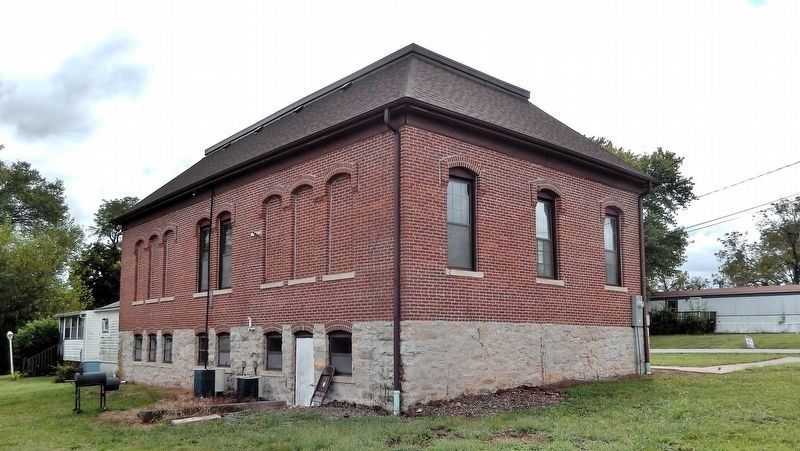
The Harrison School is preserved and operated by the Opportunity 1888 Foundation, a private foundation started by descendants of Harrison School alumni. The mission of the Foundation is to inspire and empower people to valueand preserve their own unique historic journey. The Foundation serves as an educational, cultural, and civic resource to promote Tipton’s African American history and its connections to the wider community. Harrison School became part of the African American Civil Rights Network in 2023.Photographed by Cosmos Mariner, September 24, 20255. Harrison School (north/rear elevation)From the National Register Nomination: The back of the property faces north and due to the slight drop in grade the raised basement appears higher on this elevation than the south elevation. There is no direct access to the first floor. Instead, there are two 8/8 modern windows in the center bay that are set in the original openings with stone sills and brick window hoods. Like the primary elevation, there are three openings in the first and third bay with stone sills and decorative brick window hoods, but the openings were bricked up during the 1979 renovation. The right bay of the basement has two windows flanking an entrance with a replacement door. However, the historic brick arch has been retained. The basement is accessed by a set of basement steps that have concrete retaining walls that extend slightly above ground level.
2. Harrison School National Historic Site (Opportunity 1888 Foundation).
Excerpt: On February 1, 2021, Harrison School was officially added to the National Park Service’s Register of Historic Places (NRHP). Of the 95,000 entries in the NRHP, only about 1,900 are African American. Harrison School’s story is also listed on the Smithsonian’s National Museum of African American History and Culture’s Community Curation website. Today, Harrison School stands as the last remaining 19th-century school building in Moniteau County built explicitly for black students.(Submitted on October 5, 2025, by Cosmos Mariner of Cape Canaveral, Florida.)
In 1888, a bond levy brought Tipton’s blacks and whites together for the specific purpose of constructing two new schools; one for whites (the third) and the other for blacks. The bond raised $12,000for the construction of the two schools ($10,000 for the white public school and $2,000 for the black school). Tipton’s black school opened in fall 1890 and was called Harrison School. Harrison School’s stone foundation was cut, quarried, and laid by some of Tipton’s formerly enslaved black citizens.Photographed by Cosmos Mariner, September 24, 20256. Harrison School (south/front elevation)From the National Register Nomination: Harrison School is a one-story, common-bond red brick building with a raised stone basement. It measures approximately 54 feet by 31 feet and features a hipped roof that once supported a bell tower that was removed in the 1940s. The school is three bays wide with a central entrance that projects slightly from the rest of the façade. It is sheltered by a portico with a shed roof and square post that rests upon a raised concrete stoop. The stoop is accessed on the west side by concrete stairs with a wrought iron railings. The stoop, stairs, and railings date from the 1979 renovation. Historically, the stairs were wooden and descended directly in front of the entrance. The primary floor of Harrison School's interior was originally divided into two classrooms and two cloakrooms; one side accommodated first through fourth grades and the other fifth through eighth. Each of the classes had a coal-burning stove in the center of each room. In 1936, Harrison School became a two-year high school and used one of the main level rooms for the high school classes. The basement, which had previously contained two coal bins, was converted into two classrooms for the grade school in 1936.
As Harrison School only went to the eighth grade before the 1930s, if students wanted to continue their education, they needed to enroll in schools in Kansas City, Jefferson City, Sedalia, or St. Louis, Missouri. Lincoln High School in Sedalia was one of the schools that black students from Tipton and the surrounding communities attended. Traveling to another town to complete high school often hindered the educational opportunities of Tipton’s black residents, as it meant having to find transportation, secure funding, and/or seek living arrangements in those towns.
In 1936, Tipton’s School Board allowed Harrison School to start a two-year high school program; however, no additional allotment of money was provided for Harrison’s newly sanctioned high school program. To accommodate the high school students, a classroom (which had been a coal bin) was created in the basement of Harrison School for the elementary students and the high school classes were taught on the main floor. In 1938, seven students (Ruth Shinault, Sadie Johnson, Florine Maupins, Miriam Shipley, Earl Maupins, William Webb, and George Wright) were the first graduates of Harrison High School. Harrison’s high school program only lasted until about 1942, when it was discontinued, and students were again either bused to Sedalia or found their own educational options.

Credits. This page was last revised on October 5, 2025. It was originally submitted on October 2, 2025, by Cosmos Mariner of Cape Canaveral, Florida. This page has been viewed 74 times since then and 41 times this year. Photos: 1. submitted on October 4, 2025, by Cosmos Mariner of Cape Canaveral, Florida. 2, 3, 4, 5, 6. submitted on October 5, 2025, by Cosmos Mariner of Cape Canaveral, Florida.
