Angeles National Forest near Santa Clarita in Los Angeles County, California — The American West (Pacific Coastal)
Geology of the Canyon
Saint Francis Dam Disaster National Memorial and National Monument
| — | The Role of Geology | — |
Photographed by Craig Baker, October 1, 2025
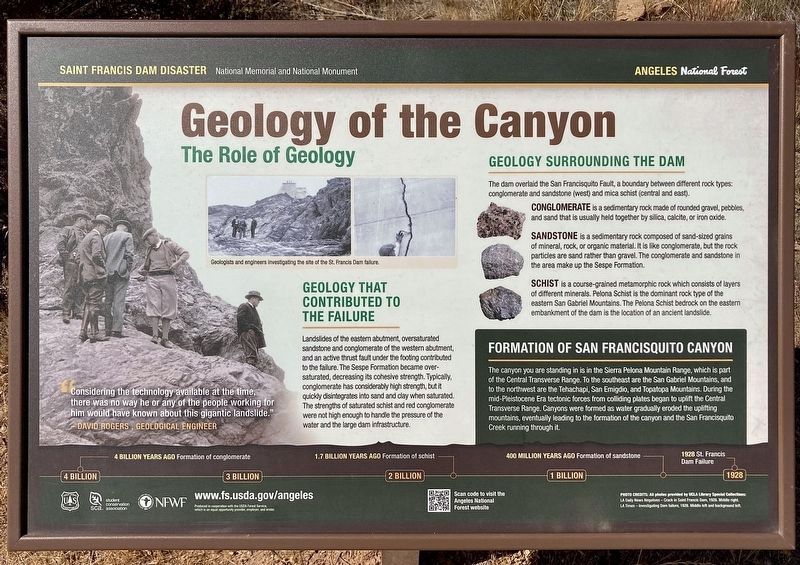
1. Geology of the Canyon
Geology That Contributed to the Failure
Landslides of the eastern abutment, oversaturated sandstone and conglomerate of the western abutment, and an active thrust fault under the footing contributed to the failure. The Sespe Formation became over-saturated, decreasing its cohesive strength. Typically, conglomerate has considerably high strength, but it quickly disintegrates into sand and clay when saturated. The strengths of saturated schist and red conglomerate were not high enough to handle the pressure of the water and the large dam infrastructure.
Geology of the Dam
The dam overlaid the San Francisquito Fault, a boundary between different rock types: conglomerate and sandstone (west) and mica schist (central and east). Conglomerate is a sedimentary rock made of rounded gravel, pebbles, and sand that is usually held together by silica, calcite, or iron oxide. Sandstone is a sedimentary rock composed of sand-sized grains of mineral, rock, or organic material. It is like conglomerate, but the rock particles are sand rather than gravel. The conglomerate and sandstone in the area make
this page online
"Considering the technology available at the time, there was no way he or any of the people working for him would have known about this gigantic landslide."
-David Rogers, Geological Engineer
Formation of the San Francisquito Canyon
The canyon you are standing in is in the Sierra Pelona Mountain Range, which is part of the Central Transverse Range. To the southeast are the San Gabriel Mountains, and to the northwest are the Tehachapi, San Emigdio, and Topatopa Mountains. During the mid-Pleistocene Era tectonic forces from colliding plates began to uplift the Central Transverse Range. Canyons were formed as water gradually eroded the uplifting mountains, eventually leading to the formation of the canyon and the San Francisquito Creek running through it.
Erected by U.S. Forest Service, Student Conservation
Photographed by Craig Baker, October 1, 2025
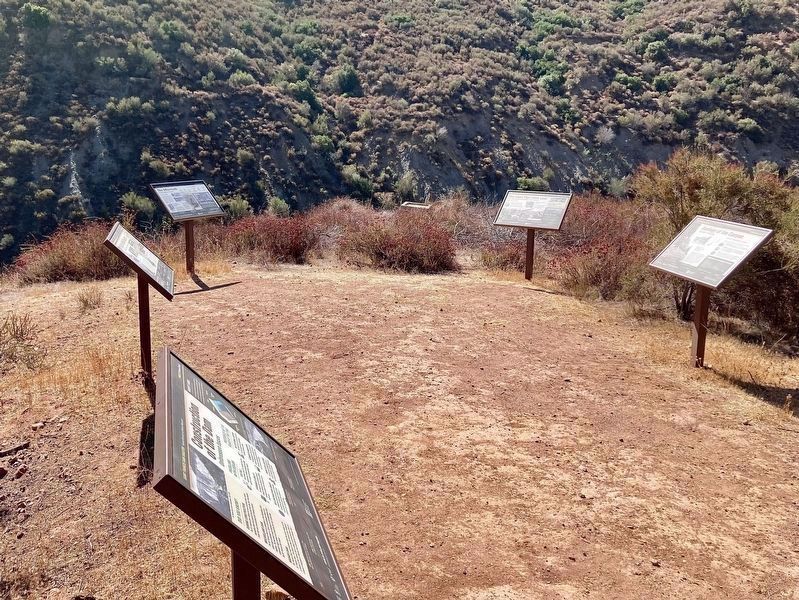
2. Geology of the Canyon marker
One of eight interpretive signs here.
Topics. This historical marker is listed in these topic lists: Disasters • Industry & Commerce • Man-Made Features • Natural Resources.
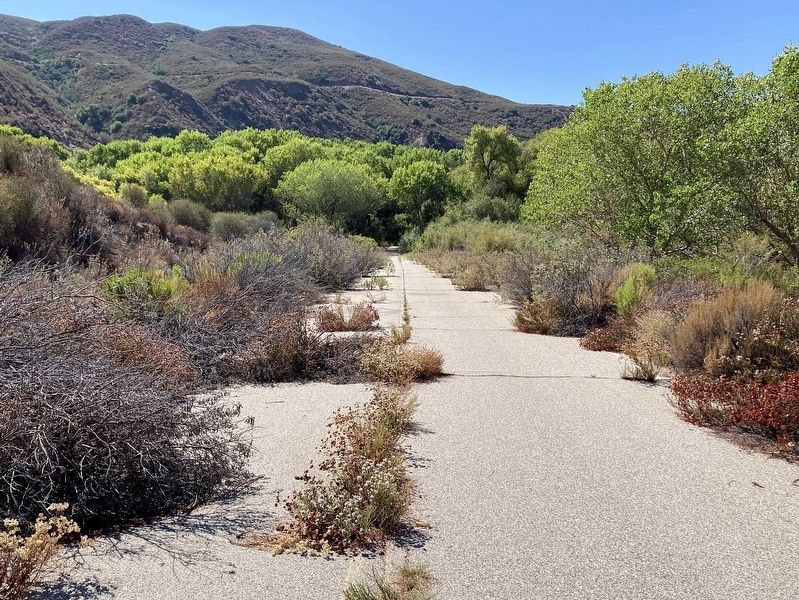
Location. 34° 32.822′ N, 118° 30.868′ W. Marker is near Santa Clarita, California, in Los Angeles County. It is in Angeles National Forest. It can be reached from San Francisquito Canyon Road just north of San Francisquito Motorway, on the right when traveling north. Walk ¼-mile south along the abandoned roadway to the dam site. The trail to the markers is 0.2-mile past the dam site, on the right. Touch for map. Marker is at or near this postal address: 35618 San Francisquito Canyon Rd, Santa Clarita CA 91390, United States of America. Touch for directions.

Regionally, this marker is in Greater Los Angeles and in the Transverse Ranges. It is also on the American Pacific Coast. Globally, it is in North America, on the Ring of Fire, on the Pacific Rim, in the Western Hemisphere, in the Western World, and in the Anglosphere. Historically, it finds itself in what was once
Photographed by Craig Baker, October 1, 2025
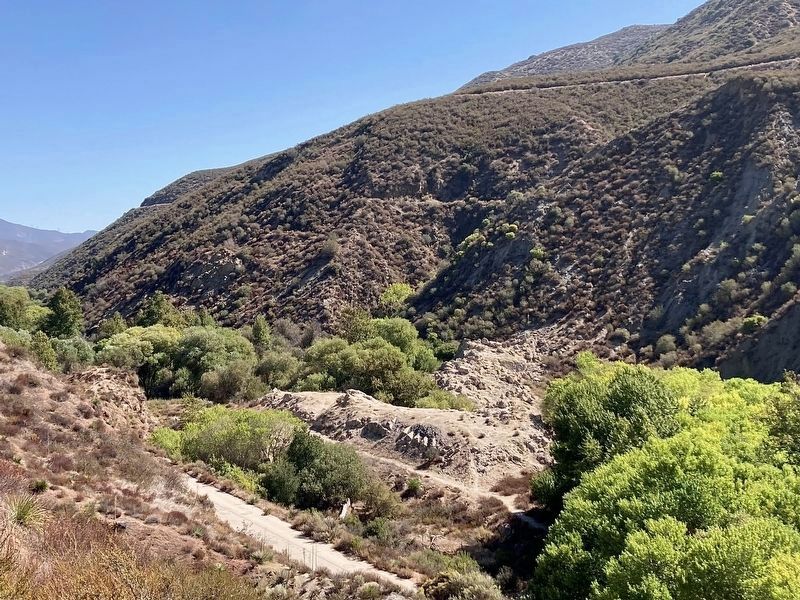
3. Saint Francis Dam Ruins
Near a section of the canyon road that is now abandoned due to repeated storm damage.
Other nearby markers. At least 8 other markers are within one mile of this marker, measured as the crow flies: The Lives That Were Lost (here, next to this marker); Night of the Disaster (here, next to this marker); The Aftermath (here, next to this marker); Construction of the Dam (here, next to this marker); William Mulholland (a few steps from this marker); Water Wars (a few steps from this marker); Before the Dam (a few steps from this marker); a different marker also named St. Francis Dam Disaster Site (approx. one mile away). Touch for a list and map of all markers in Santa Clarita.
Another marker is no longer nearby. St. Francis Dam Disaster Site (was a few steps from this marker but has been confirmed missing).
More about this marker. Plans are underway to build a trail directly from the highway to the markers.
Related markers. Click here for a list of markers that are related to this marker. - Saint Francis Dam Disaster sites.
Photographed by Craig Baker, October 1, 2025
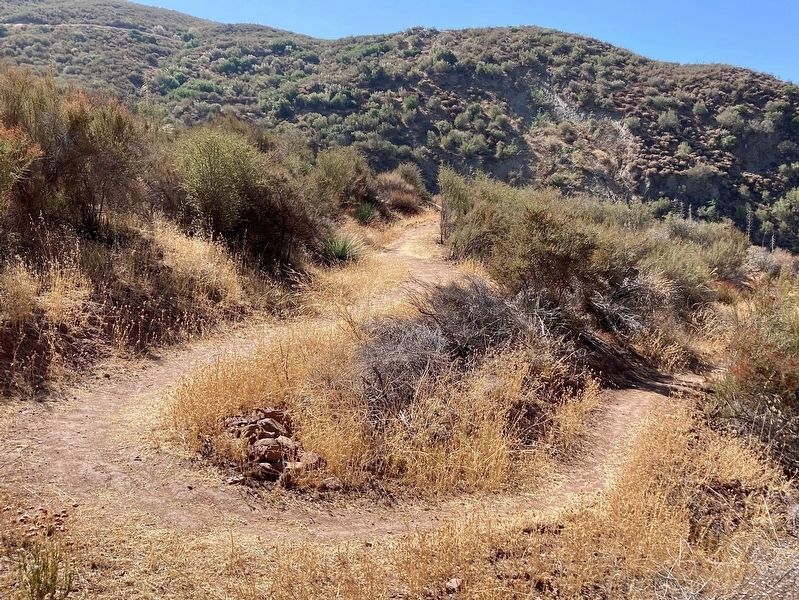
4. Trail to the Marker
The trail begins at the abandoned road south of the dam site.
Photographed by Craig Baker, October 1, 2025
5. Abandoned Road
Along the walk to the Dam site.
Photographed by Craig Baker, October 1, 2025
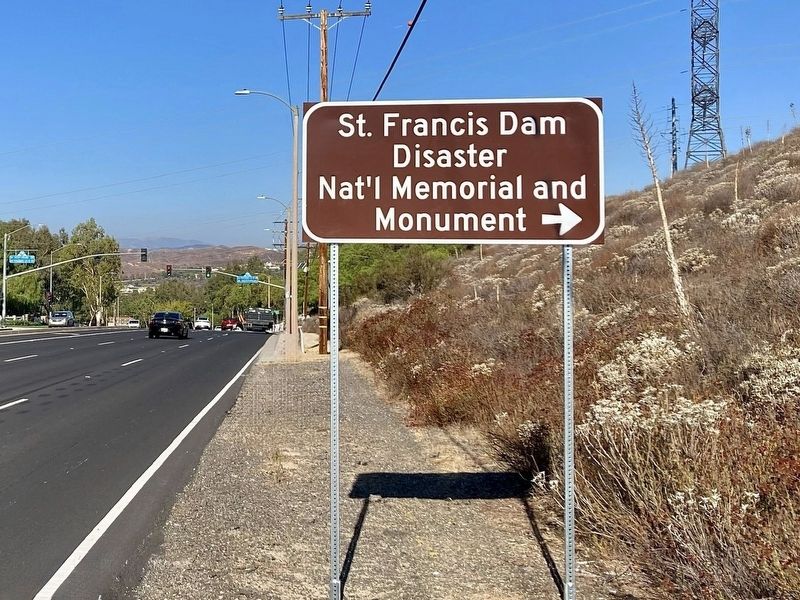
6. Road Sign
On Copper Hill Road at San Francisquito Canyon Road, 7½ miles south of the dam site.
Credits. This page was last revised on October 25, 2025. It was originally submitted on October 2, 2025, by Craig Baker of Sylmar, California. This page has been viewed 80 times since then and 46 times this year. Photos: 1, 2, 3, 4, 5, 6. submitted on October 2, 2025, by Craig Baker of Sylmar, California.
