Petersburg in Dinwiddie County, Virginia — The American South (Mid-Atlantic)
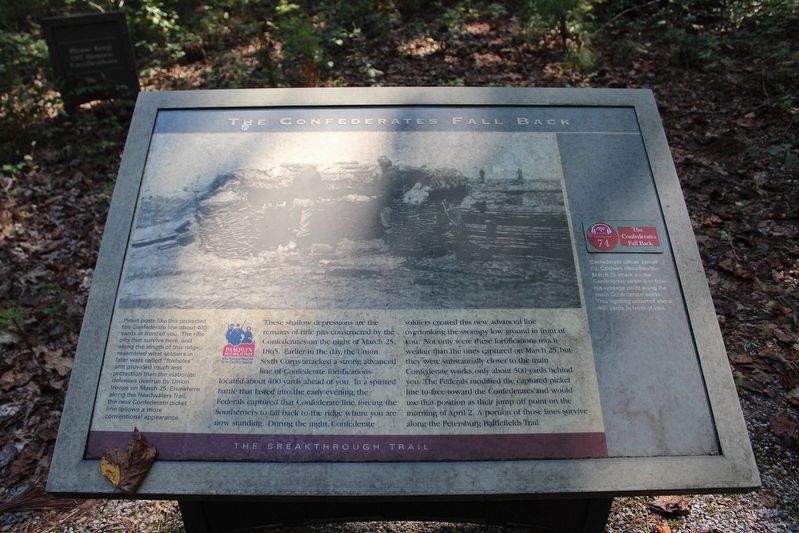
The Confederates Fall Back
| — | The Breakthrough Trail | — |
Photographed by Evan Dwyer, September 21, 2024
1. The Confederates Fall Back Marker
(captions)
Picket posts like this protected the Confederate line about 400 yards in front of you. The rifle pits that survive here, and along the length of this ridge, resembled what soldiers in later wars called "foxholes" and provided much less protection than the elaborate defenses overrun by Union troops on March 25. Elsewhere along the Headwaters Trail, the new Confederate picket line follows a more conventional appearance.
Confederate officer James F.J. Caldwell describes the March 25 attack on the Confederate picket line from his vantage point along the main Confederate works. This fighting occurred about 400 yards in front of you.
Erected by Pamplin
this page online
Topics. This historical marker is listed in this topic list: War, US Civil. A significant historical date for this entry is March 25, 1865.
Location. 37° 10.684′ N, 77° 28.25′ W. Marker is in Petersburg, Virginia, in Dinwiddie County. It can be reached from Duncan Road south of Boydton Plank Road (U.S. 1), on the left when traveling south. Marker is within Pamplin Historical Park on the Main Loop of the Breakthrough Trail. Touch for map. Marker is at or near this postal address: 6125 Boydton Plank Road, Petersburg VA 23803, United States of America. Touch for directions.

Regionally, this marker is in the Piedmont, in Southside Virginia, and specifically in Central Virginia. It is also in the American South and specifically in the Upper South. Globally, it is in North America, the Western Hemisphere, the Western World, and the Anglosphere. Historically, it finds itself in what was once the territory of the Mississippian Culture, one of the original Thirteen Colonies, one of the Confederate States of America, and the Antebellum South.
Other nearby markers. At least 8 other markers are within walking distance of this
Photographed by Evan Dwyer, September 21, 2024
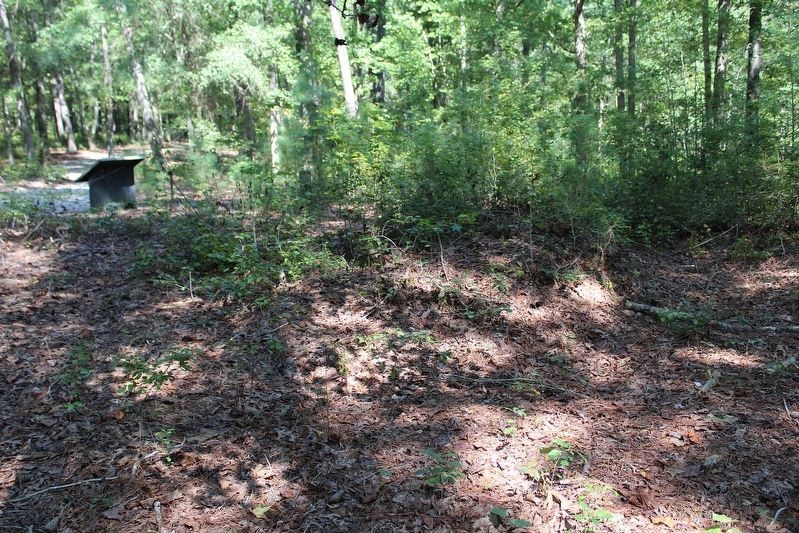
2. The Confederates Fall Back Marker & Picket Post
The slight mound and the depression (filled with green growth) behind it is the most substantial of the rifle pits in the vicinity of the marker. The marker itself is visible at left. This view is approaching the marker, with the trail continuing north beyond it.

Photographed by Evan Dwyer, September 21, 2024
3. Confederate Rifle Pits
These pits, described in the marker, are just west on the trail and have wooden signs denoting the groupings.

Photographed by Evan Dwyer
4. 3D Elevation Imagery of the Area
Imaging from USGS's 3D Elevation Program (3DEP) shows the ground features of this portion of the trail. The white circle is the marker' location. The small, bean-shaped pit just south of it is the picket post shown in the second photograph on this page. The varied dents in the ground shown as pock-marks to the north are the rifle pits mentioned, some of which are shown in the third photograph on this page. The trail's bridge over the swamp is evident - the interrupted, thicker berm to the right of it is a Confederate dam intended to inundate the ground with water as a defensive measure. The curved, winding low ground to the right of center and running right-left at the top of the image is the wet course of Arthur's Swamp. The distinct lines running diagonal at the lower right mark a modern roadbed.
Photographed by Evan Dwyer, December 8, 2024
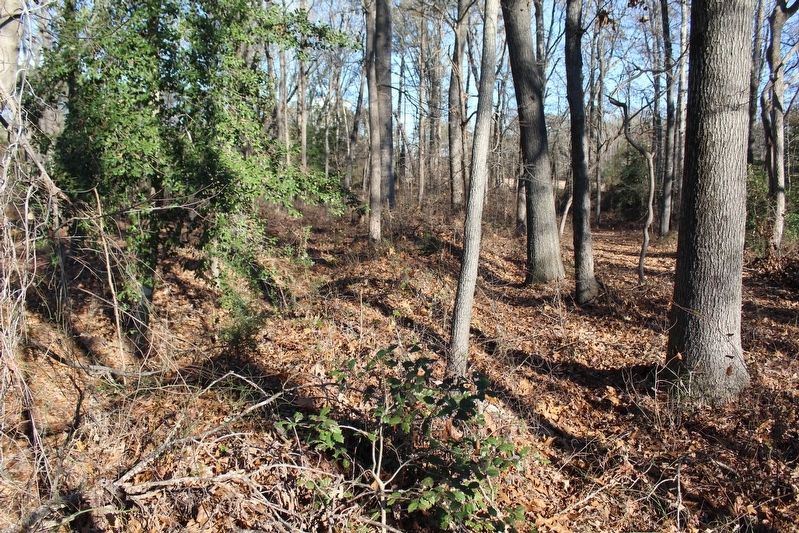
5. Original Confederate Picket Line
This image is the picket line that was captured and repurposed to face the Confederates on 25 March 1865 as described in the marker. Though difficult to discern, these overgrown mounds have defensive trenches on both sides - one side dug by Confederates, the other dug by Federals. This set of earthworks is the portion along the Petersburg Battlefields Trail (outside of Pamplin Historical Park), referenced by the final sentence on the marker. They can be found in the woodlot around 37°10'51.2"N 77°27'42.0"W. Parking to reach them is at the trailhead, 7028 Church Road.
Credits. This page was last revised on October 8, 2025. It was originally submitted on October 2, 2025, by Evan Dwyer of Richmond, Virginia. This page has been viewed 54 times since then and 19 times this year. Photos: 1, 2, 3, 4, 5. submitted on October 2, 2025, by Evan Dwyer of Richmond, Virginia. • Bernard Fisher was the editor who published this page.
