Petersburg in Dinwiddie County, Virginia — The American South (Mid-Atlantic)
The Ravine
| — | The Breakthrough Trail | — |
Photographed by Evan Dwyer, September 21, 2024
1. The Ravine Marker
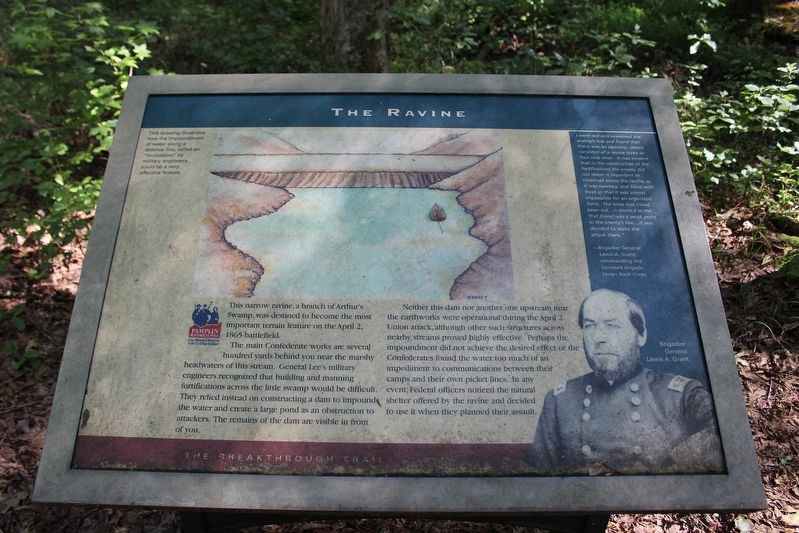
The main Confederate works are several hundred yards behind you near the marshy headwaters of this stream. General Lee's military engineers recognized that building and manning fortifications across the little swamp would be difficult. They relied instead on constructing a dam to impound the water and create a large pond as an obstruction to attackers. The remains of the dam are visible in front of you.
Neither this dam nor another one upstream near the earthworks were operational during the April 2 Union attack, although other such structures across nearby streams proved highly effective. Perhaps the impoundment did not achieve the desired effect or the Confederates found the water too much of an impediment to communications between their camps and their own picket lines. In any event, Federal officers noticed the natural shelter offered by the ravine and decided to use it when they planned their assault.
"I went out and examined the enemy's line and found that there was an opening.... which consisted of a ravine three or four rods wide. It was evident that in the construction of the fortifications the enemy did not deem it important to construct across the ravine, as it was swampy, and filled with trees so that it was almost impassable for an organized force. The trees had [now] been cut.... it seemed to me that [here] was a weak point in the enemy's line.... It was decided to make the attack there."
this page online
(captions)
This drawing illustrates how the impoundment of water along a defense line, called an "inundation" by military engineers, could be a very effective feature.
Brigadier General Lewis A. Grant
Erected by Pamplin Historical Park.
Topics. This historical marker is listed in this topic list: War, US Civil. A significant historical date for this entry is April 2, 1865.
Location. 37° 10.754′ N, 77° 28.264′ W. Marker is in Petersburg, Virginia, in Dinwiddie County. It can be reached from Duncan Road south of Boydton Plank Road (U.S. 1), on the left when traveling south. Marker is within Pamplin Historical Park, on the Main Loop of the Breakthrough Trail. Touch for map. Marker is at or near this postal address: 6125 Boydton Plank Road, Petersburg VA 23803, United States of America. Touch for directions.

Regionally, this marker is in the Piedmont, in Southside Virginia, and specifically in Central Virginia. It is also in the American South and specifically in the Upper South. Globally, it is in North America, the Western Hemisphere, the Western

Photographed by Evan Dwyer, September 21, 2024
2. The Ravine Marker
On the trail bridge across this branch of Arthur's Swamp. The military dam is out of view to the right of the frame.
Other nearby markers. At least 8 other markers are within walking distance of this marker: The Confederates Fall Back (about 400 feet away, measured in a direct line); The Attack Begins (about 500 feet away); The Headwaters Trail (about 600 feet away); The Breakthrough (about 600 feet away); Old Vermont Brigade (about 600 feet away); A Mysterious Historic Feature (about 600 feet away); “A Great Struggle is Now Impending” (about 700 feet away); “A Determination That Knew No Such Word as Fail” (about 700 feet away). Touch for a list and map of all markers in Petersburg.
Photographed by Evan Dwyer, September 21, 2024
3. The Military Dam
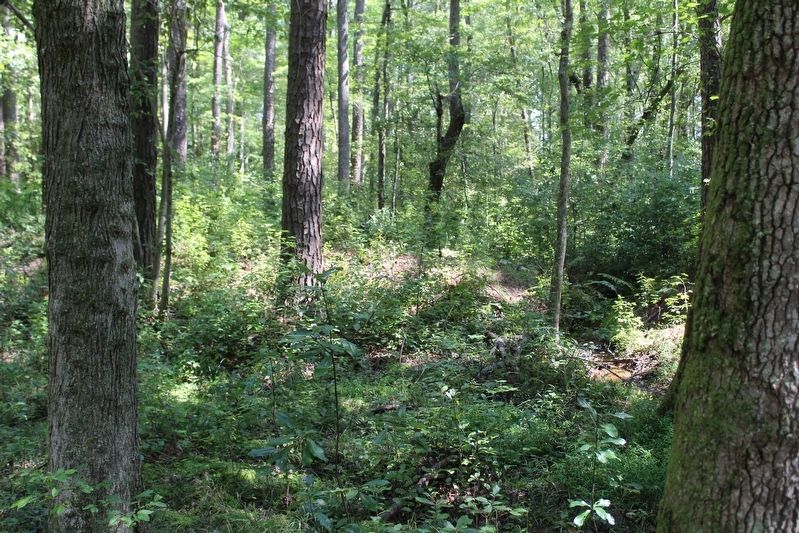
The remains of the dam mentioned in the marker are very difficult to see aside from when the forest growth dies over the winter. This view from Autumn 2024 attempts to show the dam - if the viewer looks at the trickle of the stream at lower right, visible next to the tree that runs the length of the entire right side of the frame, that stream flows through a break in the dam. The northern mound of the dam's remnants is the earthen lump in the photo's center. The stream flows just to its right, and the break is barely visible as a dark spot between two overgrown mounds of dirt.

Photographed by Evan Dwyer
4. 3D Elevation Imagery of the Area
This view from the USGS' 3D Elevation Program (3DEP) shows the swamp, trail bridge, and dam. The white circle is on the trail bridge and represents the marker's position. The thick mound to the right with the gap in the middle is the military dam referenced in the marker. This view also illustrates how the swamp lay lower than the surrounding area, even without introducing elevation curves to the image. As shown in the third photo on this page, the stream itself is usually very small - so the wide, swampy ravine could be exploited by soldiers for cover while they moved towards the Confederate lines, almost like a covered way. The little pock-marked dents on the south bank of the swamp in the 3DEP view are Confederate rifle pits ("foxholes").
Credits. This page was last revised on October 8, 2025. It was originally submitted on October 2, 2025, by Evan Dwyer of Richmond, Virginia. This page has been viewed 60 times since then and 19 times this year. Photos: 1, 2, 3, 4. submitted on October 2, 2025, by Evan Dwyer of Richmond, Virginia. • Bernard Fisher was the editor who published this page.
