Warsaw in Richmond County, Virginia — The American South (Mid-Atlantic)
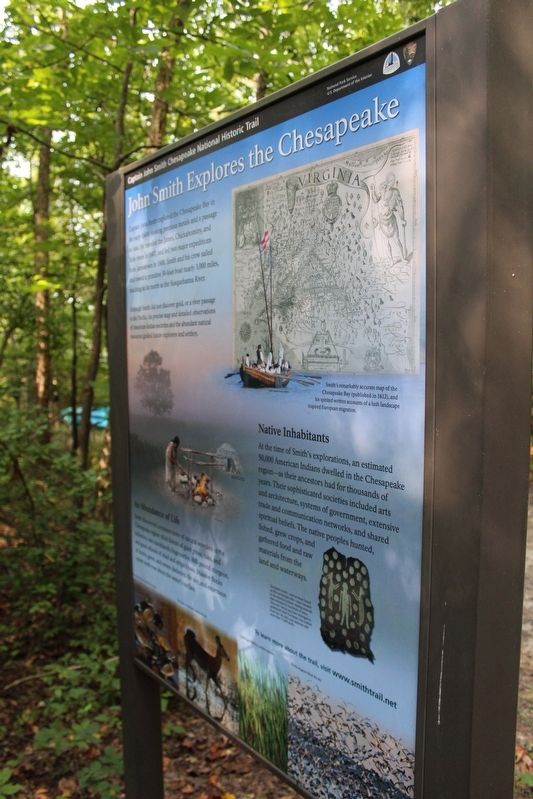
John Smith Explores the Chesapeake
| — | Captain John Smith Explores the Chesapeake Bay | — |
Photographed by Evan Dwyer, September 6, 2025
1. John Smith Explores the Chesapeake Marker
Captain John Smith explored the Chesapeake Bay in the early 1600s seeking precious metals and a passage to Asia. He traveled the James, Chickahominy, and York rivers in 1607, and led two major expeditions from Jamestown in 1608. Smith and his crew sailed and rowed a primitive 30-foot boat nearly 3,000 miles, reaching as far north as the Susquehanna River.
Although Smith did not discover gold, or a river passage to the Pacific, his precise map and detailed observations of American Indian societies and the abundant natural resources guided future explorers and settlers.
An Abundance of Life
Smith discovered a treasure trove of natural wonders in the Chesapeake region: thick forests of giant pines, oaks and hickories; vast marshlands; huge turtles, 800-pound sturgeon, and great schools of shad and striped bass. Massive flocks of ducks, geese, and swans darkened the sky; and enormous oyster reefs rose above the water's surface.
Native Inhabitants
At the time of Smith’s exploration, an estimated 50,000 American Indians dwelled in the Chesapeake region—as their ancestors had for thousands of years. Their sophisticated societies included arts and architecture, systems of government, extensive trade and communication networks, and shared spiritual beliefs. The native peoples hunted, fished, grew crops, and gathered food and raw materials from the land and waterways.
(captions)
(upper right) Smith’s remarkably accurate map of the Chesapeake Bay (published in 1612), and his spirited written accounts of a lush landscape inspired European migration.
(lower right) Decorative shells—such as those found on this ceremonial robe—were valuable in the American Indian's trading network that extended for hundreds of miles. This robe (which may have belonged to paramount chief Powhatan) was crafted from elk skins
this page online
Erected by National Park Service, U.S. Department of the Interior.
Topics. This historical marker is listed in these topic lists: Exploration • Indigenous Peoples and Communities • Settlements & Settlers. A significant historical year for this entry is 1607.
Location. 38° 0.227′ N, 76° 48.353′ W. Marker is in Warsaw, Virginia, in Richmond County. It can be reached from Menokin Road south of Piney Grove Road, on the left when traveling north. Menokin has a main farm lane leading from Menokin Road into the heart of the property, with two roads that branch off from it - one (the first left) goes to the Visitor's Center, while the second road (second left) leads down a steep gravel drive to the kayak launch at the base of the bluffs. This marker is in the small 3-space parking lot at the end of that road. Touch for map. Marker is at or near this postal address: 4037 Menokin Road, Warsaw VA 22572, United States of America. Touch for directions.

Regionally, this marker is on the Northern Neck. It is also in the American South, specifically in the Upper South, in the Tidewater, in the Chesapeake Bay Region, and on the Eastern Seaboard. Globally, it is in the North Atlantic Region, North America, the Western Hemisphere, the Western World, and the Anglosphere. Historically, it finds itself in what was once the territory of the Mississippian Culture, one of the original Thirteen Colonies, one of the Confederate States of America, and the Antebellum South.
Other nearby markers. At least 8 other markers are within 4 miles of this marker, measured as the crow flies: Virginia Indian History at Menokin (here, next to this marker); The Terraces (approx. 0.3 miles away); Outbuildings (approx. 0.4 miles away); The Remembrance Structure (approx. 0.4 miles away); Trees in this Grove (approx. 0.4 miles away); Francis Lightfoot Lee's Menokin (approx. half a mile away); Menokin (approx. one mile away); Nomini Baptist Meetinghouse (approx. 3.7 miles away). Touch for a list and map of all markers in Warsaw.
Another marker is no longer nearby. Exterior Design (was approx. 0.4 miles away but has been confirmed missing).
More about this marker. This is one of a series of identical markers at each stop on the John Smith Chesapeake Bay trail.
Credits. This page was last revised on October 14, 2025. It was originally submitted on October 2, 2025, by Evan Dwyer of Richmond, Virginia. This page has been viewed 65 times since then and 29 times this year. Photo 1. submitted on October 2, 2025, by Evan Dwyer of Richmond, Virginia. • Devry Becker Jones was the editor who published this page.
