Fort Yates in Sioux County, North Dakota — The American Midwest (Upper Plains)
Lakota, Dakota & Dakota People
Photographed by Barry Swackhamer, July 20, 2025
1. Lakota, Dakota & Dakota People Marker
Inscription.
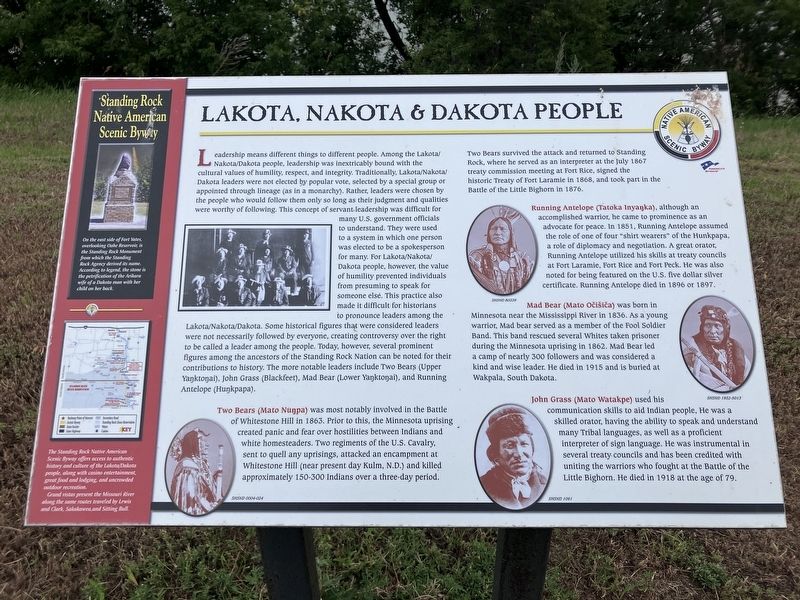
Lakota, Dakota and Dakota People. . Leadership means different things to different people. Among the Lakota/Nakota/Dakota people, leadership was inextricably bound with the cultural values of humility, respect, and integrity. Traditionally, Lakota/Nakota/Dakota leaders were not elected by popular vote, selected by a special group or appointed through lineage (as in a monarchy). Rather leaders were chosen by the people who would follow them only so long as there judgment and qualities were worth of following. The concept of servant leadership was difficult for many U.S, government officials to understand. They were used to a system in which one person was elected to be a spokesperson for many. For Lakota/Nakota/Dakota people, however, the value of humility prevent individuals from presuming to speak for someone else. This practice also made it difficult for historians to pronounce leaders among the Lakota/Nakota/Dakota. Some historical figures that were considered leaders were not necessarily followed by everyone, creating controversy over the right to be called a leader among the people. Today, however, several prominent figures among the ancestors of the Standing Rock Nation can be noted for their contributions to history. The more notable leaders include Two Bears (Upper Yanktonai), John Grass (Blackfeet), Mad Bear (Lower Yanktonai), and Running Antelope (Hunkpapa). , Two Bears (Malo Nunpa) was most notably involved in the Battle of Whitestone Hill in 1863. Prior to this, the Minnesota uprising created panic and fear over hostilities between Indians and white homesteaders. Two regiments of the U.S. Cavalry sent to quell any uprisings, attacked an encampment at Whitestone Hill (near present day Kulm, N.D.) and killed approximately 150-300 Indians over a three-day period. Two Bears survived the attack and returned to Standing Rock, where he served as an interpreter at the July 1867 treaty commission meeting at Fort Rice, signed the historic Treaty of Fort Laramie in 1868, and took part in the Battle of the Little Bighorn in 1876. , Running Antelope (Tatoka Inyanka), although an accomplished warrior, he came to prominence as an advocate for peace. In 1851, Running Antelope assumed the role of one of four "shirt wearers" of the Hunkpapa, a role of diplomacy and negotiation. A great orator, Running Antelope utilized his skills at treaty councils at Fort Laramie, Fort Rice and Fort Peck. He was also noted for being featured on the U.S. five dollar silver certificate. Running Antelope died in 1896 or 1897. , Mad Bear (Mato Očiiča) was born in Minnesota near the Mississippi River in 1836. As a young warrior, Mad Bear served as a member of the Fool Soldier Band. This band rescued several Whites take prisoner during the Minnesota uprising of 1862. Mad Bear led a camp of nearly 300 followers and was considered a kind and wise leader. He died in 1915 and is buried at Wakpala, South Dakota , John Grass (Mato Watakpe) used his communication skills to aid Indian people, He was a skilled orator, having the ability to speak and understand many Tribal languages, as well as a proficient interpreter of sign language. He was instrumental in several treaty councils and has been credited with uniting the warriors who fought at the Battle of Little Bighorn. He died in 1918 at the age of 79.
Leadership means different things to different people. Among the Lakota/Nakota/Dakota people, leadership was inextricably bound with the cultural values of humility, respect, and integrity. Traditionally, Lakota/Nakota/Dakota leaders were not elected by popular vote, selected by a special group or appointed through lineage (as in a monarchy). Rather leaders were chosen by the people who would follow them only so long as there judgment and qualities were worth of following. The concept of servant leadership was difficult for many U.S, government officials to understand. They were used to a system in which one person was elected to be a spokesperson for many. For Lakota/Nakota/Dakota people, however, the value of humility prevent individuals from presuming to speak for someone else. This practice also made it difficult for historians to pronounce leaders among the Lakota/Nakota/Dakota. Some historical figures that were considered leaders were not necessarily followed by everyone, creating controversy over the right to be called a leader among the people. Today, however, several prominent figures among the ancestors of the Standing Rock Nation can be noted for their contributions to history. The more notable leaders include Two Bears (Upper Yanktonai), John Grass (Blackfeet), Mad Bear (Lower Yanktonai), and Running Antelope (Hunkpapa).
Click or scan to see this page online
Two Bears (Malo Nunpa) was most notably involved in the Battle of Whitestone Hill in 1863. Prior to this, the Minnesota uprising created panic and fear over hostilities between Indians and white homesteaders. Two regiments of the U.S. Cavalry sent to quell any uprisings, attacked an encampment at Whitestone Hill (near present day Kulm, N.D.) and killed approximately 150-300 Indians over a three-day period. Two Bears survived the attack and returned to Standing Rock, where he served as an interpreter at the July 1867 treaty commission meeting at Fort Rice, signed the historic Treaty of Fort Laramie in 1868, and took part in the Battle of the Little Bighorn in 1876.
Running Antelope (Tatoka Inyanka), although an accomplished warrior, he came to prominence as an advocate for peace. In 1851, Running Antelope assumed the role of one of four "shirt wearers" of the Hunkpapa, a role of diplomacy and negotiation. A great orator, Running Antelope utilized his skills at treaty councils at Fort Laramie, Fort Rice and Fort Peck. He was also noted for being featured on the U.S. five dollar silver certificate. Running Antelope died in 1896 or 1897.
Mad Bear (Mato Očiiča) was born in Minnesota near the Mississippi River in 1836. As a young warrior, Mad Bear served as a member of the Fool Soldier Band. This band rescued several Whites
Photographed by Barry Swackhamer, July 20, 2025
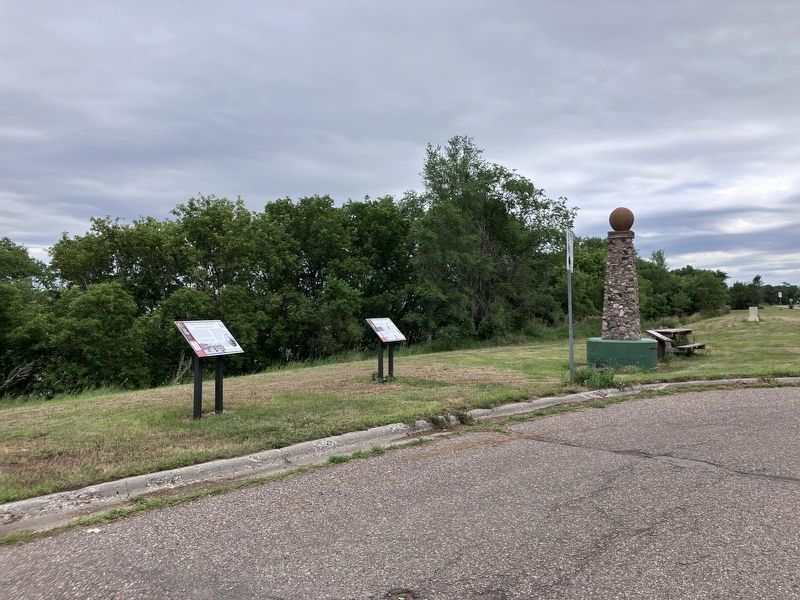
2. Lakota, Dakota & Dakota People Marker, on the right
take prisoner during the Minnesota uprising of 1862. Mad Bear led a camp of nearly 300 followers and was considered a kind and wise leader. He died in 1915 and is buried at Wakpala, South Dakota
John Grass (Mato Watakpe) used his communication skills to aid Indian people, He was a skilled orator, having the ability to speak and understand many Tribal languages, as well as a proficient interpreter of sign language. He was instrumental in several treaty councils and has been credited with uniting the warriors who fought at the Battle of Little Bighorn. He died in 1918 at the age of 79.
Location. 46° 5.604′ N, 100° 37.62′ W. Marker is in Fort Yates, North Dakota, in Sioux County. It is at the intersection of Standing Rock Avenue and Fort Street, on the left when traveling south on Standing Rock Avenue. Touch for map. Marker is in this post office area: Fort Yates ND 58538, United States of America. Touch for directions.

Regionally, this marker is on North Dakota’s Missouri Plateau. It is also in the American Lewis & Clark Corridor, on the prairies, and on the Northern Plains. Globally, it is in North America, the Western Hemisphere, the Western World, and the Anglosphere. Historically, it finds itself in what was once Ruperts Land and also the Louisiana Purchase.
Another marker is no longer nearby. Sitting Bull (was approx. 0.4 miles away but has been permanently removed).
Credits. This page was last revised on October 5, 2025. It was originally submitted on October 5, 2025, by Barry Swackhamer of Brentwood, California. This page has been viewed 71 times since then and 23 times this year. Photos:1, 2. submitted on October 5, 2025, by Barry Swackhamer of Brentwood, California.
