Farmington in Alcorn County, Mississippi — The American South (East South Central)
Slow March From Shiloh
Photographed by Deborah Spencer, October 4, 2025
1. Slow March From Shiloh Marker
—Three weeks after its victory at Shiloh on April 6-7, 1862, the Union army continued its advance on Corinth.
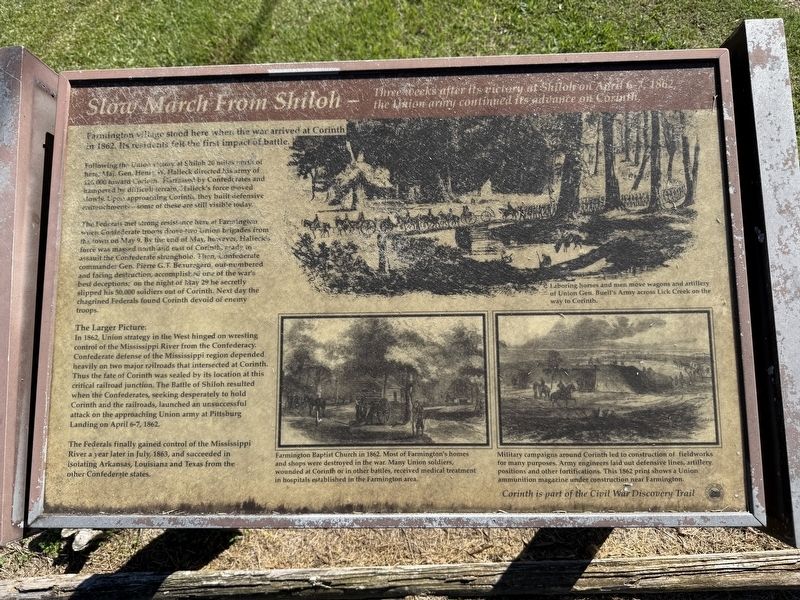
Farmington village stood here when the war arrived at Corinth in 1862. Its residents felt the first impact of battle.
Following the Union victory at Shiloh 20 miles north of here, Maj Gen. Henry W. Halleck directed his army of 126,000 toward Corinth. Harassed by Confederates and hampered by difficult terrain, Halleck's force moved slowly. Upon approaching Corinth, they built defensive entrenchments - some of these are still visible today.
br> The Federals met strong resistance here at Farmington when Confederate troops drove two Union brigades from the town on May 9. By the end of May, however, Halleck's force was massed north and east of Corinth, ready to assault the Confederate stronghold. Then, Confederate commander Gen. Pierre G.T. Beauregard, out-numbered and facing destruction accomplish one of the war's best deceptions; on the night of May 29 he secretly slipped his 50,000 soldiers out of Corinth. Next day the chagrined Federals found Corinth devoid of enemy troops.
The Larger Picture
In 1862,
this page online
The Federals finally gained control of the Mississippi River a year later in July, 1863, and succeeded in isolating Arkansas, Louisiana and Texas from the other Confederate states.
Corinth is part of the Civil War Discovery Trail
(captions)
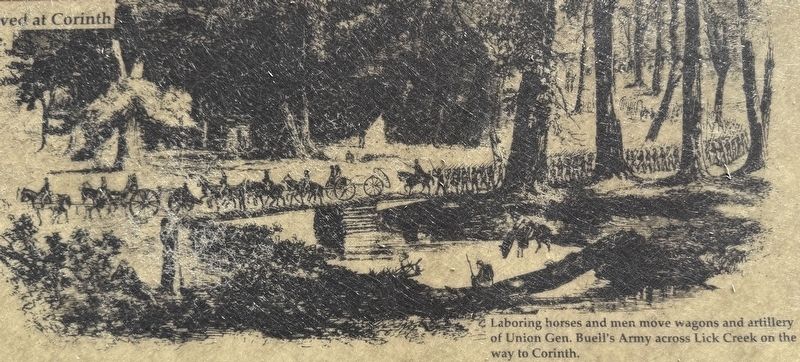
Laboring horses and men move wagons and artillery of Union Gen. Buell's Army across Lick Creek on the way to Corinth.
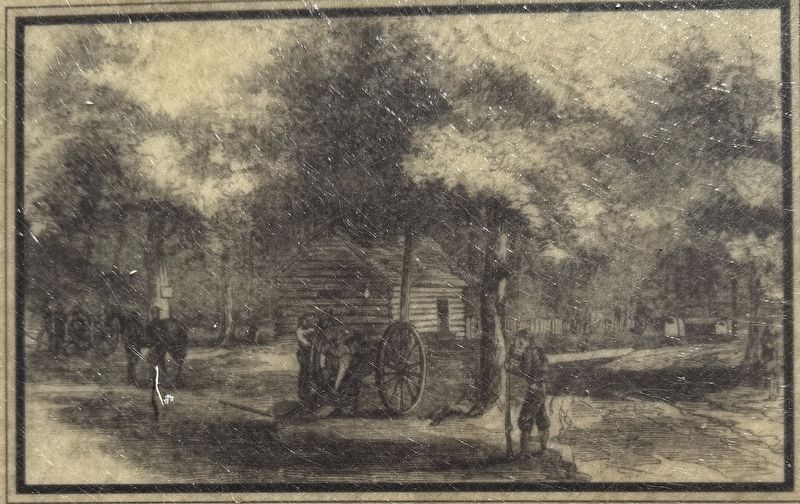
Farmington Baptist Church in 1862. Most of Farmington's homes and shops were destroyed in the war. Many Union soldiers, wounded at Corinth or in other battles, received medical treatment in hospitals established in the Farmington area.
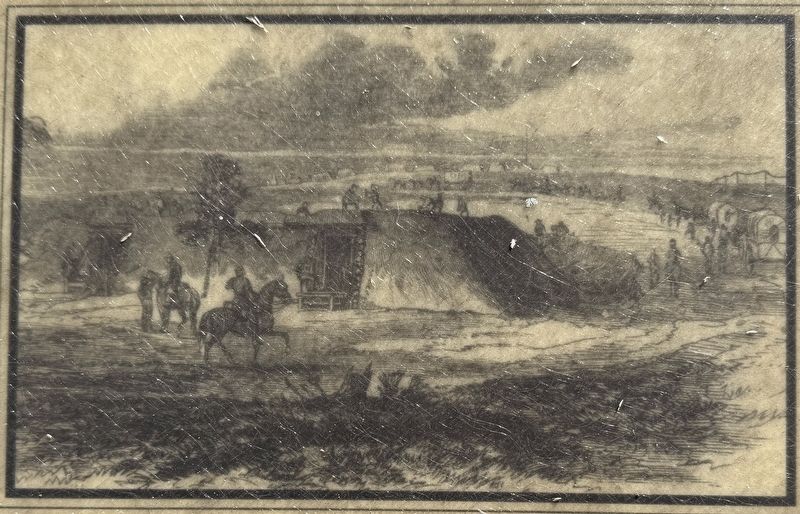
Military campaigns around Corinth led to construction of fieldworks for many purposes. Army engineers laid out defensive lines, artillery positions and other fortifications. This 1862 print shows a Union ammunition magazine under construction near Farmington.
Erected by Civil
Photographed by Deborah Spencer, October 4, 2025
2. Crossing Lick Creek
Laboring horses and men move wagons and artillery
of Union Gen. Buell's Army across Lick Creek on the
way to Corinth
Topics. This historical marker is listed in this topic list: War, US Civil. A significant historical date for this entry is May 9, 1862.
Location. 34° 56.613′ N, 88° 27.399′ W. Marker is in Farmington, Mississippi, in Alcorn County. It is on County Highway 106 0.1 miles south of Kendrick Road, on the left when traveling south. At the entrance to the Farmington Church Cemetery. Touch for map. Marker is in this post office area: Corinth MS 38834, United States of America. Touch for directions.

Regionally, this marker is in andspecifically ast Mississippi in the North Mississippi Hills. It is also in the American South, specifically in the Deep South, in Appalachia, and specifically in Southern Appalachia. Globally, it is in North America, a Gulf of Mexico state, the Western Hemisphere, the Western World, and the Anglosphere. Historically, it finds itself in what was once the territory of the Mississippian Culture, one of the Confederate States of America, and the Antebellum South.
Other nearby markers. At least 8 other markers are within 4 miles of this marker, measured as the crow flies: Farmington Baptist Church
Photographed by Deborah Spencer, October 4, 2025
3. Farmington Baptist Church in 1862.
Most of Farmington's homes
and shops were destroyed in the war. Many Union soldiers,
wounded at Corinth or in other battles, received medical treatment
in hospitals established in the Farmington area.
Photographed by Deborah Spencer, October 4, 2025
4. Union ammunition magazine
Military campaigns around Corinth led to construction of fieldworks
for many purposes. Army engineers laid out defensive lines, artillery
positions and other fortifications. This 1562 print shows a Union
ammunition magazine under construction near Farmington.
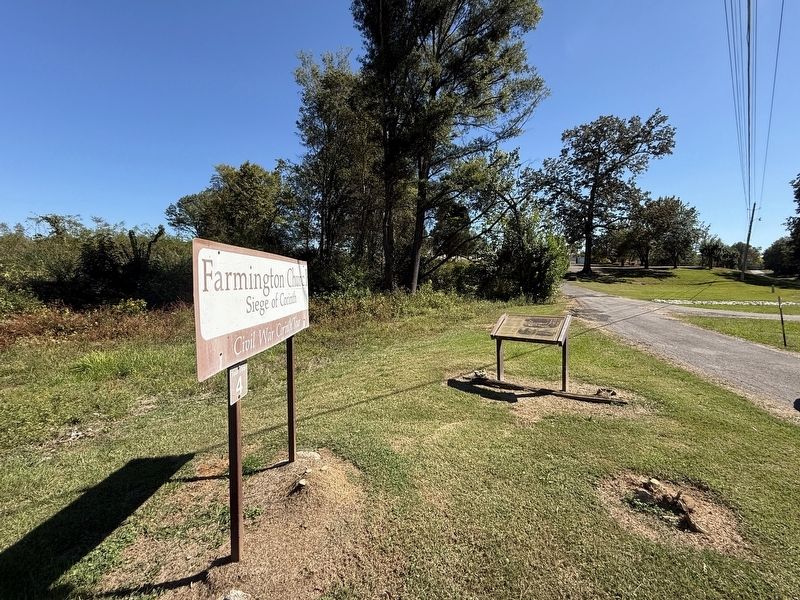
Photographed by Deborah Spencer, October 4, 2025
5. Slow March From Shiloh Marker
Credits. This page was last revised on October 11, 2025. It was originally submitted on October 6, 2025, by Deborah Spencer of Huntsville, Alabama. This page has been viewed 78 times since then and 39 times this year. Photos: 1, 2, 3, 4, 5. submitted on October 6, 2025, by Deborah Spencer of Huntsville, Alabama. • Bernard Fisher was the editor who published this page.
