Harbor Beach in Huron County, Michigan — The American Midwest (Great Lakes)
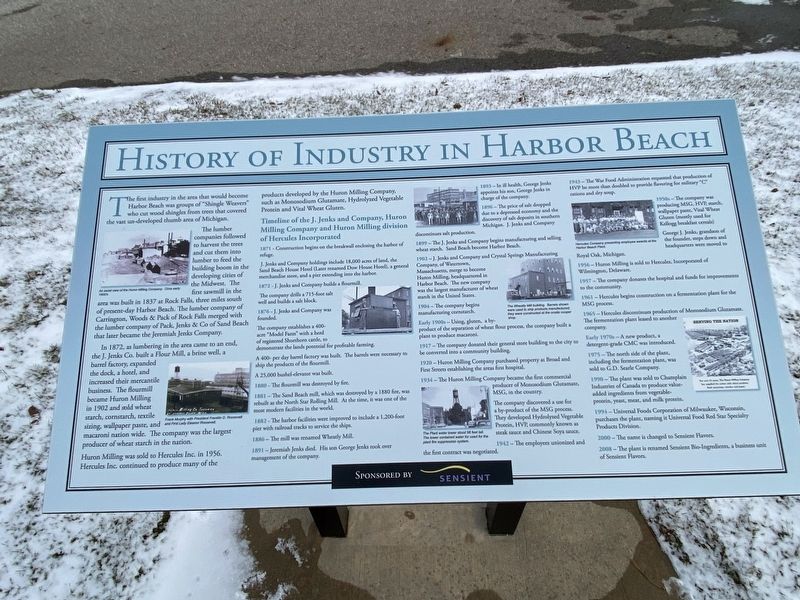
History of Industry in Harbor Beach
Photographed by J.T. Lambrou, December 20, 2022
1. History of Industry in Harbor Beach Marker
The first industry in the area that would become Harbor Beach was groups of "Shingle Weavers" who cut wood shingles from trees that covered the vast undeveloped thumb area of Michigan.
The lumber companies followed to harvest the trees and cut them into lumber to feed the building boom in the developing cities of the Midwest. The first sawmill in the area was built in 1837 at Rock Falls, three miles south of present-day Harbor Beach. The lumber company of Carrington, Woods & Pack of Rock Falls merged with the lumber company of Pack, Jenks & Co of Sand Beach that later became the Jeremiah Jenks Company.
In 1872, as lumbering in the area came to an end, the J. Jenks Co. built a Flour Mill, a brine well, a barrel factory, expanded the dock, a hotel, and increased their mercantile business. The flourmill became Huron Milling in 1902 and sold wheat starch, cornstarch, textile sizing, wallpaper paste, and macaroni nation wide. The company was the largest producer of wheat starch in the nation.
Huron Milling was sold to Hercules Inc. in 1956. Hercules Inc. continued to produce many of the products developed
this page online
Timeline of the J. Jenks and Company, Huron Milling Company and Huron Milling division of Hercules Incorporated
1871 - Construction begins on the breakwall enclosing the harbor of refuge.
J. Jenks and Company holdings include 18,000 acres of land, the Sand Beach House Hotel (later renamed Dow House Hotel), a general merchandise store, and a pier extending into the harbor.
1872 - J. Jenks and Company builds a flourmill.
The company drills a 715-foot salt well and builds a salt block.
1876 - J. Jenks and Company was founded.
The company establishes a 400-acre "Model Farm” with a herd of registered Shorthorn cattle, to demonstrate the lands potential for profitable farming.
A 400- per day barrel factory was built. The barrels were necessary to ship the products of the flourmill.
A 25,000 bushel-elevator was built.
1880 - The flourmill was destroyed by fire.
1881 — The Sand Beach mill, which was destroyed by a 1880 fire, was rebuilt as the North Star Rolling Mill. At the time, itwas one of the most modern facilities in the world.Photographed by J.T. Lambrou, December 20, 20222. History of Industry in Harbor Beach Marker
1882 - The harbor facilities were improved to include a 1,200-foot pier with railroad tracks to service the ships.
1886 — The mill was renamed Wheatly Mill.
1891 — Jeremiah Jenks died. His son George Jenks took over management of the company.
1893 — In ill health, George Jenks appoints his son, George Jenks in charge of the company.
1896 — The price of salt dropped due to a depressed economy and the discovery of salt deposits in southern Michigan. J. Jenks and Company discontinues salt production.
1899 — J. Jenks and Company begins manufacturing and selling wheat starch. Sand Beach become Harbor Beach.
1902 — J. Jenks and Company and Crystal Springs Manufacturing Company, of Watertown, Massachusetts, merge to become Huron Milling, headquartered in Harbor Beach. The new company was the largest manufacturer of wheat starch in the United States.
1904 — The company begins manufacturing cornstarch.
Early 1900s — Using, gluten, a by-product of the separation of wheat flour process, rthe company built a plant to produce macaroni.
1917 — The companydonated their general store building to the city to be converted into a community building.Photographed by J.T. Lambrou, December 20, 20223. PlantThe now named Sensient Flavors factory
1920 — Huron Milling Company purchased property at Broad and First Streets establishing the area’s first hospital.
1934 — The Huron Milling Company became the first commercial producer of Monosodium Glutamate, MSG, in the country.
The company discovered a use for a by-product of the MSG process. They developed Hydrolyzed Vegetable Protein, HVP, commonly known as steak sauce and Chinese Soya sauce.
1942 — The employees unionized and the first contract was negotiated.
1943 — War Food Administration requested that production of HVP be more than doubled to provide flavoring for military “C” rations and dry soup.
1950s — The company was producing MSG, HVP. starch, wallpaper paste, Vital Wheat Gluten (mostly used for Kellogg breakfast cereals)
George Jenks, grandson of the founder, steps down and headquarters were moved to Royal Oak, Michigan.
1956 — Huron Milling is sold to Hercules, Incorporated of Wilmington, Delaware.
1957 — The company donates the hospital and funds for improvements to the community.
1961 — Hercules begins construction on a fermentation plant for the MSG process.
1965 — Hercules discontinues production of Monosodium Glutamate. The fermentation plant leased to another company.
Early 1970 — A new product, a detergent-grade CMC was introduced.
1975 — The north side of the plant, including the fermentation plant, was sold to G.D. Searle Company.
1990 — The plant was sold to Champlain Industries of Canada to produce value-added ingredients from vegetable-protein, yeast, meat, and milk protein.
1994 — Universal Foods Corporation of Milwaukee, Wisconsin, purchases the plant, naming it Universal Food Red Star Specialty Products Division.
2000 — The name is changed to Sensient Flavors.
2008 — The plant is renamed Sensient Bio-Ingredients, a business unit of Sensient Flavors.
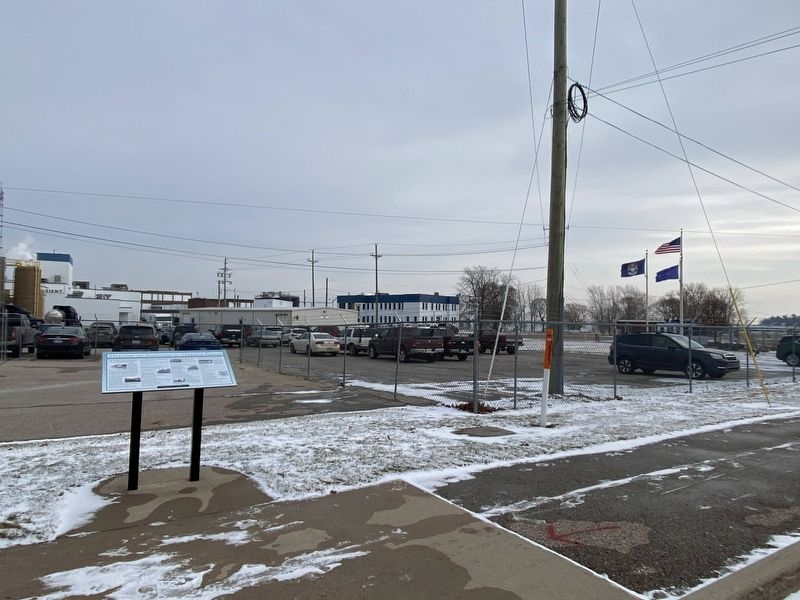
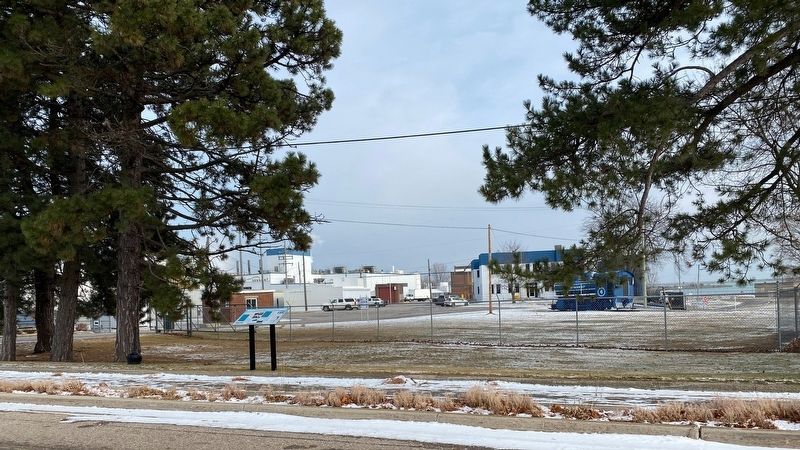
Erected 2020 by Sensient.
Topics. This historical marker is listed in these topic lists: Environment • Industry & Commerce. A significant historical year for this entry is 1837.
Location. 43° 50.709′ N, 82° 39.041′ W. Marker is in Harbor Beach, Michigan, in Huron County. It is at the intersection of Water Street and State Street, on the right when traveling east on Water Street. Touch for map. Marker is at or near this postal address: 79 State Street, Harbor Beach MI 48441, United States of America. Touch for directions.

Regionally, this marker is on Michigan’s Thumb and in one of the Lake Huron Shore counties. It is also in the American Midwest. Globally, it is in North America, on the Great Lakes, in the Western Hemisphere, in the Western World, and in the Anglosphere. Historically, it finds itself in what was once the Northwest Territory.
Other nearby markers. At least 8 other markers are within walking distance of this marker: Harbor Beach Community House (within shouting distance of this marker); Harbor Beach Veterans Memorial (within shouting distance of this marker); Harbor Beach Railroad (about 300 feet away, measured in a direct line); Downtown Harbor Beach (about 300 feet away); Birthplace of Frank Murphy (about 600 feet away); Frank Murphy (about 600 feet away); Harbor Beach Churches (about 600 feet away); The Harbor Beach Lighthouse Lens (about 600 feet away). Touch for a list and map of all markers in Harbor Beach.
Credits. This page was last revised on October 19, 2025. It was originally submitted on January 6, 2023, by J.T. Lambrou of New Boston, Michigan. This page has been viewed 3,509 times since then and 229 times this year. Last updated on October 7, 2025, by Carl Gordon Moore Jr. of North East, Maryland. Photos: 1, 2, 3. submitted on January 6, 2023, by J.T. Lambrou of New Boston, Michigan. • Devry Becker Jones was the editor who published this page.
