Miami Township near Miamisburg in Montgomery County, Ohio — The American Midwest (Great Lakes)
Welcome to The Ginkgo Stage
Photographed by Craig Doda, October 4, 2025
1. Welcome to The Ginkgo Stage Marker
Inscription.
Welcome to The Ginkgo Stage. .
The Ginkgo Stage. This venue is hereby named in recognition of the Ginkgo tree. A symbol of ageless beauty, global connectivity and long life, the Ginkgo represents our goals for one another as individuals and a community.,
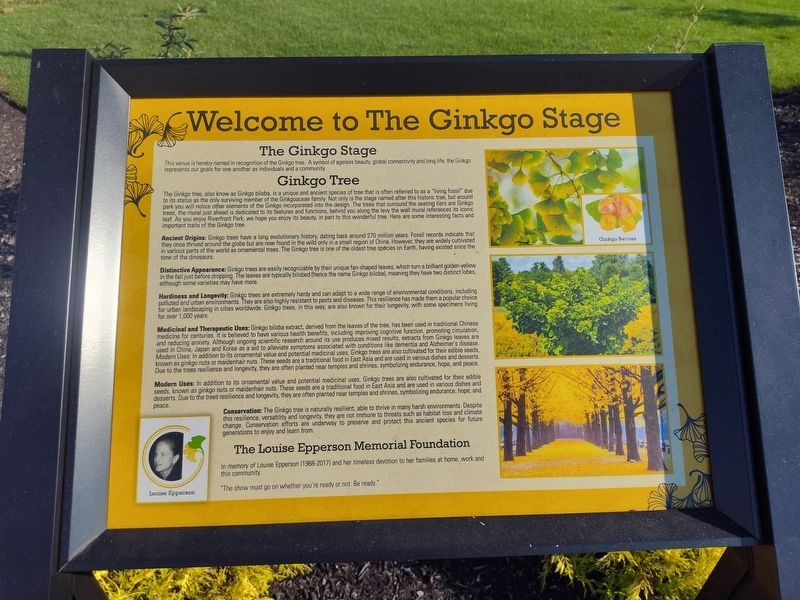
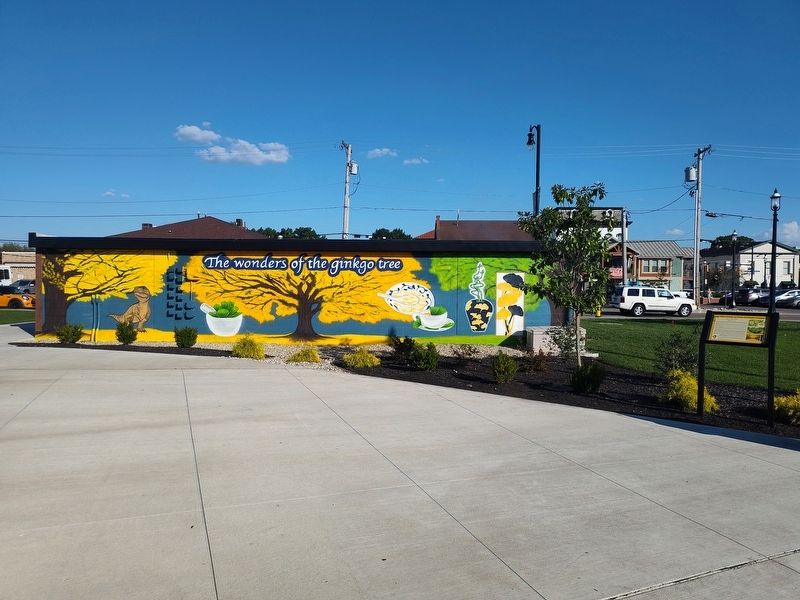
Ginkgo Tree. The Ginkgo tree, also know as Ginkgo biloba, is a unique and ancient species of tree that is often referred to as a "living fossil" due to its status as the only surviving member of the Ginkgoaceae family. Not only is the stage named after this historic tree, but around park you will notice other elements of the Ginkgo incorporated into the design. The trees that surround the seating tiers are Ginkgo trees, the mural just ahead is dedicated to its features and functions, behind you along the levy the wall mural references its iconic leaf. As you enjoy Riverfront Park, we hope you enjoy its beauty, in part to this wonderful tree. Here are some interesting facts and important traits of the Ginkgo tree., Ancient Origins: Ginkgo trees have a long evolutionary history, dating back around 270 million years. Fossil records indicate that they once thrived around the globe but are now found in the wild only in a small region of China. However, they are widely cultivated in various parts of the world as ornamental trees. The Ginkgo tree is one of the oldest tree species on Earth, having existed since the time of the dinosaurs., Distinctive Appearance: Ginkgo trees are easily recognizable by their unique fan-shaped leaves, which turn a brilliant golden-yellow in the fall just before dropping. The leaves are typically bilobed (hence the name Ginkgo biloba), meaning they have two distinct lobes, although some varieties may have more., Hardiness and Longevity: Ginkgo trees are extremely hardy and can adapt to a wide range of environmental conditions, including polluted and urban environments. They are also highly resistant to pests and diseases. This resilience has made them a popular choice for urban landscaping in cities worldwide. Ginkgo trees, in this way, are also known for their longevity, with some specimens living for over 1,000 years., Medicinal and Therapeutic Uses: Ginkgo biloba extract, derived from the leaves of the tree, has been used in traditional Chinese medicine for centuries. It is believed to have various health benefits, including improving cognitive function, promoting circulation, and reducing anxiety. Although ongoing scientific research around its use produces mixed results, extracts from Ginkgo leaves are used in China, Japan and Korea as a aid to alleviate symptoms associated with conditions like dementia and Alzheimer's disease., Modern Uses: In addition to its ornamental value and potential medicinal uses, Ginkgo trees are also cultivated for their edible seeds, known as ginkgo nuts or maidenhair nuts. These seeds are a traditional food in East Asia and are used in various dishes and desserts. Due to the trees resilience and longevity, they are often planted near temples and shrines, symbolizing endurance, hope, and peace., Conservation: The Ginkgo tree is naturally resilient, able to thrive in many harsh environments. Despite this resilience, versatility and longevity, they are not immune to threats such as habitat loss and climate change. Conservation efforts are underway to preserve and protect this ancient species for future generations to enjoy and learn from.,
The Louise Epperson Memorial Foundation. In memory of Louise Epperson (1968-2017) and her timeless devotion to her families at home, work and this community.,
"The show must go on whether you're ready or not. Be ready."
The Ginkgo Stage
This venue is hereby named in recognition of the Ginkgo tree. A symbol of ageless beauty, global connectivity and long life, the Ginkgo represents our goals for one another as individuals and a community.
Ginkgo Tree
The Ginkgo tree, also know as Ginkgo biloba, is a unique and ancient species of tree that is often referred to as a "living fossil" due to its status as the only surviving member of the Ginkgoaceae family. Not only is the stage named after this historic tree, but around park you will notice other elements of the Ginkgo incorporated into the design. The trees that surround the seating tiers are Ginkgo trees, the mural just ahead is dedicated to its features and functions, behind you along the levy the wall mural references its iconic leaf. As you enjoy Riverfront Park, we hope you enjoy its beauty, in part to this wonderful tree. Here are some interesting facts and important traits of the Ginkgo tree.
Ancient Origins: Ginkgo trees have a long evolutionary history, dating back around 270 million years. Fossil records indicate that they once thrived around the globe but are now found in
Click or scan to see this page online
the wild only in a small region of China. However, they are widely cultivated in various parts of the world as ornamental trees. The Ginkgo tree is one of the oldest tree species on Earth, having existed since the time of the dinosaurs.
Distinctive Appearance: Ginkgo trees are easily recognizable by their unique fan-shaped leaves, which turn a brilliant golden-yellow in the fall just before dropping. The leaves are typically bilobed (hence the name Ginkgo biloba), meaning they have two distinct lobes, although some varieties may have more.
Hardiness and Longevity: Ginkgo trees are extremely hardy and can adapt to a wide range of environmental conditions, including polluted and urban environments. They are also highly resistant to pests and diseases. This resilience has made them a popular choice for urban landscaping in cities worldwide. Ginkgo trees, in this way, are also known for their longevity, with some specimens living for over 1,000 years.
Medicinal and Therapeutic Uses: Ginkgo biloba extract, derived from the leaves of the tree, has been used in traditional Chinese medicine for centuries. It is believed to have various
Photographed by Craig Doda, October 4, 2025
2. Welcome to The Ginkgo Stage Marker
health benefits, including improving cognitive function, promoting circulation, and reducing anxiety. Although ongoing scientific research around its use produces mixed results, extracts from Ginkgo leaves are used in China, Japan and Korea as a aid to alleviate symptoms associated with conditions like dementia and Alzheimer's disease.
Modern Uses: In addition to its ornamental value and potential medicinal uses, Ginkgo trees are also cultivated for their edible seeds, known as ginkgo nuts or maidenhair nuts. These seeds are a traditional food in East Asia and are used in various dishes and desserts. Due to the trees resilience and longevity, they are often planted near temples and shrines, symbolizing endurance, hope, and peace.
Conservation: The Ginkgo tree is naturally resilient, able to thrive in many harsh environments. Despite this resilience, versatility and longevity, they are not immune to threats such as habitat loss and climate change. Conservation efforts are underway to preserve and protect this ancient species for future generations to enjoy and learn from.
The Louise Epperson Memorial Foundation
In memory of Louise Epperson (1968-2017) and her timeless devotion to her families at home, work and this community.
"The show must go on whether you're ready or not. Be ready."
Location. 39° 38.548′ N, 84° 17.394′ W. Marker is near Miamisburg, Ohio, in Montgomery County. It is in Miami Township. It is at the intersection of Water Street and West Linden Avenue, on the right when traveling south on Water Street. Touch for map. Marker is at or near this postal address: 16 N Miami St, Miamisburg OH 45342, United States of America. Touch for directions.

Regionally, this marker is in Ohio’s Dayton Metro and in the Miami Valley. It is also in the American Midwest and in the Corn Belt. Globally, it is in North America, the Western Hemisphere, the Western World, and the Anglosphere. Historically, it finds itself in what was once the Haudenosaunee (Iroquois) Confederacy, the territory of the Mississippian Culture, and the Northwest Territory.
Credits. This page was last revised on October 22, 2025. It was originally submitted on October 12, 2025, by Craig Doda of Napoleon, Ohio. This page has been viewed 56 times since then and 15 times this year. Photos:1, 2. submitted on October 12, 2025, by Craig Doda of Napoleon, Ohio. • Devry Becker Jones was the editor who published this page.
