
Durham in Durham County, North Carolina — The American South (South Atlantic)
Durham's Station
The Creek of New Hope
| — | Carolinas Campaign | — |
Photographed by Mike McKeown, October 12, 2025
1. Durham's Station Marker
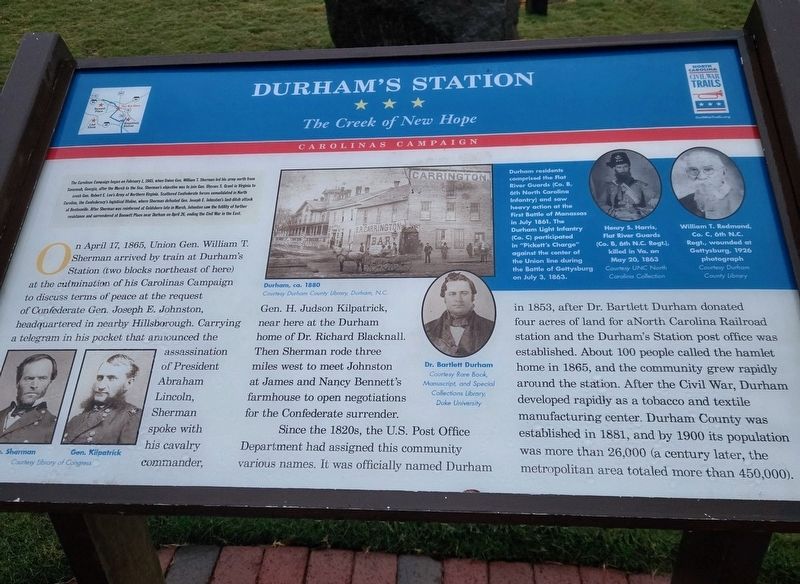
On April 17, 1865, Union Gen. William T. Sherman arrived by train at Durham's Station (two blocks northeast of here) at the culmination of his Carolinas Campaign to discuss terms of peace at the request of Confederate Gen. Joseph E. Johnston, headquartered in nearby Hillsborough. Carrying a telegram in his pocket that announced the assassination of President Abraham Lincoln, Sherman spoke with his cavalry commander, Gen. H. Judson Kilpatrick, near here at the Durham
this page online
Since the 1820s, the U.S. Post Office Department had assigned this community various names. It was officially named Durham in 1853, after Dr. Bartlett Durham donated four acres of land fora North Carolina Railroad station and the Durham's Station post office was established. About 100 people called the hamlet home in 1865, and the community grew rapidly around the station. After the Civil War, Durham developed rapidly as a tobacco and textile manufacturing center. Durham County was established in 1881, and by 1900 its population was more than 26,000 (a century later, the metropolitan area totaled more than 450,000).
(captions)
Gen. Sherman • Gen. Kilpatrick Courtesy Library of Congress
Durham, ca. 1880 Courtesy Durham County Library, Durham, N.C.
Dr. Bartlett Durham Courtesy Rare Book, Manuscript, and Special Collections Library, Duke University
Durham residents comprised the Flat River Guards (Co. B, 6th North Carolina Infantry) and saw heavy action at the First Battle of Manassas in July 1861. The Durham Light Infantry (Co. C) participated in "Pickett's Charge" against the center of the Union line during the Battle of Gettysburg on July 3, 1863.
Henry S. Harris, Flat River Guards (Co. B, 6th N.C. Regt), killed in Va. on May 20, 1863 Courtesy UNC North Carolina Collection
William T. Redmond, Co. C, 6th N.C. Regt., wounded at Gettysburg, 1926 photograph Courtesy Durham County Library
Erected by North
Photographed by Mike McKeown, October 12, 2025
2. Durham's Station Marker
Topics and series. This historical marker is listed in these topic lists: Railroads & Streetcars • War, US Civil. In addition, it is included in the North Carolina Civil War Trails series list. A significant historical date for this entry is April 17, 1865.
Location. 35° 59.605′ N, 78° 54.22′ W. Marker is in Durham, North Carolina, in Durham County. It is on Blackwell Street north of Jackie Robinson Drive, on the right when traveling north. Marker is located in Diamond View Park, near Durham Bulls Athletic Park and Durham Performing Arts Center. Touch for map. Marker is at or near this postal address: 315 Blackwell St, Durham NC 27701, United States of America. Touch for directions.

Regionally, this marker is in North Carolina’s Piedmont and in the Research Triangle. It is also in the American South and specifically in the Upper South. Globally, it is in North America, the Western Hemisphere, the Western World, and the Anglosphere. Historically, it finds itself in what was once the territory of the Mississippian Culture, one of the original Thirteen Colonies, one of the Confederate States of America, and the Antebellum South.
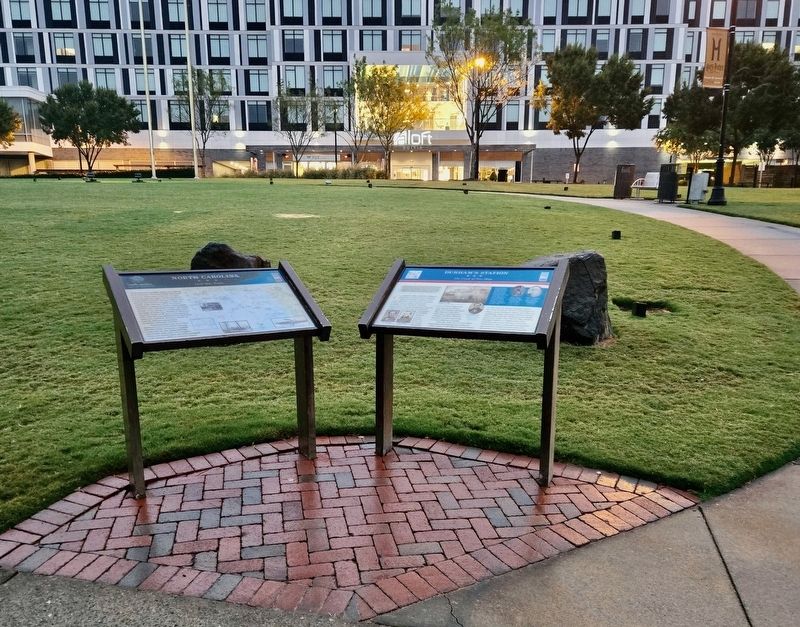
Other nearby markers. At least 8 other markers are within walking distance of this marker: North Carolina (here, next to this marker); Emanuel J. Evans, 1907-1997, and Sara N. Evans, 1905-1986 (approx. 0.2 miles away); Five Points Loan Company (approx. ¼ mile away); Visionary Leadership in the New South (approx. ¼ mile away); Financial and Professional Impact in Durham (approx. ¼ mile away); A Black Capital for the World to See (approx. ¼ mile away); North Carolina Mutual Life Insurance Co. / Mechanics and Farmers Bank (approx. ¼ mile away); Black Wall Street (approx. ¼ mile away). Touch for a list and map of all markers in Durham.
Another marker is no longer nearby. Durham's Station (has been replaced with this marker).
Related marker. Click here for another marker that is related to this marker. Old CWT Marker At This Location also titled "Durham's Station"".
Credits. This page was last revised on October 15, 2025. It was originally submitted on October 13, 2025, by Mike McKeown of Baltimore, Maryland. This page has been viewed 97 times since then and 39 times this year. Photos: 1, 2. submitted on October 13, 2025, by Mike McKeown of Baltimore, Maryland. • Bernard Fisher was the editor who published this page.
