Omaha in Douglas County, Nebraska — The American Midwest (Upper Plains)
Profitable Possibilities
Photographed by Barry Swackhamer, July 15, 2025
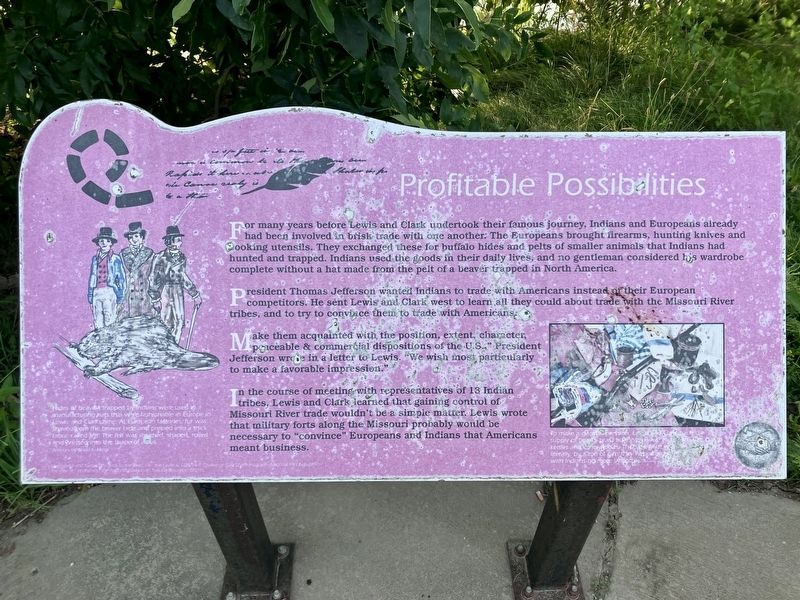
1. Profitable Possibilities Marker
Captions: (bottom left) Hides of beaver trapped by Indians were used in manufacturing hats that were fashionable in Europe in Lewis and Clark's time. At European factories, fur was shaved from the beaver hide and pressed into a thick fabric called felt. The felt was steamed, shaped, rolled and pressed into the shape of a hat.; (bottom right) Too damaged to transcribe .
Inscription.
Profitable Possibilities. . For many years before Lewis and Clark undertook their famous journey, Indians and Europeans already had been involved in brisk trade with one another. The Europeans brought firearms, hunting knives and cooking utensils. They exchanged these for buffalo hides and pelts of smaller animals that Indians had hunted and trapped. Indians used the goods in their daily lives, and no gentleman considered his wardrobe complete without a hat made from the pelt of a beaver trapped in North America. President Thomas Jefferson wanted Indians to trade with Americans instead of their European competitors. He sent Lewis and Clark west to learn all they could about trade with the Missouri River tribes, and try to convince them to trade with Americans. "Make them aquatinted with the position, extent, character, peaceable and commercial dispositions of the U.S.," President Jefferson wrote in a letter to Lewis. "We wish most particularly to make a favorable impression." In the course of meeting with representatives of 13 Indian tribes, Lewis and Clark learned that gaining control of Missouri River trade wouldn't be a simple mater. Lewis wrote that military forts along the Missouri probably would be necessary to "convince" European and Indians that Americans meant business.
For many years before Lewis and Clark undertook their famous journey, Indians and Europeans already had been involved in brisk trade with one another. The Europeans brought firearms, hunting knives and cooking utensils. They exchanged these for buffalo hides and pelts of smaller animals that Indians had
hunted and trapped. Indians used the goods in their daily lives, and no gentleman considered his wardrobe complete without a hat made from the pelt of a beaver trapped in North America.
President Thomas Jefferson wanted Indians to trade with Americans instead of their European competitors. He sent Lewis and Clark west to learn all they could about trade with the Missouri River tribes, and try to convince them to trade with Americans.
"Make them aquatinted with the position, extent, character, peaceable & commercial dispositions of the U.S.," President Jefferson wrote in a letter to Lewis. "We wish most particularly to make a favorable impression."
In the course of meeting with representatives of 13 Indian tribes, Lewis and Clark learned that gaining control of Missouri River trade wouldn't be a simple mater. Lewis
Click or scan to see this page online
wrote that military forts along the Missouri probably would be
necessary to "convince" European and Indians that Americans meant business.
Erected by National Park Service, City of Omaha, Papio-Missouri River Natural Resources District.
Location. 41° 17.541′ N, 95° 54.178′ W. Marker is in Omaha, Nebraska, in Douglas County. It is on Abbott Drive near East Locust Street. The marker is on the footpath beside Carter Lake. Touch for map. Marker is at or near this postal address: 4501 Abbott Drive, Omaha NE 68110, United States of America. Touch for directions.

Regionally, this marker is in Eastern Nebraska. It is also in the American Midwest, in the Lewis & Clark Corridor, in the Corn Belt, and on the prairies. Globally, it is in North America, the Western Hemisphere, the Western World, and the Anglosphere. Historically, it finds itself in what was once the Louisiana Purchase.
Other nearby markers. At least 8 other markers are
Photographed by Barry Swackhamer, July 15, 2025
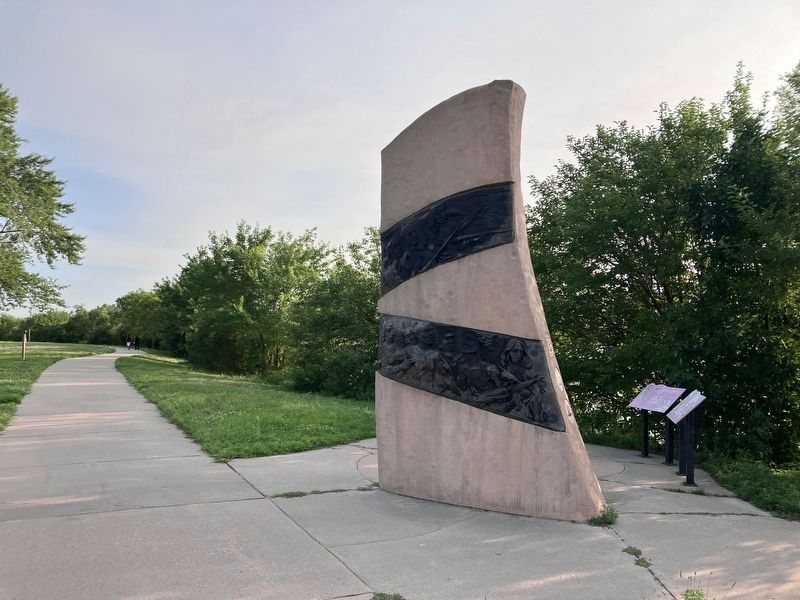
2. Profitable Possibilities Marker, behind the York Monument
Credits. This page was last revised on October 15, 2025. It was originally submitted on October 14, 2025, by Barry Swackhamer of Brentwood, California. This page has been viewed 57 times since then and 23 times this year. Photos:1, 2. submitted on October 14, 2025, by Barry Swackhamer of Brentwood, California.
