Regierungsvierte in Berlin in Mitte, Germany — Northeast German Plain (The European Plain)
Kampf gegen das 2. Königs-Regiment
⎯⎯⎯
Fight against the 2nd King's Regiment
Photographed by Andrew Ruppenstein, August 27, 2025
1. Kampf gegen das 2. Königs-Regiment / Fight against the 2nd King's Regiment Marker

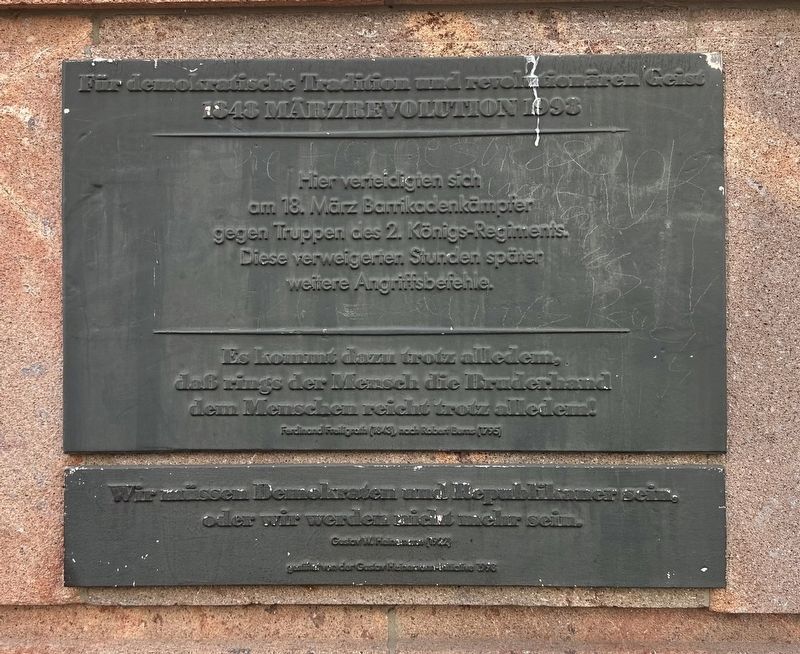
1848 März Revolution 1998
Hier verteidigten sich am 18. März Barrikadenkämpfer gegen Truppen des 2. Königs-Regiments. Diese verweigerten Stunden später weitere Angriffsbefehle.
Es kommt dazu trotz alledem, daß rings der Mensch die Bruderhand dem Menschen reicht trotz alledem!
Ferdinand Freiligrath (1849), nach Robert Burns (1795)
Wir müssen Demokraten und Republikaner sein, oder wir werden nicht mehr sein.
Gustav W. Heinemann (1922)
1848 March Revolution 1998
On March 18, barricade fighters defended themselves here against troops of the 2nd King's Regiment. Hours later, the troops refused further orders to attack.
Despite everything, it comes to this: people extend a brotherly hand to one another, despite everything!
Ferdinand Freiligrath (1849), after Robert Burns (1795)
We must be democrats and republicans, or we will cease to exist.
Gustav W. Heinemann (1922)
Erected 1998 by Gustav Heinemann-Initiative.
Topics. This historical marker is listed in this topic list: Wars, Non-US. A significant historical date for this entry is March 18, 1848.
Location. 52° 30.774′ N,
this page online

Regionally, it is in Europe, the European Union, Atlantic Europe, Central Europe, the Schengen Area, Western Europe, and the Western World. Historically, it finds itself in what was once the Holy Roman Empire, the former East Germany, and at the Berlin Wall.
Other nearby markers. At least 8 other markers are within walking distance of this marker: Franz Berwald (here, next to this marker); Russisches Haus in Berlin / Russian House in Berlin (a few steps from this marker); Deutscher Leichtathletik Verband / German Athletics Association (within shouting distance of this marker); Haus der Demokratie / House of Democracy (approx. 0.3 kilometers away); Leonhard Euler (approx. 0.3 kilometers away); Carl Gotthard Langhans (approx. 0.3 kilometers away); Die Berliner Mauer - The Berlin Wall (approx. 0.3
Photographed by Andrew Ruppenstein, August 27, 2025
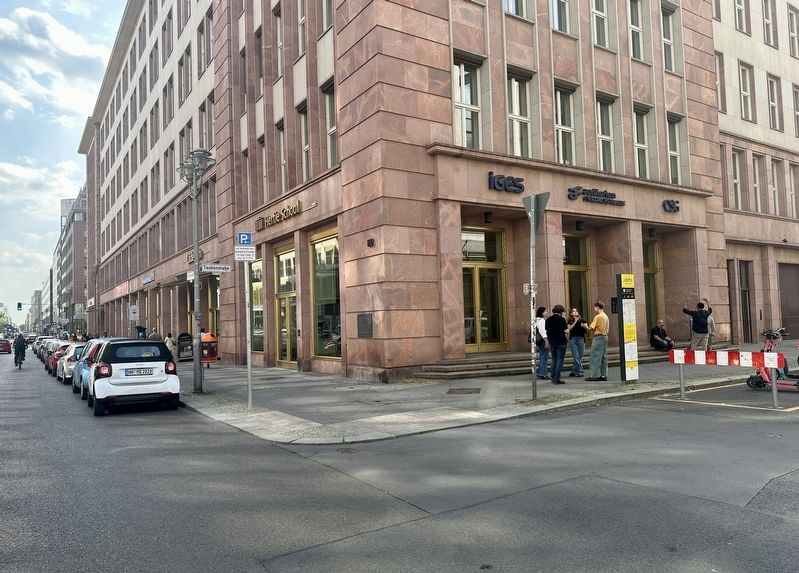
2. Fight against the 2nd King's Regiment Marker - wide view
The marker is visible here on the corner of the building.
More about this marker. This is one of at least a dozen historical markers installed in 1998 in Berlin‘s Mitte district marking sites of importance in the March Revolution.
Also see . . .
1. The Barricades at Kronen- and Friedrichsstrasse… (German History in Documents and Images). Full title: The Barricades at Kronen- and Friedrichsstrasse (in Berlin) on March 18, 1848, as Seen by an Eyewitness (1848).
Extract from abstract:
On March 18, 1848, it seemed as though the Prussian monarch, King Friedrich Wilhelm IV (1795–1861), would concede to popular demands for the withdrawal of Prussian troops called to Berlin to suppress revolutionary unrest, the convening of another United Landtag (state parliament), and the passing of a constitution. However, as citizens gathered in front of his Berlin palace to thank him, disputes once again erupted between the military and the crowd. The king ordered the army to clear the square. The soldiers fired, killing several people, and street fighting broke out.… In response to the uprising, the Prussian king agreed to withdraw his troops and appointed a liberal cabinet. For the time being, the revolution had triumphed in Prussia, too.(Submitted on October 16, 2025.)
2. German revolutions of 1848–1849 (Wikipedia). Extract:
The German revolutions of 1848–1849 (German: Deutsche Revolution 1848/1849), the opening phase of which was also called the March Revolution (German: Märzrevolution), were initially part of the Revolutions of 1848 that broke out in many European countries. They were a series of loosely coordinated protests and rebellions in the states of the German Confederation, including the Austrian Empire.… The middle-class elements were committed to liberal principles, while the working class sought radical improvements to their working and living conditions. As the middle- and working-class components of the Revolution split, the conservative aristocracy defeated it. Liberals were forced into exile to escape political persecution, where they became known as Forty-Eighters. Many emigrated to the United States, settling from Wisconsin to Texas.(Submitted on October 16, 2025.)
Credits. This page was last revised on October 16, 2025. It was originally submitted on October 16, 2025, by Andrew Ruppenstein of Lamorinda, California. This page has been viewed 53 times since then and 19 times this year. Photos: 1, 2. submitted on October 16, 2025, by Andrew Ruppenstein of Lamorinda, California.
