Chatfield in Fillmore County, Minnesota — The American Midwest (Upper Plains)
Chatfield's Civic Geometry
Photographed by McGhiever, October 4, 2025
1. Chatfield's Civic Geometry Marker
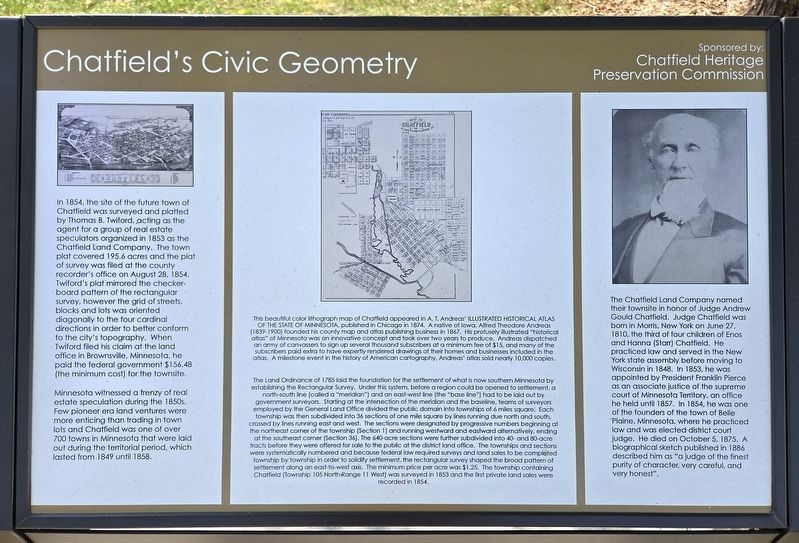
In 1854, the site of the future town of Chatfield was surveyed and platted by Thomas B. Twiford, acting as the agent for a group of real estate speculators organized in 1853 as the Chatfield Land Company. The town plat covered 195.6 acres and the plat of survey was filed at the county recorder's office on August 28, 1854. Twiford's plat mirrored the checkerboard pattern of the rectangular survey, however the grid of streets, blocks and lots was oriented diagonally to the four cardinal directions in order to better conform to the city's topography. When Twiford filed his claim at the land office in Brownsville, Minnesota, he paid the federal government $156.48 (the minimum cost) for the townsite.
Minnesota witnessed a frenzy of real estate speculation during the 1850s. Few pioneer era land ventures were more enticing than trading in town lots and Chatfield was one of over 700 towns in Minnesota that were laid out during the territorial period, which lasted from 1849 until 1858.
This beautiful color lithograph map of Chatfield appeared in A.T. Andreas' ILLUSTRATED HISTORICAL ATLAS OF THE STATE OF MINNESOTA, published
this page online
The Land Ordinance of 1785 laid the foundation for the settlement of what is now southern Minnesota by establishing the Rectangular Survey. Under this system, before a region could be opened to settlement, a north-south line (called a "meridian") and an east-west line (the "base line") had to be laid out by government surveyors. Starting at the intersection of the meridian and the baseline, teams of surveyors employed by the General Land Office divided the public domain into townships of 6 miles square. Each township was then subdivided into 36 sections
Photographed by McGhiever, October 4, 2025
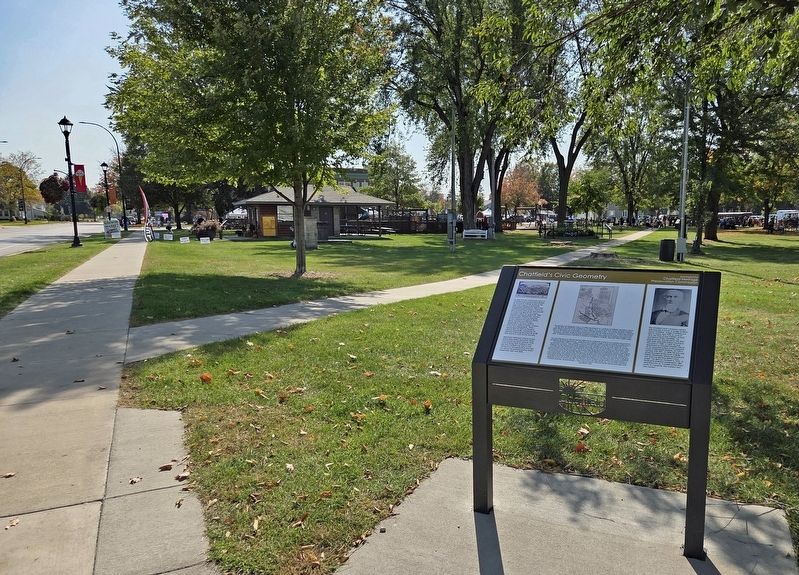
2. Chatfield's Civic Geometry Marker at the north corner of City Park
The Chatfield Land Company named their townsite in honor of Judge Andrew Gould Chatfield. Judge Chatfield was born in Morris, New York on June 27, 1810, the third of four children of Enos and Hanna (Starr) Chatfield. He practiced law and served in the New York state assembly before moving to Wisconsin in 1848. In 1853, he was appointed by President Franklin Pierce as an associate justice of the supreme court of Minnesota Territory, an office he held until 1857. In 1854, he was one of the founders of the town of Belle Plaine, Minnesota, where he practiced law and was elected district court judge. He died on October 5, 1875. A biographical sketch published in 1886 described him as "a judge of the finest purity of character, very careful, and very honest".
Erected by Chatfield Heritage Preservation Commission.
Topics. This historical marker is listed in these topic lists: Law Enforcement • Settlements & Settlers. A significant historical year for this entry is 1854.
Location. 43° 50.68′ N, 92° 11.284′ W. Marker is in Chatfield, Minnesota, in Fillmore County. It is at the intersection of Main Street S. (U.S. 52) and 3rd Street SW on Main Street S.. The marker is at the north corner of Chatfield's City Park. Touch for map. Marker is at or near this postal address: 305 Main Street S, Chatfield MN 55923, United States of America. Touch for directions.

Regionally, this marker is in Southeast Minnesota and in Greater Rochester. It is also in the American Midwest, in the Corn Belt, and in the Driftless Area — Bluff Country. Globally, it is in North America, the Western Hemisphere, the Western World, and the Anglosphere. Historically, it finds itself in what was once Rupert’s Land, the territory of the Mississippian Culture, and the Louisiana Purchase.
Other nearby markers. At least 8 other markers are within walking distance of this marker: Main Street—From Wilderness Trail to Modern Highway (within shouting distance of this marker); Chatfield (within shouting distance of this marker); Chatfield's Historic Carnegie Library (within shouting distance of this marker); Chatfield Loses County Courthouse, Gains Its First Municipal Park (within shouting distance of this marker); Chatfield's Legacy of Community Music (within shouting distance of this marker); Chatfield's Public Education Legacy (about 400 feet away, measured in a direct line); Chatfield High School (1916-1959) (about 500 feet away); The New Deal Comes to Chatfield (about 600 feet away). Touch for a list and map of all markers in Chatfield.
Credits. This page was last revised on October 17, 2025. It was originally submitted on October 17, 2025, by McGhiever of Minneapolis, Minnesota. This page has been viewed 70 times since then and 29 times this year. Photos: 1, 2. submitted on October 17, 2025, by McGhiever of Minneapolis, Minnesota.
