
Farmington in Franklin County, Maine — The American Northeast (New England)
John Frank Stevens

Photographed by Conrad Ward, October 5, 2025
1. John Frank Stevens Plaque
1853-1943
He changed the face of the Earth
This memorial is dedicated to a quiet and impressive man whose early years of study and discipline were spent on this campus.
John Frank Stevens was born on a humble farm in West Gardiner, the son of Harriet Leslie French and John Smith Stevens received free tuition and was graduated from Farmington Normal School in 1872.
He went west, learning to sleep under wet skies on open plains while gathering practical engineering experience. For the Canadian Pacific Railroad he bridged and blasted highways through unknown territory. He became chief engineer for the unsubsidized transcontinental railroad through the Rocky Mountains. Alone and in bitter cold when his Indian guide could go no further, Stevens discovered Marias Pass, where an heroic statue of him was erected by the Great Northern Railroad for engineering this key passage across the Continental Divide.
Stevens was named chief engineer of the Panama Canal Commission in 1905 by U.S. Secretary of War William Howard Taft. There he reinvigorated a demoralized work force
this page online
After World War I, Stevens was decorated by five nations for heading President Wilson’s effort to reorganize the Trans-Siberian and Chinese Eastern railways to keep Allied supply lines open.
In 1928 his last major project was a 7.8 mile tunnel in Washington State’s Stevens Pass, named for him years earlier when he created a dramatic switchback route at the summit of the Cascade Mountains.
John Stevens is considered to have been one of the greatest railroad engineers of all time. In 1927 he was elected president of the American Society of Civil Engineers. Asked how he got so far, he replied: “By working all day and studying half the night. Work and study is the secret of 90%

Photographed by Conrad Ward, October 5, 2025
2. John Frank Stevens Marker
He is buried with his wife, Harriet O’Brien of Boston, at Mount Hope Cemetery, Boston. The placement of this memorial in 1995 was initiated by the interest and gift of Donald and Linda Bean Folkers of Cumberland, Maine, and by Farmington State Normal School graduate, Lawrence M. Sturtevant ’40, of North Belgrade.
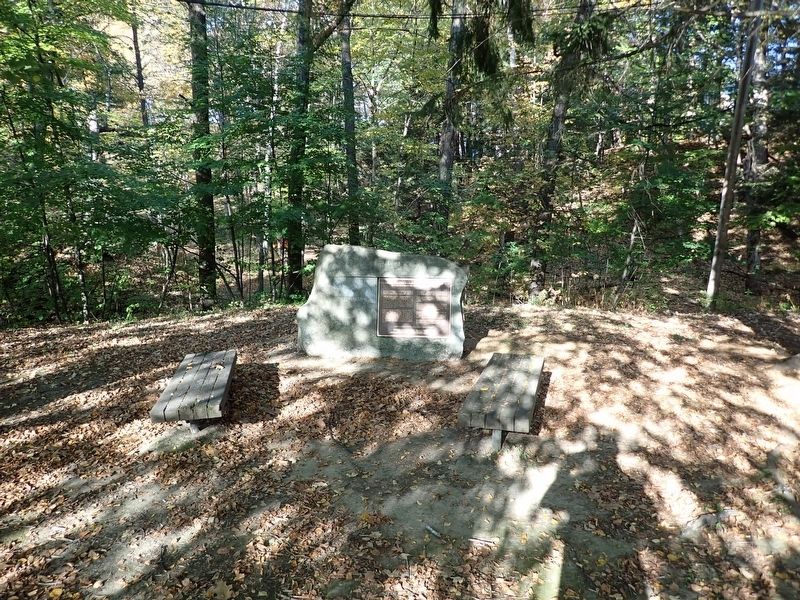
This 7-ton natural boulder was located at Rome, Maine, donated to the University of Maine by the Stowell Timberlands Corporation, and moved by the Washington Monument Company to this site.
Erected 1995.
Topics. This historical marker is listed in these topic lists: Charity & Public Work • Railroads & Streetcars • Waterways & Vessels.
Location. 44° 39.92′ N, 70° 8.742′ W. Marker is in Farmington, Maine, in Franklin County. It can be reached from Prescott Street south of Main Street (Maine Route 4),
Photographed by Conrad Ward, October 5, 2025
3. John Frank Stevens Marker

Regionally, this marker is in the Western Maine Lakes and Mountains Region. It is also in the American Northeast and in New England. Globally, it is in North America, the Great North Woods, the Western Hemisphere, the Western World, and the Anglosphere.
Other nearby markers. At least 3 other markers are within walking distance of this marker: Dr. Rock's Rock (approx. ¼ mile away); Votes For Women (approx. ¼ mile away); University of Maine at Farmington (approx. 0.3 miles away).
Regarding John Frank Stevens. Farmington Normal School became Farmington State Teachers College in 1945 and finally University of Maine at Farmington in 1971.
Also see . . . John Frank Stevens (Wikipedia). (Submitted on October 18, 2025.)
Credits. This page was last revised on October 25, 2025. It was originally submitted on October 18, 2025, by Conrad Ward of Guilford, Connecticut. This page has been viewed 76 times since then and 26 times this year. Photos: 1, 2, 3. submitted on October 18, 2025, by Conrad Ward of Guilford, Connecticut. • Andrew Ruppenstein was the editor who published this page.
