Marshfield in Webster County, Missouri — The American Midwest (Upper Plains)
Edwin Powell Hubble
November 20, 1889 — September 28, 1953

Photographed by Cosmos Mariner, September 25, 2025
1. Edwin Powell Hubble Marker
Born in Marshfield, MO., Hubble was a pioneering astronomer who discovered the universe is expanding, reshaping modern cosmology.
Topics. This historical marker is listed in this topic list: Science & Medicine. A significant historical date for this entry is November 20, 1889.
Location. 37° 20.25′ N, 92° 54.46′ W. Marker is in Marshfield, Missouri, in Webster County. It is at the intersection of South Clay Street and West Jackson Street (State Highway 38), on the right when traveling south on South Clay Street. The marker and sculpture are located in front of the Webster County Historical Society building. Touch for map. Marker is at or near this postal address: 219 South Clay Street, Marshfield MO 65706, United States of America. Touch for directions.

Regionally, this marker is in Southwest Missouri and in Greater Springfield. It is also in the American Ozarks, in the Lewis & Clark Corridor, and in the Corn Belt. Globally, it is in North America, the Western Hemisphere, the Western World, and the Anglosphere. Historically, it finds itself in what was once the territory of the Mississippian Culture, the Louisiana Purchase,
this page online
Other nearby markers. At least 8 other markers are within walking distance of this marker: Howitzer, Medium, Towed (about 300 feet away, measured in a direct line); Webster County War Memorial (about 300 feet away); Marshfield Hand Dug Well (about 400 feet away); Edwin Hubble (about 400 feet away); In Remembrance of Those Who Helped Shape Our Community (about 400 feet away); Veterans Memorial (about 500 feet away); Webster County (about 500 feet away); Trail of Tears (approx. half a mile away). Touch for a list and map of all markers in Marshfield.
Related markers. Click here for a list of markers that are related to this marker. Edwin Powell Hubble
Also see . . . Edwin Powell Hubble (Wikipedia).
Excerpt: He played a crucial role in establishing the fields of extragalactic astronomy and observational cosmology. Hubble proved that many objects previously thought to be clouds of dust and gas and classified as "nebulae" were actually galaxies beyond the Milky Way. He used the strong direct relationship between a classical Cepheid variable's luminosity and pulsation period (discovered in 1908(Submitted on October 23, 2025, by Cosmos Mariner of Cape Canaveral, Florida.)by Henrietta Swan Leavitt) for scaling galactic and extragalactic distances.Photographed by Cosmos Mariner, September 25, 20252. Edwin Powell Hubble Sculpture
Hubble confirmed in 1929 that the recessional velocity of a galaxy increases with its distance from Earth, a behavior that became known as Hubble's law, although it had been proposed two years earlier by Georges Lemaître. The Hubble law implies that the universe is expanding. A decade before, the American astronomer Vesto Slipher had provided the first evidence that the light from many of these nebulae was strongly red-shifted, indicative of high recession velocities.
Hubble's name is most widely recognized for the Hubble Space Telescope, which was named in his honor, with a model prominently displayed in his hometown of Marshfield, Missouri.
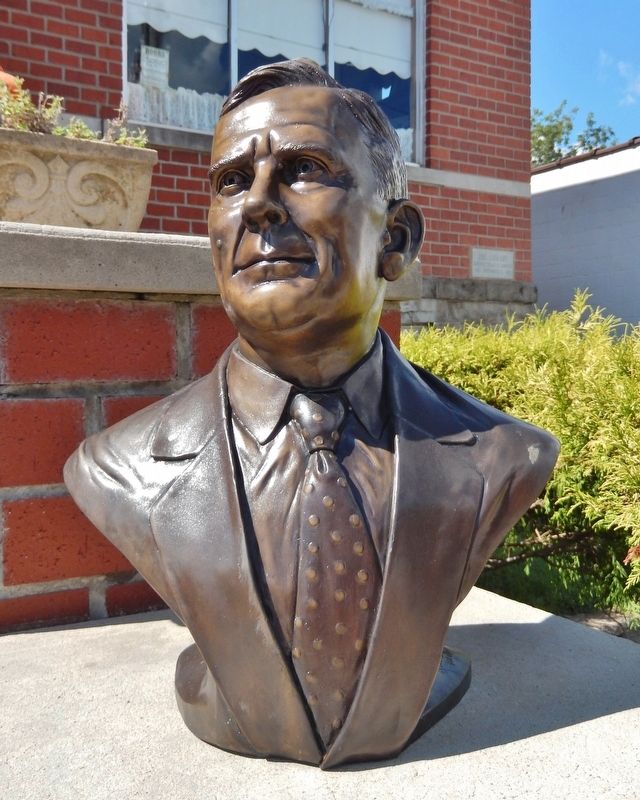

Photographed by Cosmos Mariner, September 25, 2025
3. Edwin Powell Hubble Marker & Sculpture
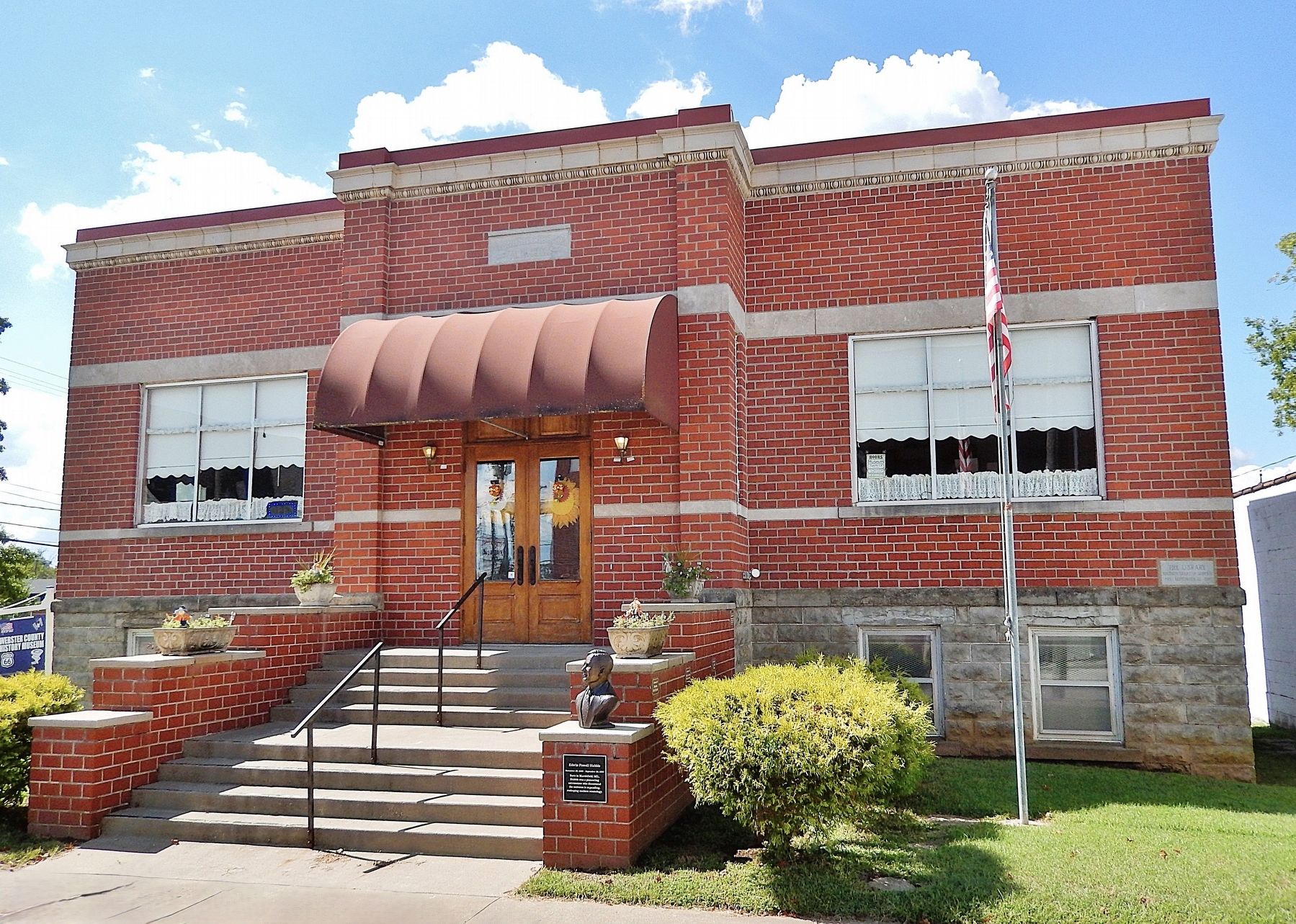
Photographed by Cosmos Mariner, September 25, 2025
4. Edwin Powell Hubble Marker
The marker is mounted on the right side of the staircase in front of the Webster County Historical Society building.
Credits. This page was last revised on October 23, 2025. It was originally submitted on October 22, 2025, by Cosmos Mariner of Cape Canaveral, Florida. This page has been viewed 121 times since then and 83 times this year. Photos: 1, 2, 3, 4. submitted on October 23, 2025, by Cosmos Mariner of Cape Canaveral, Florida.
