
Near Big Pine in Inyo County, California — The American West (Pacific Coastal)
Los Angeles Aqueduct
100-Year Anniversary

Photographed by Craig Baker
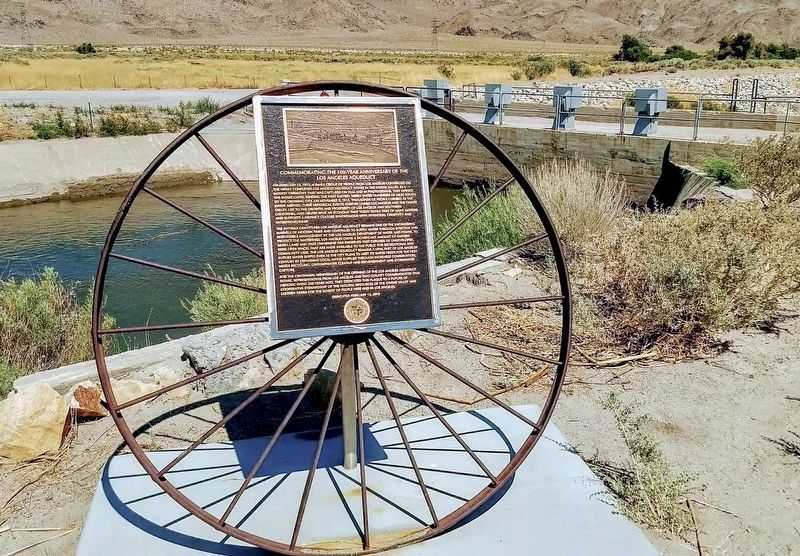
1. Los Angeles Aqueduct Marker
On February 13, 1913, a small group of people from Los Angeles converged on the newly completed Los Angeles Aqueduct intake in the Owens Valley. In a modest ceremony that was captured on film and in photographs, they opened the intake gates, sending the first Eastern Sierra water hundreds of miles south to the growing city. On November 5, 1913, thousands of people cheered as the water arrived. These historical events forever linked Los Angeles and the Owens Valley, led to the growth and prosperity of Los Angeles and Southern California, and helped spur an economy that today rivals that of many nations and supports a distinct culture synonymous with invention, creativity and entrepreneurship.
The entirely gravity-fed Los Angeles Aqueduct remains one of the engineering marvels of modern times and continues to supply water through effective and responsible management by the Los Angeles Department of Water and Power. To protect the watershed, Los Angeles owns a significant amount of Eastern Sierra land and that ownership has preserved vast expanses of undeveloped, wide open spaces that are made available
this page online
For the centennial anniversary of the opening of the Los Angeles Aqueduct intake, representatives from Los Angeles and Inyo County commemorated that historic event 100 years ago. They dedicated this plaque to a future of cooperative stewardship of the natural resources of the Owens Valley and Eastern Sierra for the benefit of people here and in Los Angeles.
Dedicated February 13, 2013
Erected 2013 by Los Angeles Department of Water and Power.
Topics. This historical marker is listed in these topic lists: Natural Resources • Waterways & Vessels. A significant historical date for this entry is February 13, 1913.
Location. 36° 58.544′ N, 118° 12.595′ W. Marker is near Big Pine, California, in Inyo County. It is at the intersection of the Los Angeles Aqueduct and the Owens River
Photographed by Craig Baker
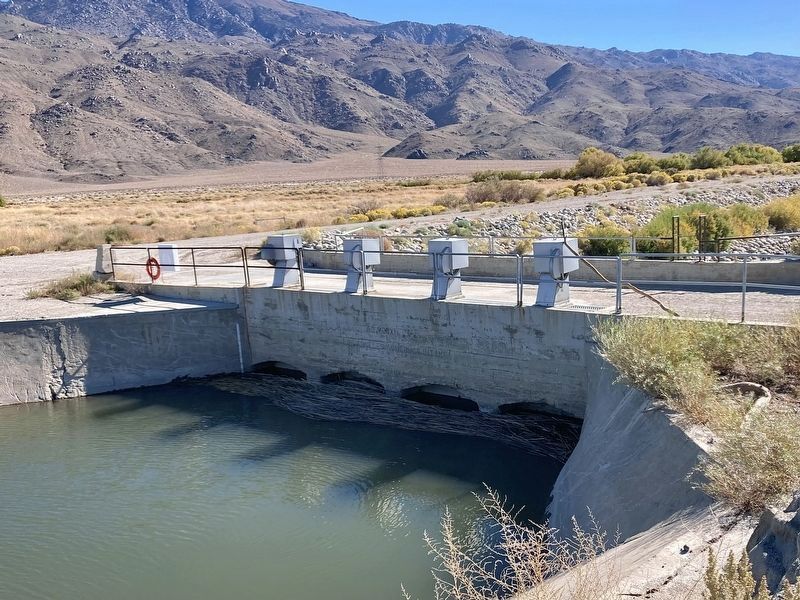
2. Los Angeles Aqueduct Intake and Marker

Regionally, this marker is in California’s Sierra Nevada. It is also in the American Mountain West. Globally, it is in North America, on the Ring of Fire, in the Pacific Rim, in the Western Hemisphere, in the Western World, and in the Anglosphere. Historically, it finds itself in what was once New Spain and also Mexico’s Alta California.
Other nearby markers. At least 8 other markers are within 12 miles of this marker, measured as the crow flies: Los Angeles Aqueduct Intake (approx. 1.4 miles away); Oak Creek Community Park (approx. 9.4 miles away); Camp Independence (approx. 9.9 miles away); Mt. Whitney Fish Hatchery (approx. 10.2 miles away); Historic Independence (approx. 11.7 miles away); Inyo County Courthouse (approx. 11.9 miles away); Putnam’s Stone Cabin (approx. 12 miles away); Mining in Inyo County (approx. 12 miles
Photographed by Craig Baker, October 30, 2025
3. Los Angeles Aqueduct Intake
Regarding Los Angeles Aqueduct. The aqueduct's construction was controversial from the start, as water diversions to Los Angeles eliminated the Owens Valley as a viable farming community.
In 1905, the city of Los Angeles began acquiring water and land rights in the Owens Valley, initially misleading farmers who were under the assumption that the purchases were intended for a local water project. By 1934, the city of Los Angeles had acquired 95% of the agricultural land in the Owens Valley.
The operation of the Los Angeles Aqueduct has led to public debate, court battles, and legislation over its environmental impacts on ecosystems and health impacts on residents. Beginning in the 1970s, a series of court ordered restrictions were imposed on water exports.
In 1991, the City of Los Angeles signed the Inyo-LA Long Term Water Agreement. Concessions of the deal included mitigation projects that sought to reduce further air contamination and health risks associated with the dust storms as well as future preservation of the ecology of the Owens Valley. In 2006, work commenced on the Lower Owens River Project, 15 years after it was signed.
In 2005, the Los Angeles Urban Water Management Report reported that 40–50% of the aqueduct's historical supply is now devoted to ecological resources in Mono and Inyo counties.
Also see . . . Owens River — California’s Gold. In this hour-long video produced for local PBS television stations in 2008, Huell Howser tours the aqueduct intake, Owens River, and Owens Lake. Film of the 1913 opening ceremony is seen at 34 minutes into the video. (Submitted on December 6, 2025.)
Credits. This page was last revised on December 6, 2025. It was originally submitted on October 26, 2025, by Craig Baker of Sylmar, California. This page has been viewed 67 times since then and 34 times this year. Photos: 1, 2. submitted on October 26, 2025, by Craig Baker of Sylmar, California. 3. submitted on October 31, 2025, by Craig Baker of Sylmar, California.
