Audubon-Downriver in Spokane in Spokane County, Washington — The American West (Northwest)
Matsutaro and Hatsume Kawaguchi
(1903-1981) (1909-2002)
Photographed by Shirley A Stirling, August 30, 2025
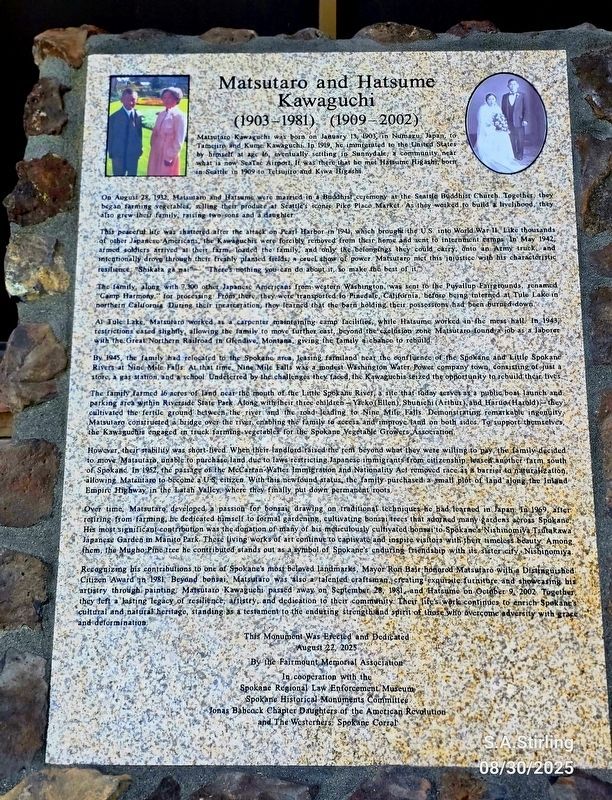
1. Matsutaro and Hatsume Kawaguchi Marker
On August 28, 1932, Matsutaro And Hatsume were married in a Buddhist ceremony at the Seattle Buddhist Church. Together, they began farming vegetables, selling their produce at Seattle's iconic Pike Place Market as they worked to build a livelihood, they also grew their family, raising two sons and a daughter.
This peaceful life was shattered after the attack on Pearl Harbor in 1941, which brought the US into World War II. Like thousands of other Japanese Americans, the Kawaguchis were forcibly removed from their home and sent to internment camps. In May 1942, armed soldiers arrived at their farm, loaded the family, and only the belongings they could carry, onto an Army truck, and intentionally drove through their freshly planted fields; a cruel show of power. Matsutaro met this
this page online
At Tule Lake, Matsutaro worked, as a carpenter maintaining camp facilities, while Hatsume worked in the mess hall. In 1943, restrictions eased slightly, allowing the family to move further east, beyond the exclusion zone. Matsutaro found job as a laborer with the Great Northern Railroad in Glendive, Montana, giving the family a chance to rebuild.
By 1945, the family had relocated to the Spokane area, leasing farmland near the confluence of the Spokane and Little Spokane Rivers at Nine Mile Falls. At that time, Nine Mile Falls was a modest Washington Water Power company town, consisting of just a store, a gas station, and a school.
Photographed by Shirley A Stirling, August 30, 2025
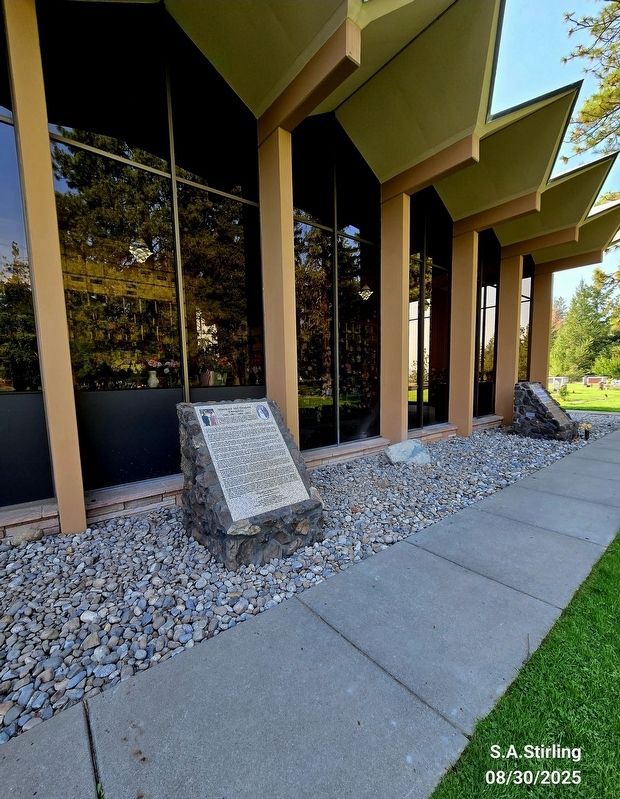
2. Wide angle view of Matsutaro and Hatsume Kawaguchi Marker
The family farmed 16 acres of land near the mouth of the Little Spokane River, a site that today serves as a public boat launch and parking area within Riverside State Park. Along with their three children - Yaeko (Ellen), Shunichi (Arthur), and Haruo (Harold) - they cultivated the fertile ground between, the river and the road leading to Nine Mile Falls. Demonstrating remarkable ingenuity, Matsutaro constructed a bridge over the river, enabling the family to access and improve land on both sides. To support themselves, the Kawaguchis engaged in truck farming vegetables for the Spokane Vegetable Growers Association.
However, their stability was short-lived. When their landlord raised the rent beyond what they were willing to pay, the family decided to move. Matsutaro, unable to purchase land due to laws restricting Japanese immigrants from citizenship, leased another farm south of Spokane. In 1952, the passage of the McCartan-Walter Immigration and Nationality Act removed race as a barrier to naturalization, allowing Matsutaro
Photographed by Shirley A Stirling, August 30, 2025
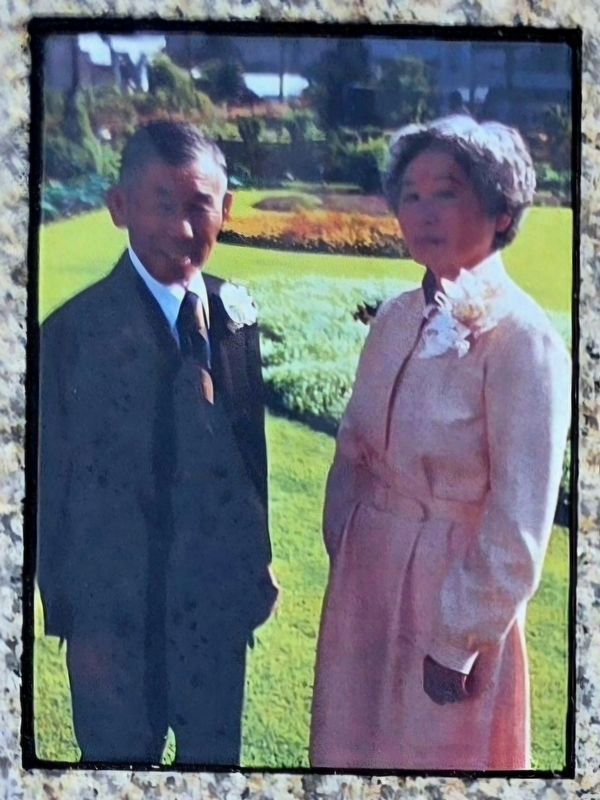
3. Image enlarged from top left of the Matsutaro and Hatsume Kawaguchi Marker.
Over time, Matsutaro developed a passion for bonsai, drawing on traditional techniques he had learned in Japan. In 1969, after retiring from farming, be dedicated himself to formal gardening, cultivating bonsai trees that adorned many gardens across Spokane.
His most significant contribution was the donation of many of his meticulously cultivated bonsai to Spokanes Nishinomiya Tsutakawa Japanese Garden in Manito Park. These living works of art continue to captivate and inspire visitors with their timeless beauty. Among them, the Mugho Pinetree he contributed stands out as a symbol of Spokane's enduring friendship with its sister city, Nishinomiya.
Recognizing his contributions to one of Spokane's most beloved landmarks, Mayor Ron Bair honored Matsutaro with a Distinguished Citizen Award in 1981. Beyond bonsai, Matsutaro was also a talented craftsman, creating exquisite furniture and showcasing his artistry through painting. Matsutaro Kawaguchi passed away on September 28, 1981 and Hatsume on October 9, 2002. Together, they left a lasting legacy of resilience, artistry, and dedication to their community. Their life's work continues to enrich Spokane's cultural and natural heritage, standing as a testament to the enduring strength and spirit of those who overcome adversity with grace and determination.
Erected 2025 by Fairmont Memorial Association in cooperation with the Jonas Babcock Chapter Daughters of the American Revolution, Spokane Regional Law Enforcement Museum, Spokane Historical Monuments Committees, and The Westerners Spokane Corral.
Topics and series. This historical marker is listed in these topic lists: Arts, Letters, Music • Civil Rights • Horticulture & Forestry • War, World II. In addition, it is included in the Daughters of the American Revolution (DAR) series list. A significant historical date for this entry is January 13, 1901.
Location. 47° 42.105′ N, 117° 29.398′ W. Marker is in Spokane, Washington, in Spokane County. It is in Audubon-Downriver. It is on West Wellesley Avenue east of N Hartley Street. Touch for map. Marker is at or near this postal address: 5200 W Wellesley Ave, Spokane WA 99208, United States of America. Touch for directions.

Regionally, this marker is in the American Mountain West and in the Lewis & Clark Corridor. Globally, it is in North America, on the Pacific Rim, in the Western Hemisphere, in the Western World, and in the Anglosphere.
Other nearby markers. At least 8 other markers are within 3 miles of this marker, measured as the crow flies: Byron C. Riblet (about 400 feet away, measured in a direct line); Herbert Bolster (about 400 feet away); A Legacy of Joy and Wonderful Memories (about 600 feet away); Elizabeth Tappan Tannatt Memorial (about 700 feet away); Thomas Redding Tannatt / Elizabeth Forster Tappan (about 700 feet away); Jesse Ray Drowley (approx. 0.4 miles away); Never Forget Garden (approx. 0.6 miles away); Whist-Alks Way (approx. 2.3 miles away). Touch for a list and map of all markers in Spokane.
Another marker is no longer nearby. Col. George Wright (was approx. 2.3 miles away but has been permanently removed).
Credits. This page was last revised on November 2, 2025. It was originally submitted on October 27, 2025, by Shirley A Stirling of Lacey, Washington. This page has been viewed 119 times since then and 73 times this year. Photos: 1, 2, 3. submitted on October 27, 2025, by Shirley A Stirling of Lacey, Washington. • James Hulse was the editor who published this page.
