Baldwin in St. Mary Parish, Louisiana — The American South (West South Central)
Welcome to Baldwin
Photographed by Cajun Scrambler, October 23, 2025
1. Welcome to Baldwin Marker
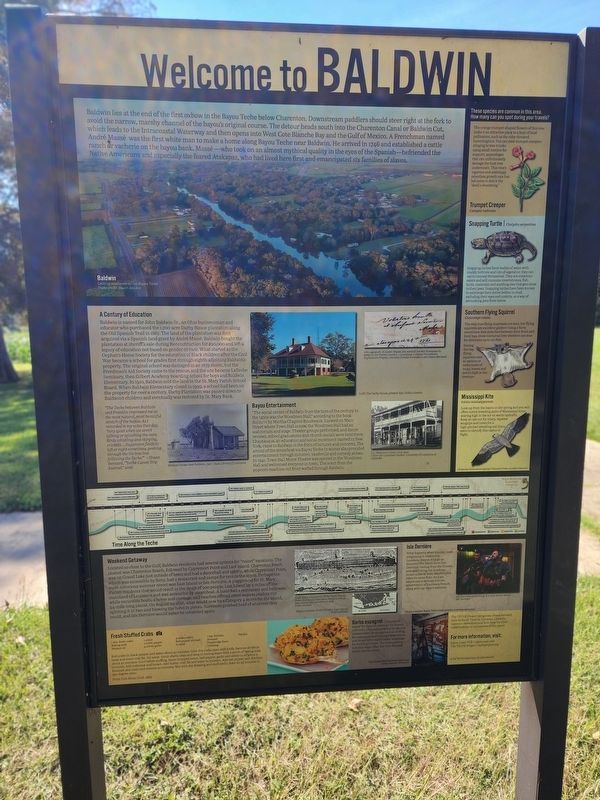
Baldwin lies at the end of the first oxbow in the Bayou Teche below Charenton. Downstream paddlers should steer right at the fork to avoid the narrow, marshy channel of the bayou's original course. The detour heads south into the Charenton Canal or Baldwin Cut, which leads to the Intracoastal Waterway and then opens into West Cote Blanche Bay and the Gulf of Mexico. A Frenchman named André Massé was the first white man to make a home along Bayou Teche near Baldwin. He arrived in 1746 and established a cattle ranch or vacherie on the bayou bank. Massé-who took on an almost mythical quality in the eyes of the Spanish-befriended the Native Americans and especially the feared Atakapas, who had lived here first and emancipated six families of slaves.
A Century of Education
Baldwin is named for John Baldwin Sr., an Ohio businessman and educator who purchased the 1,700-acre Darby House plantation along the Old Spanish Trail in 1867. The land of the plantation was first acquired via a Spanish land grant by André Massé. Baldwin bought the plantation at sheriff's sale during Reconstruction for $20,000 and left a legacy
this page online
"The Teche between Baldwin and Franklin impressed me as the most natural, most beautiful stretch of the bayou. As I recorded in my notes that day, 'Very quiet when we aren't talking or splashing the oars. Birds whistling and chirping, crickets... Sugarcane fields to left or right sometimes, peeking through the the tree line following the Teche." - Shane Bernard, "Teche Canoe Trip Journal," 2016
Bayou Entertainment
"The social center of

Photographed by Cajun Scrambler, September 12, 2025
2. Welcome to Baldwin Marker
Weekend Getaway
Located so close to the Gulf, Baldwin residents had several options for "resort" vacations. The closest was Charenton Beach, followed by Cypremort Point and Last Island. Charenton Beach was on Grand Lake just outside of town and had a dancehall and cabins, while Cypremort Point, which was accessible by ferry, had a restaurant and camps for rent in the 1930s. Perhaps the most notorious
Photographed by Cajun Scrambler, September 12, 2025
3. Welcome to Baldwin Marker
Fresh Stuffed Crabs
1 doz. fresh crabs
Baking soda
1 onion
1/2 bell pepper
Wesson oil
4 cloves garlic
4 stalks celery
Red pepper and salt to taste
1 tsp. Kitchen Bouquet
Pepperidge Farm Dressing
Parsley
Boil crabs in black pepper and water about 30 minutes. Cool. Pry crabs open with knife. Remove all white meat and some crab fat. Set aside. Scrub shells clean and drop in boiling water with a pinch of baking soda about 20 minutes. Cool before stuffing. Saute chopped onion, bell pepper, garlic and celery in oil about 5 minutes. Add crabmeat and brown. Add butter, crab fat and water to moisten. Add red pepper, salt, Kitchen Bouquet and cover and simmer 30 minutes. Mix with dry dressing and stuff shells. Bake 20-25 minutes in 350-degree oven.
Barbe espagnol - “Spaniard's beard"
for Spanish moss, as the French referred to the plant growing on oak and cypress trees. Moss was used as stuffing for mattresses and making horse collars, and mixed with mud to make bousillage for building houses. The moss ginning industry began after the Civil War and lasted into the 1970s.
Isle Dernière
What happens when you pair rock songs sung in traditional Louisiana French with go-go dancers? The bayou band Isle Dernière. Hailing from the Houma area and hitting the Acadiana music scene in 2012, Isle Dernière takes its name from the Last Island and is dedicated to the preservation of Louisiana French, along with our state's wetlands.
Find a complete Bayou Teche music playlist at techeproject.org!
The TECHE Project recognizes Shane Bernard, Patti Holland, Tami St. Germain, Chloé St. Germain-Vermillion and Erin Bass for their contributions to the content of this panel.
For more information, visit:
Cajun Coast VCB | cajuncoast.com The TECHE Project | techeproject.org
Erected 2021 by The TECHE Project.
Topics. This historical marker is listed in these topic lists: Settlements & Settlers • Waterways & Vessels.
Location. 29° 50.542′ N, 91° 32.348′ W. Marker is in Baldwin, Louisiana, in St. Mary Parish. It is on Resweber Road south of Charenton Road (Louisiana Road 326). Touch for map. Marker is at or near this postal address: 100 Resweber Rd, Franklin LA 70538, United States of America. Touch for directions.

Regionally, this marker is in one of the River Parishes, in Acadiana — Cajun Country, and specifically in Bayou Country. It is also in the American South, specifically in the Deep South, on the Gulf Coast, and in the Great River Road Region. Globally, it is in North America, a Gulf of Mexico state, the Western Hemisphere, the Western World, and the Anglosphere. Historically, it finds itself in what was once New Spain, Acadia, the territory of the Mississippian Culture, the Louisiana Purchase, one of the Confederate States of America, and the Antebellum South.
Other nearby markers. At least 8 other markers are within 4 miles of this marker, measured as the crow flies: The Massé - Darby House (approx. half a mile away); Jefferson Davis Louisiana Association (approx. 2.4 miles away); Welcome to Charenton and the Chitimacha Reservation (approx. 3 miles away); Bayou Teche (approx. 3.2 miles away); Chitimacha Veterans' Monument (approx. 3.2 miles away); Donelson Caffery (approx. 3.8 miles away); German Prisoner of War Camp (approx. 3.9 miles away); St. Mary's Episcopal Church (approx. 4 miles away).
Another marker is no longer nearby. Belle Isle Salt Mine Memorial (was approx. 2.4 miles away but has been confirmed missing).
Also see . . . Official The Teche Project website. (Submitted on October 31, 2025, by Cajun Scrambler of Assumption, Louisiana.)
Credits. This page was last revised on October 31, 2025. It was originally submitted on October 31, 2025, by Cajun Scrambler of Assumption, Louisiana. This page has been viewed 88 times since then and 57 times this year. Photos: 1, 2, 3. submitted on October 31, 2025, by Cajun Scrambler of Assumption, Louisiana.
