Downtown in Topeka in Shawnee County, Kansas — The American Midwest (Upper Plains)
The Indian Policy of a New Nation
Photographed by Jason Voigt, October 29, 2025
1. The Indian Policy of a New Nation Marker
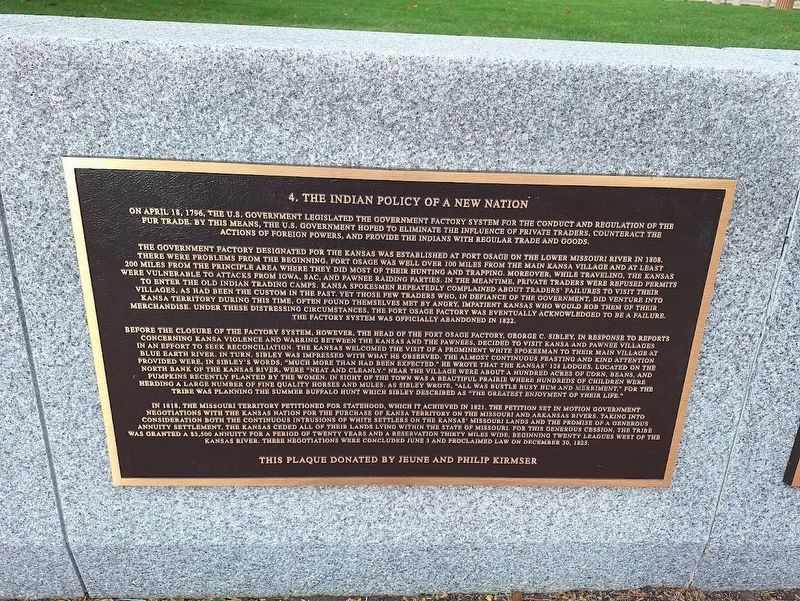
On April 18, 1796, the U.S. government legislated the government factory system for e conduct and regulation of the fur trade. By this means, the U.S. government hoped to eliminate the influence of private traders, counteract the actions of foreign powers, and provide the Indians with regular trade and goods.
The government factory designated for the Kansas was established at Fort Osage on the Lower Missouri River in 1808. There were problems from the beginning. Fort Osage was well over 100 miles from the main Kansa village and at least 200 miles from the principle area where they did most of their hunting and trapping. Moreover, while traveling, the Kansas were vulnerable to attacks from Iowa, Sac, and Pawnee raiding parties. In the meantime, private traders were refused permits to enter the old Indian trading camps. Kansa spokesmen repeatedly complained about traders' failures to visit their villages, as had been the custom in the past. Yet those few traders who, in defiance of the government, did venture into Kansa Territory during this time, often found themselves met by angry, impatient Kansas who would rob them
this page online
Before the closure of the factory system, however, the head of the Fort Osage factory, George C. Sibley, in response to reports concerning Kansa violence and warning between the Kansas and the Pawnees, decided to visit Kansa and Pawnee villages in an effort to seek reconciliation. The Kansas welcomed the visit of a prominent white spokesman to their main village at Blue Earth River. In turn, Sibley was impressed with what he observed. The almost continuous feasting and kind attention provided were, in Sibley's words, "Much more than had been expected." He wrote that the Kansas' 128 lodges, located on the north bank of the Kansas River, were "neat and cleanly. Near the village were about a hundred acres of corn, beans and pumpkins recently planted by the women. In sight of the town was a beautiful prairie where hundreds of children were herding a large number of fine quality horses and mules. As Sibley wrote, "All was bustle busy hum and merriment." For
Photographed by Jason Voigt, October 29, 2025
2. The Indian Policy of a New Nation Marker
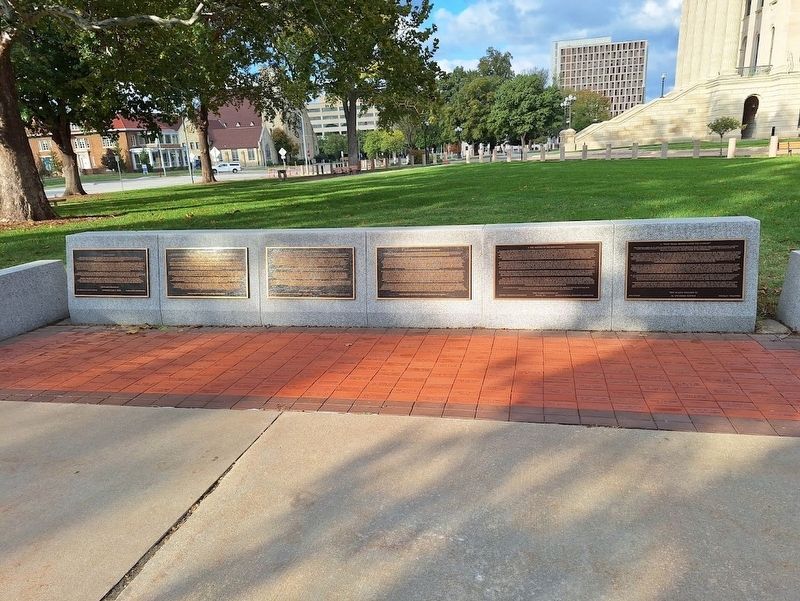
Marker is third from the right.
In 1818, the Missouri Territory petitioned for statehood, which it achieved in 1821. The petition set in motion government negotiations with the Kansas Nation for the purchase of Kansa Territory on the Missouri and Arkansas Rivers. Taking into consideration both the continuous intrusions of white settlers on the Kansas' Missouri lands and the promise of a generous annuity settlement. The Kansas ceded all of their lands lying within the state of Missouri. For this generous cession, the tribe was granted a $3,000 annuity for a period of twenty years and a reservation thirty miles wide, beginning twenty leagues west of the Kansas River. These negotiations were concluded June 3 and proclaimed law on December 30, 1825.
Erected by Jeune and Philip Kirmser. (Marker Number 4.)
Topics. This historical marker is listed in these topic lists: Indigenous Peoples and Communities • Settlements & Settlers. A significant historical date for this entry is April 18, 1796.
Location. 39° 2.867′ N, 95° 40.75′ W. Marker is in Topeka, Kansas, in
Photographed by Jason Voigt, October 29, 2025
3. The Indian Policy of a New Nation Marker
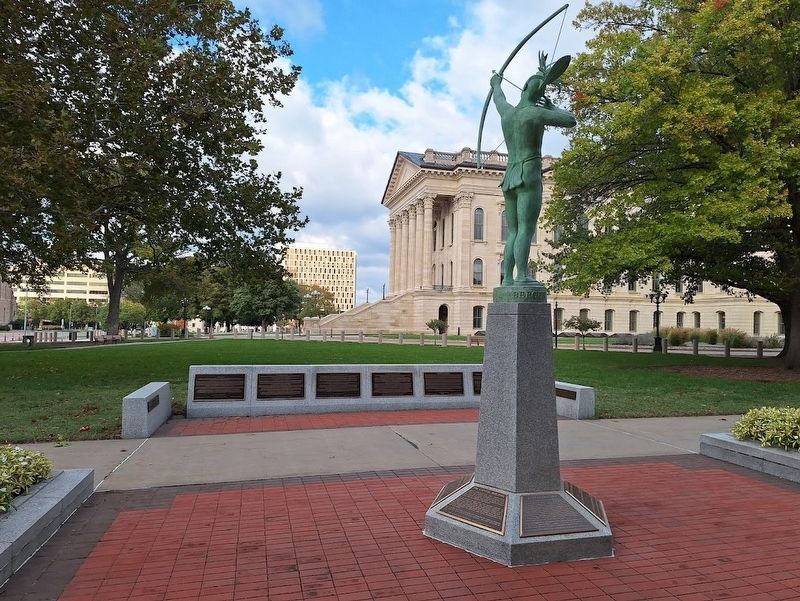
On the grounds of Kansas State Capitol

Regionally, this marker is in Eastern Kansas. It is also in the American Midwest, in the Corn Belt, on the prairies, and on the Southern Plains. Globally, it is in North America, the Western Hemisphere, the Western World, and the Anglosphere. Historically, it finds itself in what was once the Louisiana Purchase.
Other nearby markers. At least 8 other markers are within walking distance of this marker: The Impact of the European Fur Trade (here, next to this marker); The Failure of the Missionaries (here, next to this marker); The Kansa Way of Life (here, next to this marker); "What shall be done with the Kansas?" (here, next to this marker); Kansa Origins (here, next to this marker); The Capitol Building (here, next to this marker); The Governor's Plaque (here, next to this marker); Kansas Children (here, next to this marker). Touch for a list and map of all markers in Topeka.
Credits. This page was last revised on October 31, 2025. It was originally submitted on October 31, 2025, by Jason Voigt of Glen Carbon, Illinois. This page has been viewed 44 times since then and 22 times this year. Photos: 1, 2, 3. submitted on October 31, 2025, by Jason Voigt of Glen Carbon, Illinois.
