Downtown in Topeka in Shawnee County, Kansas — The American Midwest (Upper Plains)
"What shall be done with the Kansas?"
Photographed by Jason Voigt, October 29, 2025
1. "What shall be done with the Kansas?" Marker
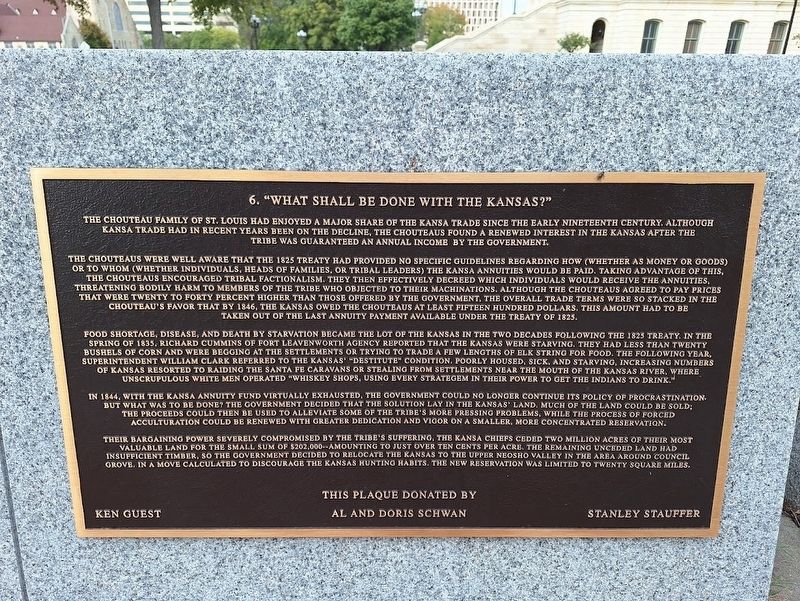
The Chouteau family of St. Louis had enjoyed a major share of the Kansa trade since the early nineteenth century. Although Kansa trad had in recent years been on the decline, the Chouteaus found a renewed interest in the Kansas after the tribe was guaranteed an annual income by the government.
The Chouteaus were well aware that the 1825 treaty had provided no specific guidelines regarding how (whether as money or goods) or to whom (whether individuals, heads of families, or tribal leaders) the Kansa annuities would be paid. Taking advantage of this, the Chouteaus encouraged tribal factionalism. They then effectively decreed which individuals would receive the annuities, threatening bodily harm to members of the tribe who objected to their machinations. Although the Chouteaus agreed to pay prices that were twenty to forty percent higher than those offered by the government, the overall trade terms were so stacked in the Chouteau's favor that by 1846, the Kansas owed the Chouteaus at least fifteen hundred dollars. This amount had to be taken out of the last annuity payment available under the Treaty of 1825.
Food
this page online
In 1844, with the Kansa annuity fund virtually exhausted, the government could no longer continue is policy of procrastination. But what was to be done? The government decided that the solution lay in the Kansas' land. Much of the land could be sold; the proceeds could then be used to alleviate some of the tribe's more pressing problems. While the process of forced acculturation could be renewed with
Photographed by Jason Voigt, October 29, 2025
2. "What shall be done with the Kansas?" Marker
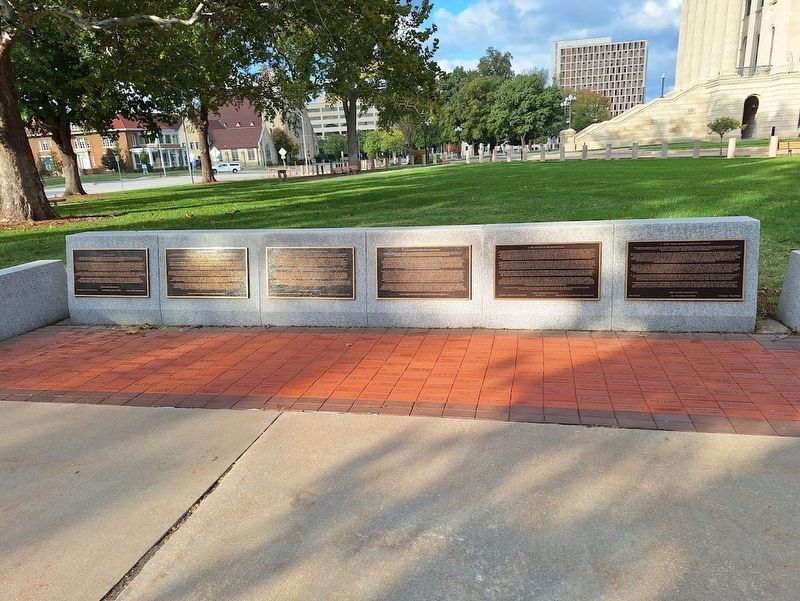
Marker is the last one on the right.
Their bargaining power severely compromised by the tribe's suffering, the Kansa chiefs ceded two million acres of their most valuable land for the small sum of $202,000--amounting to just over ten cents per acre. The remaining unceded land had insufficient timber, so the government decided to relocate the Kansas to the upper Neosho valley in the area around Council Grove. In a move calculated to discourage the Kansas hunting habits. The new reservation was limited to twenty square miles.
Erected by Ken Guest, Al & Doris Schwan and Stanley Stauffer. (Marker Number 6.)
Topics. This historical marker is listed in this topic list: Indigenous Peoples and Communities. A significant historical year for this entry is 1825.
Location. 39° 2.866′ N, 95° 40.748′ W. Marker is in Topeka, Kansas, in Shawnee County. It is in Downtown. It is on Southwest Harrison Street north of Southwest 10th Avenue, on the right when traveling north. The marker is on the north wall of the Ad Astra Plaza, southwest of the Kansas State Capitol building. Touch for map. Marker is at or near this postal address: 300 SW 10th Ave, Topeka KS 66626, United States of America. Touch for directions.

Regionally, this marker is in Eastern Kansas. It is also in the American Midwest, in the Corn Belt, on the prairies, and on the Southern Plains. Globally, it is in North America, the Western Hemisphere, the Western World, and the Anglosphere. Historically, it finds itself in what was once the Louisiana Purchase.
Other nearby markers. At least 8 other markers are within walking distance of this marker: The Failure of the Missionaries (here, next to this marker); The Indian Policy of a New Nation (here, next to this marker); The Impact of the European Fur Trade (here, next to this marker); The Kansa Way of Life (here, next to this marker); Kansa Origins (here, next to this marker); The Capitol Building (here, next to this marker); The Governor's Plaque (here, next to this marker); Kansas Children (here, next to this marker). Touch for a list and map of all markers in Topeka.
Credits. This page was last revised on October 31, 2025. It was originally submitted on October 31, 2025, by Jason Voigt of Glen Carbon, Illinois. This page has been viewed 59 times since then and 23 times this year. Photos: 1, 2. submitted on October 31, 2025, by Jason Voigt of Glen Carbon, Illinois.
