Downtown in Topeka in Shawnee County, Kansas — The American Midwest (Upper Plains)
Removal to Indian Territory
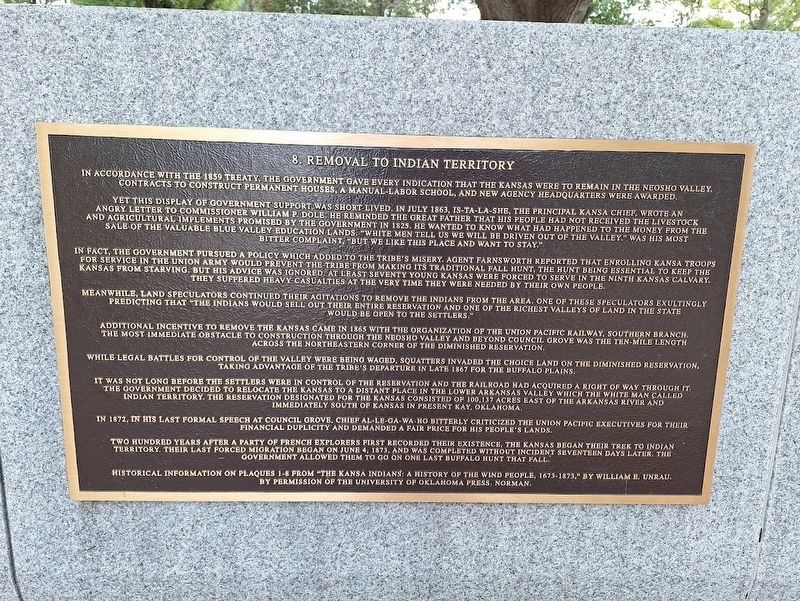
Photographed by Jason Voigt, October 29, 2025
1. Removal to Indian Territory Marker
In accordance with the 1859 treaty, the government gave every indication that the Kansas were to remain in the Neosho Valley. Contracts to construct permanent houses, a manual-labor school, and new agency headquarters were awarded.
Yet this display of government support was short-lived. In July 1863, Is-Ta-La-She, the principal Kansa chief, wrote an angry letter to Commissioner William P. Dole. He reminded the great father that his people had not received the livestock and agricultural implements promised by the government in 1825. He wanted to know what had happened to the money from the sale of the value of the valuable Blue Valley education lands. "White men tell us we will be driven out of the valley." was his most bitter complaint, "but we like this place and want to stay."
In fact, the government pursued a policy which added to the tribe's misery. Agent Farnsworth reported that enrolling Kansa troops for service in the Union Army would prevent the tribe from making its traditional fall hunt, the hunt being essential to keep the Kansas from starving. But his advice was ignored. At least seventy young Kansas
this page online
Meanwhile, land speculators continued their agitations to remove the Indians from the area. One of these speculators exultingly predicting that "the Indians would sell out their entire reservation and one of the richest valleys of land in the state would be open to the settlers."
Additional incentive to remove the Kansas came in 1865 with the organization of the Union Pacific Railway, Southern Branch. The most immediate obstacle to construction through the Neosho Valley and beyond Council Grove was the ten-mile length across the northeastern corner of the diminished reservation.
While legal battles for control of the valley were being waged, squatters invaded the choice land on the diminished reservation, taking advantage of the tribe's departure in late 1867 for the Buffalo Plains.
It was not long before the settlers were in control of the reservation and the railroad had acquired a right of way through it. The government decided to relocate the Kansas to a distant place in the Lower Arkansas

Photographed by Jason Voigt, October 29, 2025
2. Removal to Indian Territory Marker
Marker is second from the left
In 1872, in his last formal speech at Council Grove, Chief Al-le-ga-wa-ho bitterly criticized the Union Pacific executives for their financially duplicity and demanded a fair price for his people's lands.
Two hundred years after a party of French explorers first recorded their existence, the Kansas began their trek to Indian Territory. Their last forced migration began on June 4, 1873, and was completed without incident seventeen days later. The government allowed them to go on one last buffalo hunt that fall.
Historical information on plaques 1-8 from "The Kansa Indians: A History of the Wind People, 1673-1873," by William E. Unrau. By permission of the University of Oklahoma Press, Norman. (Marker Number 8.)
Topics. This historical marker is listed in these topic lists: Indigenous Peoples and Communities • Settlements & Settlers. A significant historical date for this entry is June 4, 1873.
Location. 39° 2.86′ N, 95° 40.752′ W. Marker is in Topeka, Kansas, in Shawnee County. It is in Downtown. It is on Southwest Harrison Street north of Southwest 10th Avenue, on the left when traveling south. The marker is on the south wall of the Ad Astra Plaza, southwest of the Kansas State Capitol building. Touch for map. Marker is at or near this postal address: 300 SW 10th Ave, Topeka KS 66626, United States of America. Touch for directions.

Regionally, this marker is in Eastern Kansas. It is also in the American Midwest, in the Corn Belt, on the prairies, and on the Southern Plains. Globally, it is in North America, the Western Hemisphere, the Western World, and the Anglosphere. Historically, it finds itself in what was once the Louisiana Purchase.
Other nearby markers. At least 8 other markers are within walking distance of this marker: The Neosha Valley Experience (here, next to this marker); "Ad Astra" (here, next to this marker); Kansas History (here, next to this marker); "To the Stars Through Difficulties": A Chronicle (here, next to this marker); The Capitol Building (here, next to this marker); The Governor's Plaque (here, next to this marker); Kansas Children (here, next to this marker); The Kansa Tribe (here, next to this marker). Touch for a list and map of all markers in Topeka.
Credits. This page was last revised on November 1, 2025. It was originally submitted on November 1, 2025, by Jason Voigt of Glen Carbon, Illinois. This page has been viewed 53 times since then and 22 times this year. Photos: 1, 2. submitted on November 1, 2025, by Jason Voigt of Glen Carbon, Illinois.
