Ashland in Hanover County, Virginia — The American South (Mid-Atlantic)
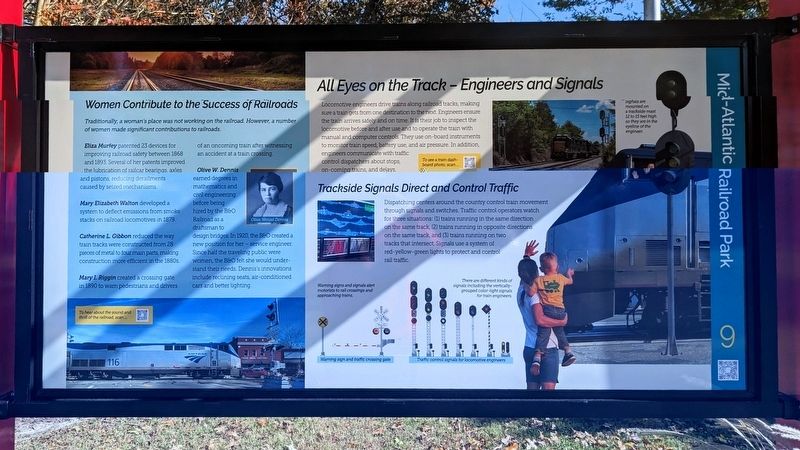
All Eyes on the Track - Engineers and Signals
| — | Mid-Atlantic Railroad Park | — |
Photographed by Bernard Fisher, November 1, 2025
1. All Eyes on the Track - Engineers and Signals Marker
Locomotive engineers drive trains along railroad tracks, making sure a train gets from one destination to the next. Engineers ensure the train arrives safely and on time. It is their job to inspect the locomotive before and after use and to operate the train with manual and computer controls. They use on-board instruments to monitor train speed, battery use, and air pressure. In addition, engineers communicate with traffic control dispatchers about stops, on-coming trains, and delays.
Trackside Signals Direct and Control Traffic
Dispatching centers around the country control train movement through signals and switches. Traffic control operators watch for three situations: (1) trains running in the same direction on the same track, (2) trains running in opposite directions on the same track, and (3) trains running on two tracks that intersect. Signals use a system of red-yellow-green lights to protect and control rail traffic.
(captions)
Signals are mounted on a trackside mast 12 to 15 feet high so they are in the eyeline of the engineer.
Warning signs and signals alert motorists to rail crossings and approaching trains. Warning sign and traffic crossing gate
There are different kinds of signals including the vertically-grouped color-light signals for train engineers. Traffic control signals for locomotive engineers
Women Contribute to the Success of Railroads
Traditionally,
this page online
Eliza Murfey patented 23 devices for improving railroad safety between 1868 and 1893. Several of her patents improved the lubrication of railcar bearings, axles and pistons, reducing derailments caused by seized mechanisms.
Mary Elizabeth Walton developed a system to deflect emissions from smoke stacks on railroad locomotives in 1879.
Catherine L. Gibbon reduced the way train tracks were constructed from 28 pieces of metal to four main parts, making construction more efficient in the 1880s.
Mary I. Riggin created a crossing gate in 1890 to warn pedestrians and drivers of an oncoming train after witnessing an accident at a train crossing.
Olive W. Dennis earned degrees in mathematics and civil engineering before being hired by the B&O Railroad as a draftsman to design bridges. In 1920, the B&O created a new position for her - service engineer. Since half the traveling public were women, the B&O felt she would understand their needs. Dennis's innovations include reclining seats, air-conditioned cars and
Photographed by Bernard Fisher, November 1, 2025
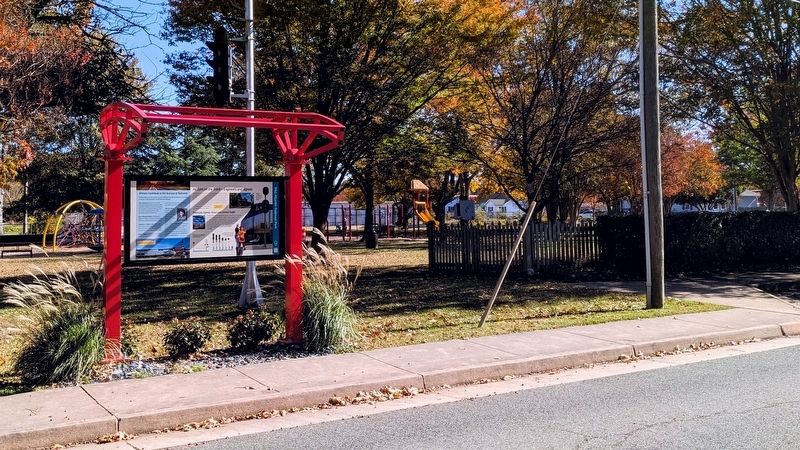
2. All Eyes on the Track - Engineers and Signals Marker
(caption) Olive Wetzel Dennis
Erected 2025 by Mid-Atlantic Railroad Park. (Marker Number 9.)
Topics. This historical marker is listed in these topic lists: Communications • Railroads & Streetcars • Women. A significant historical year for this entry is 1869.
Location. 37° 45.446′ N, 77° 28.441′ W. Marker is in Ashland, Virginia, in Hanover County. It is at the intersection of Randolph Street and England Street (Virginia Route 54), on the left when traveling south on Randolph Street. Located in Pufferbelly Park. Touch for map. Marker is at or near this postal address: 101 Randolph St, Ashland VA 23005, United States of America. Touch for directions.

Regionally, this marker is in the Piedmont, in Central Virginia, and in the Richmond Metropolitan Area. It is also in the American South, specifically in the Upper South, and on the Eastern Seaboard. Globally, it is in the North Atlantic Region, North America, the Western Hemisphere, the Western World, and the Anglosphere. Historically, it finds itself in what was once the territory of the Mississippian Culture, one of the original Thirteen Colonies,
Photographed by Bernard Fisher, November 1, 2025
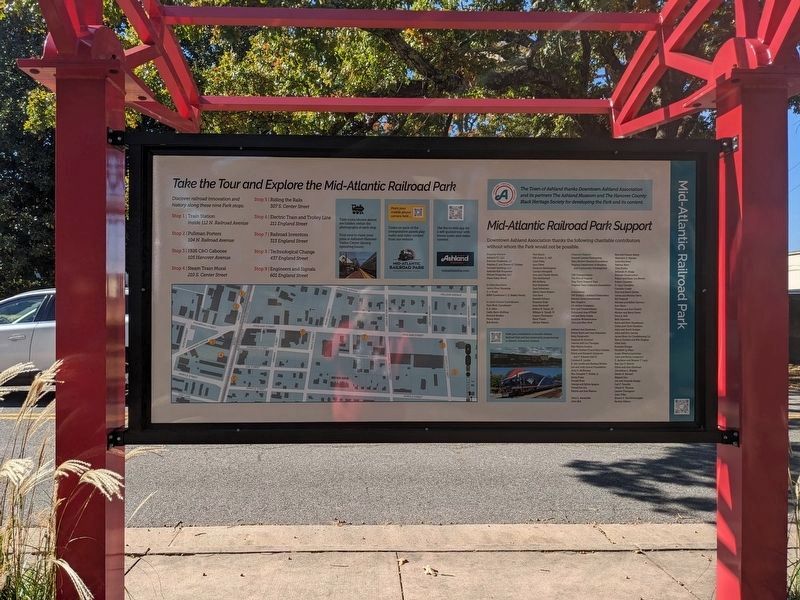
3. Mid-Atlantic Railroad Park Map
Other nearby markers. At least 8 other markers are within walking distance of this marker: Precision Braking, Higher Speeds... (about 300 feet away, measured in a direct line); Janney Coupler Improves Safety for Railroad Workers (approx. 0.2 miles away); Ashland (approx. ¼ mile away); Henry at Hanover Courthouse (approx. 0.3 miles away); Electric Train Generates Electricity for Ashland (approx. 0.3 miles away); Randolph-Macon College (approx. 0.3 miles away); a different marker also named Randolph-Macon College (approx. 0.3 miles away); Secretariat: America's Super Horse and Virginia's Pride (approx. 0.4 miles away). Touch for a list and map of all markers in Ashland.
Also see . . . Mid-Atlantic Railroad Park. (Submitted on November 2, 2025.)
Credits. This page was last revised on November 2, 2025. It was originally submitted on November 2, 2025, by Bernard Fisher of Richmond, Virginia. This page has been viewed 66 times since then and 39 times this year. Photos: 1, 2, 3. submitted on November 2, 2025, by Bernard Fisher of Richmond, Virginia.
