Austin in Travis County, Texas — The American South (West South Central)
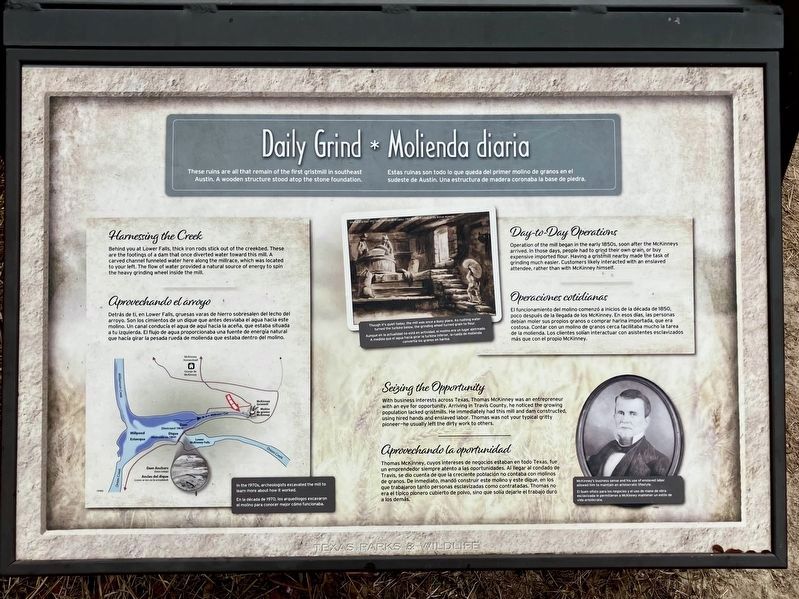
Daily Grind
⎯⎯⎯
Molienda diaria
Photographed by Tracy Andersen Roberts, November 1, 2025
1. Daily Grind / Molienda diaria Marker
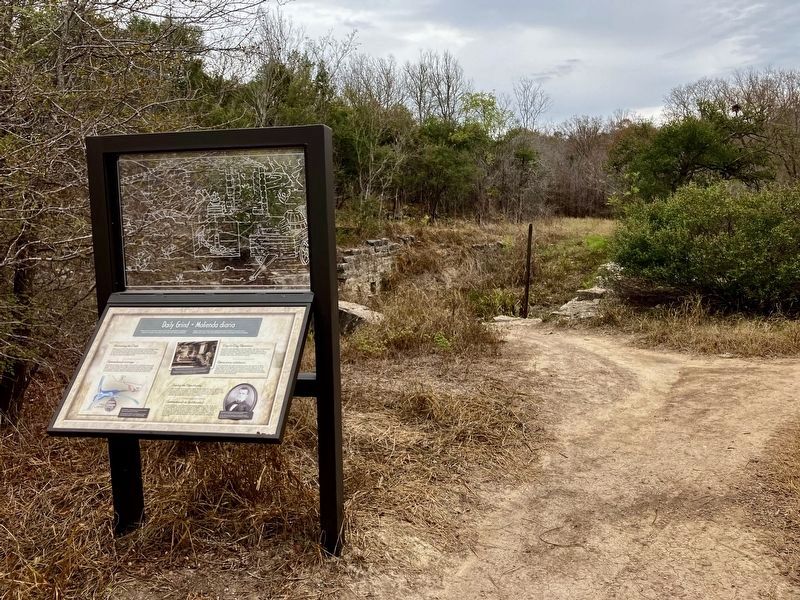
 These ruins are all that remain of the first gristmill in southeast Austin. A wooden structure stood atop the stone foundation.
Harnessing the Creek
Behind you at Lower Falls, thick iron rods stick out of the creek bed. These are the footings of a dam that once diverted water toward this mill. A carved channel funneled water here along the millrace, which was located to your left. The flow of water provided a natural source of energy to spin the heavy grinding wheel inside the mill.
Day-to-Day Operations
Operation of the mill began in the early 1850s, soon after the McKinneys arrived. In those days, people had to grind their own grain or buy expensive imported four. Having a gristmill nearby made grinding much easier. Customers likely interacted with an enslaved attendee rather than McKinney himself.
Seizing the Opportunity
With business interests across Texas, Thomas McKinney was an entrepreneur with an eye for opportunity. Arriving in Travis County, he noticed the growing population lacked gristmills. He immediately had this mill and dam constructed using hired hands and enslaved labor. Thomas was not
this page online
Captions
(Photo #1) In the 1970s, archeologists excavated the mill to learn more about how it worked.
(Photo #2) Though it's quiet today, the mill was once a busy place. As rushing water turned the turbine below, the grinding wheel turned grain to flour.
(Photo #3) McKinney's business sense and his use of enslaved lahor allowed him to maintain an aristocratic lifestyle.
Estas ruinas son todo lo que queda del primer molino de granos en el sudeste de Austin. Una estructura de madera coronaba la base de piedra.
Aprovechando el arroyo
Detrás de ti, en Lower Falls, gruesas varas de hierro sobresalen del lecho del arroyo. Son los cimientos de un dique que antes desviaba el agua hacia este molino. Un canal conducía el agua de aguí hacia la aceña, que estaba situada a tu izquierda. El flujo de agua proporcionaba una fuente de energía natural que hacía girar la pesada rueda de molienda que estaba dentro del molino.
Operaciones cotidianas
El funcionamiento del molino comenzó a inicios de la década de 1850, poco después de la llegada de los McKinney.
Photographed by Tracy Andersen Roberts, November 1, 2025
2. Daily Grind / Molienda diaria Marker
Aprovechando la oportunidad
Thomas McKinney, cuyos intereses de negocios estaban en todo Texas, fue un emprendedor siempre atento a las oportunidades. Al llegar al condado de Travis, se dio cuenta de que la creciente población no contaba con molinos de granos. De inmediato, mandó construir este molino y este dique, en los que trabajaron tanto personas esclavizadas como contratadas. Thomas no era el típico pionero cubierto de polvo, sino que solía dejarle el trabajo duro a los demás.
Subtítulos
(Foto #1) En la década de 1970, los arqueólogos excavaron el molino para conocer mejor cómo funcionaba.
(Foto #2) Aunque en la actualidad no está en actividad, el molino era un lugar ajetreado. A medida que el agua hacía girar la turbina inferior, la rueda de molienda convertía los granos en harina.
(Foto #3) El buen olfato para los negocios y el uso de mano de obra esclavizada le permitieron a McKinney mantener un estilo de vida aristócrata.
Erected by Texas
Photographed by Tracy Andersen Roberts, November 1, 2025
3. Daily Grind / Molienda diaria Marker
Topics. This historical marker is listed in these topic lists: African Americans • Industry & Commerce • Parks & Recreational Areas • Settlements & Settlers. A significant historical year for this entry is 1852.
Location. 30° 11.328′ N, 97° 43.165′ W. Marker is in Austin, Texas, in Travis County. It can be reached from Park Road west of McKinney Falls Pkwy. The marker is located in the McKinney Falls State Park on the Homestead Trail. Touch for map. Marker is in this post office area: Austin TX 78744, United States of America. Touch for directions.

Regionally, this marker is in Central Texas. It is also in the American South. Globally, it is in North America, a Gulf of Mexico state, the Western Hemisphere, the Western World, and the Anglosphere. Historically, it finds itself in what was once New Spain, the Republic of Texas, one of the Confederate States of America, and the Antebellum South.
Other nearby markers. At least 8 other markers are within 4 miles of this marker, measured as the crow flies: Creekside Community / Comunidad de Creekside (about 500 feet away, measured in a direct line); Santiago del Valle Grant (approx. half a mile away); Collins Cemetery (approx. 1.6 miles away); Richard Overton Healing Garden (approx. 2.1 miles away); Doyle Farm (approx. 2.9 miles away); Onion Creek Lodge 220, A.F. & A.M. (approx. 3.1 miles away); Ward Memorial United Methodist Church (approx. 3.2 miles away); Burditt Prairie Cemetery (approx. 3½ miles away). Touch for a list and map of all markers in Austin.
Other markers no longer nearby. The Governor Horton Place (was approx. 2.9 miles away but has been confirmed missing); Pilot Knob (was approx. 3 miles away but has been confirmed missing).
Also see . . .
1. McKinney Falls State Park History.
Voters elected McKinney as a senator to the first legislature in Austin. During this time, he made plans for his new home on Onion Creek. Between 1850 and 1852, McKinney built a two-story limestone home, gristmill and dam on his ranch.(Submitted on November 2, 2025, by Tracy Andersen Roberts of Atlanta, Georgia.)
2. Friends of McKinney Falls State Park.
As you walk around the park, you'll see signs of the people that lived there before us. You'll find the ruins of McKinney's homestead, his horse trainer's cabin, gristmill and stone walls in the park to name a few.(Submitted on November 2, 2025, by Tracy Andersen Roberts of Atlanta, Georgia.)
Credits. This page was last revised on November 6, 2025. It was originally submitted on November 2, 2025, by Tracy Andersen Roberts of Atlanta, Georgia. This page has been viewed 87 times since then and 40 times this year. Photos: 1, 2, 3. submitted on November 2, 2025, by Tracy Andersen Roberts of Atlanta, Georgia. • James Hulse was the editor who published this page.
