Near Pauline in Adams County, Nebraska — The American Midwest (Upper Plains)
Kingston Cemetery

Photographed by Cosmos Mariner, September 13, 2025
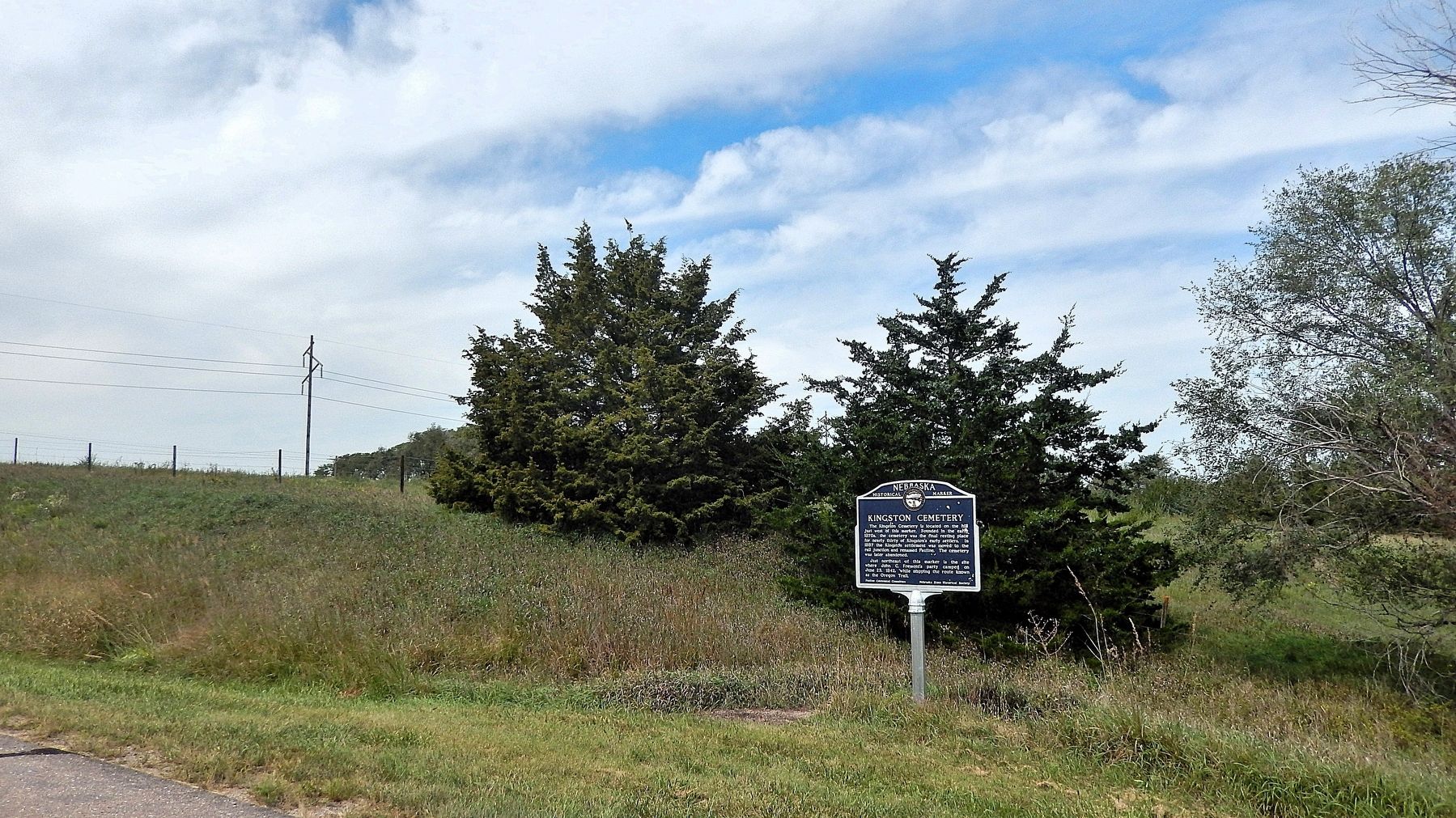
1. Kingston Cemetery Marker
The Kingston Cemetery is located on the hill just west of this marker. Founded in the early 1870s, the cemetery was the final resting place for nearly thirty of Kingston’s early settlers. In 1887 the Kingston settlement was moved to the rail junction and renamed Pauline. The cemetery was later abandoned.
Just northeast of this marker is the site where John C. Fremont’s party camped on June 25, 1842, while mapping the route known as the Oregon Trail.
Erected 1987 by Pauline Centennial Committee & Nebraska State Historical Society. (Marker Number 324.)
Topics and series. This historical marker is listed in these topic lists: Cemeteries & Burial Sites • Exploration • Settlements & Settlers. In addition, it is included in the Nebraska State Historical Society, and the Oregon Trail series lists. A significant historical date for this entry is June 25, 1842.
Location. 40° 26.241′ N, 98° 22.297′ W. Marker is near Pauline, Nebraska, in Adams County. It is on East Monument Road (State Highway 76) 1.8 miles east of U.S. 281, on the left when traveling east. The marker is in a pull-out on the north side of Nebraska Highway 76.
this page online

Regionally, this marker is in the Smoky Hills and in Eastern Nebraska. It is also in the American Midwest, in the Corn Belt, and on the prairies. Globally, it is in North America, the Western Hemisphere, the Western World, and the Anglosphere. Historically, it finds itself in what was once the Louisiana Purchase.
Other nearby markers. At least 8 other markers are within 11 miles of this marker, measured as the crow flies: Millington (approx. 1.9 miles away); Oregon Trail (approx. 3 miles away); Oregon Trail & Pony Express Trail (approx. 3.4 miles away); Crystal Lake (approx. 3.8 miles away); Spring Ranche (approx. 6.9 miles away); Brickyard Park (approx. 9.9 miles away); The Burlington Depot (approx. 10.2 miles away); Naval Ammunition Depot (approx. 10.2 miles away).
Also see . . .
1. Kingston Cemetery (Find A Grave).
(By Lois Frahm) Excerpt: There are no markers in this cemetery. The cemetery was a pasture for many years until 1965 when the State Dept of Roads was working on the road(Submitted on November 3, 2025, by Cosmos Mariner of Cape Canaveral, Florida.)sliced open some of graves when they learned it was an old pioneer cemetery. The Cemetery was never a deeded cemetery, so it was not on any maps except the 1885 plat map of Adams County.Photographed by Cosmos Mariner, September 13, 20252. Kingston Cemetery MarkerLooking northwest from East Monument Road; the cemetery was on the hill in the left background.
This cemetery served the early settlers in 1870's until the Leroy or Little Blue Cemetery (now Blue Valley) was established in 1919. The land on which the cemetery is located was first given by Charles Bird, who owned the surrounding land. The early settlers fenced the cemetery and kept the markers up, and the grounds clean, but as time passed and new owners took over the land, the fence was knocked down by cattle and grave markers lost.
In 1987 a large metal marker was bought and the state placed it on the roadside hill at the cemetery.
2. Fremont’s Expeditions of the American West (Legends of America).
(by by Frank W. Blackmar) Excerpt: The explorations of John Charles Fremont, made under an act of Congress, were important in placing an accurate description of the region west of the Mississippi and Missouri Rivers before the people. His first expedition was made in 1842 with only 21 men from the St. Louis, Missouri area, principally Creole and Canadian voyageurs who had become familiar with prairie life in the service of the fur companies in the Indian country.(Submitted on November 3, 2025, by Cosmos Mariner of Cape Canaveral, Florida.)
Credits. This page was last revised on November 3, 2025. It was originally submitted on November 3, 2025, by Cosmos Mariner of Cape Canaveral, Florida. This page has been viewed 96 times since then and 50 times this year. Photos: 1, 2. submitted on November 3, 2025, by Cosmos Mariner of Cape Canaveral, Florida.
