
Ocean Park in Santa Monica in Los Angeles County, California — The American West (Pacific Coastal)
Environmental Justice
Photographed by Duane and Tracy Marsteller, September 27, 2025
1. Environmental Justice Marker
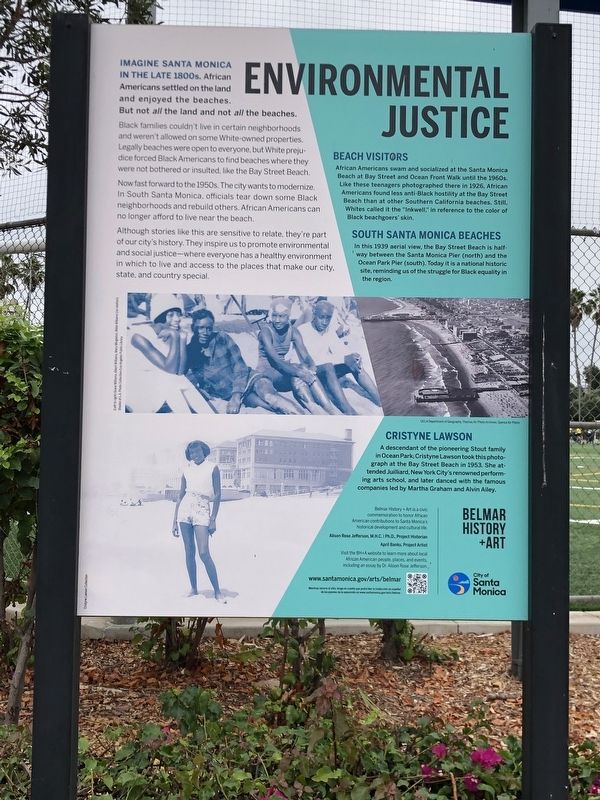
Black families couldn't live in certain neighborhoods and weren't allowed on some White-owned properties. Legally beaches were open to everyone, but White prejudice forced Black Americans to find beaches where they were not bothered or insulted, like the Bay Street Beach.
Now fast forward to the 1950s. The city wants to modernize. In South Santa Monica, officials tear down some Black neighborhoods and rebuild others. African Americans can no longer afford to live near the beach.
Although stories like this are sensitive to relate, they're part of our city's history. They inspire us to promote environmental and social justice – where everyone has a healthy environment in which to live and access to the places that make our city, state, and country special.
Beach Visitors
African Americans swam and socialized at the Santa Monica Beach at Bay Street and Ocean Front Walk until the 1960s. Like these teenagers photographed there in 1926, African Americans found less anti-Black
this page online
South Santa Monica Beaches
In this 1939 aerial view, the Bay Street Beach is halfway between the Santa Monica Pier (north) and the Ocean Park Pier (south). Today it is a national historic site, reminding us of the struggle for Black equality in the region.
Cristyne Lawson
A descendant of the pioneering Stout family in Ocean Park, Cristyne Lawson took this photograph at the Bay Street Beach in 1953. She attended Juilliard, New York City's renowned performing arts school, and later danced with the famous companies led by Martha Graham and Alvin Ailey.
[Photo Captions/Credits (clockwise from top left)]
• (Left to right) Grace Williams, Albert Williams, Mary Mingleton, Willie Williams (no relation). Shades of L.A. Photo Collection/Los Angeles Public Library
• UCLA Department of Geography, Thomas Air Photo Archives, Spence Air Photo
• Cristyne Lawson Collection
Erected by City of Santa Monica. (Marker Number 14.)
Topics. This historical marker is
Photographed by Duane and Tracy Marsteller, September 27, 2025
2. Environmental Justice Marker
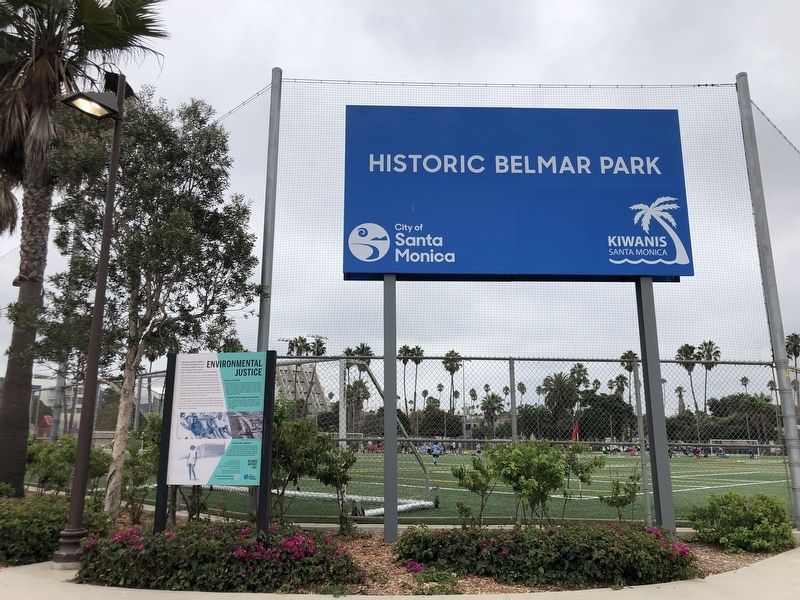
Location. 34° 0.603′ N, 118° 29.355′ W. Marker is in Santa Monica, California, in Los Angeles County. It is in Ocean Park. It can be reached from Civic Center Drive north of Main Street, on the right when traveling north. Located at the southwest corner of Belmar Park. Touch for map. Marker is at or near this postal address: 1725 Main St, Santa Monica CA 90401, United States of America. Touch for directions.

Regionally, this marker is in Greater Los Angeles and in the Transverse Ranges. It is also on the American Pacific Coast. Globally, it is in North America, on the Ring of Fire, in the Pacific Rim, in the Western Hemisphere, in the Western World, and in the Anglosphere. Historically, it finds itself in what was once New Spain and also Mexico’s Alta California.
Other nearby markers. At least 8 other markers are within walking distance of this marker: Black Women Empowered (a few steps from this marker); Not on My Beach (within shouting distance of this marker); Early Black Businesses (within shouting distance of this marker); “No, No, No Jim Crow” (within shouting distance of this marker); Black Lives in Ocean Park (about 300 feet away, measured in a direct line); Welcome to Historic Belmar Park (about 300 feet away); A Resurrection in Four Stanzas (about 300 feet away); A Neighborhood Erased (about 400 feet away). Touch for a list and map of all markers in Santa Monica.
More about this marker. It is part of Belmar History + Art, a commemoration and celebration of the African American neighborhoods of South Santa Monica and their contributions to the city's history and cultural heritage. Belmar History + Art includes sculptural artwork, an educational program, website, and interpretive signage (including this one) installed around the perimeter of Belmont Park. Note: The project web address has been changed to www.santamonica.gov/belmar-history-art
Credits. This page was last revised on December 4, 2025. It was originally submitted on November 4, 2025, by Duane and Tracy Marsteller of Murfreesboro, Tennessee. This page has been viewed 51 times since then and 18 times this year. Photos: 1, 2. submitted on November 4, 2025, by Duane and Tracy Marsteller of Murfreesboro, Tennessee.
