Bremen-Mitte in Mitte, Germany — Central Europe
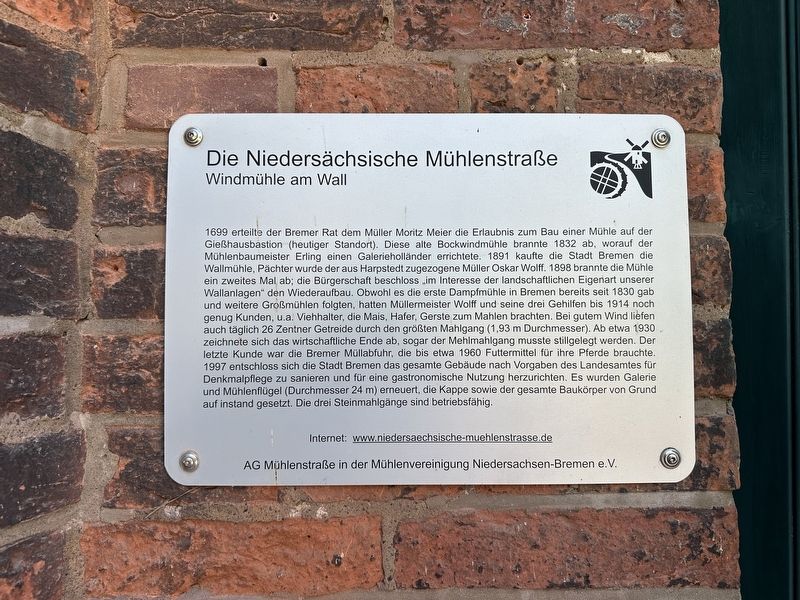
Windmühle am Wall
⎯⎯⎯
Windmill on the Wall
| — | Die Niedersächsische Mühlenstraße | — |
Photographed by Andrew Ruppenstein, May 19, 2025
1. Windmühle am Wall / Windmill on the Wall Marker

this page online
Internet: www.niedersaechsische-muehlenstrasse.de
In 1699, the Bremen council granted miller Moritz Meier permission to build a mill on the Gießhaus bastion (here, the present-day location). This old post mill burned down in 1832, whereupon millwright Erling erected a smock mill. In 1891, the city of Bremen purchased the Wallmühle (Wall Mill), and the miller Oskar Wolff, who had moved from Harpstedt, became the tenant. In 1898, the mill burned down a second time; the city council decided to rebuild it in the interest of preserving the unique character of the city's ramparts. Although the first steam mill in Bremen had already existed since 1830, and other large mills followed, miller Wolff and his three assistants still had enough customers until 1914, including livestock farmers who brought corn, oats, and barley to be milled. With a
Photographed by Andrew Ruppenstein, May 19, 2025
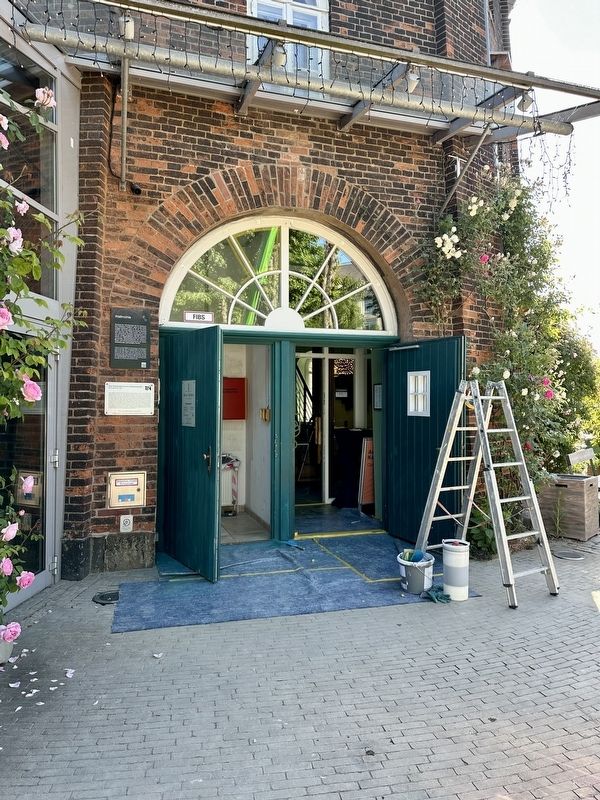
2. Windmühle am Wall / Windmill on the Wall Marker - wide view
The marker is visible here just to the left of the mill entrance.
Internet: www.niedersaechsische-muehlenstrasse.de
Erected by AG Mühlenstraße in der Mühlenvereinigung Niedersachsen-Bremen e.V.
Topics and series. This historical marker is listed in these topic lists: Industry & Commerce • Man-Made Features. In addition, it is included in the Windmills series list. A significant historical year for this entry is 1699.
Location. 53° 4.809′ N, 8° 48.409′ E. Marker is in Bremen, in Mitte. It is in Bremen-Mitte.
Photographed by Andrew Ruppenstein, May 19, 2025
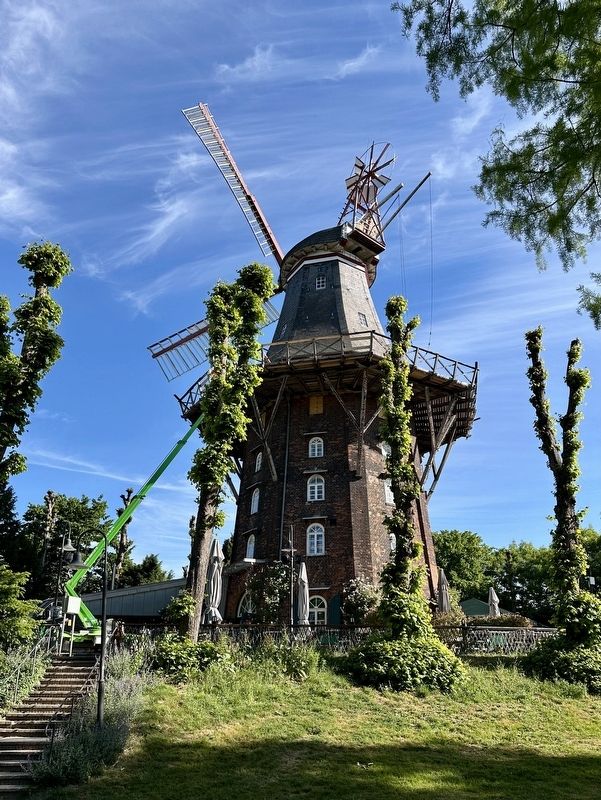
3. Windmühle am Wall / Windmill on the Wall

Regionally, it is in Europe, the European Union, Atlantic Europe, Central Europe, the Schengen Area, Western Europe, and the Western World. Historically, it finds itself in what was once the Holy Roman Empire and also the former West Germany.
Other nearby markers. At least 8 other markers are within walking distance of this marker: Wallmühle / Wall Mill (here, next to this marker); Hotel am Hillmanplatz (about 180 meters away, measured in a direct line); Wilhelm Kaisen (about 180 meters away); Die Sögestrasse / “Sow” Street (about 210 meters away); Geschäftshaus / Business and Office Building (about 210 meters away); Geschäftshaus / Commercial Building (about 240 meters away); Lehrgebäude / Instructional Building (about 240 meters away); Ronning-Haus (about 240 meters away). Touch for a list and map of all markers in Bremen.
Also see . . .
1. The Mill in the Wallanlagen Bremen (Discover Bremen). Excerpt:
A total of five windmills from the 17th and 18th centuries have been preserved in Bremen to this day. One of them is the mill in the Wallanlagen, also called "Mühle am wall", Bremen's old city fortifications, whose walls were ground down in 1802 and turned into a park. Although it burnt down completely twice in the 19th century, it was rebuilt again and again. Flour was ground here until 1947, and today the mill hosts a café.(Submitted on November 4, 2025.)
2. Willkommen bei der "Niedersächsischen Mühlenstraße" (in German). The link provided on the marker leads to this page, an introduction to the "Lower Saxony Mill Route". Excerpt (in translation):
…it was established in 1998 under the auspices of the "Lüneburg Mill Promotion Association" (MFV Lbg.) and has since encompassed 427 mill sites in 29 districts. The stated goal from the outset was to expand it to cover all of Lower Saxony. Therefore, in mid-2004, the founding association transferred its sponsorship of the Mill Route to the statewide "Lower Saxony-Bremen Mill Association" (MVNB). The continuation of this successful tourist route is the responsibility of the independently operating "Mill Route Working Group,"…(Submitted on November 4, 2025.)
Credits. This page was last revised on November 4, 2025. It was originally submitted on November 4, 2025, by Andrew Ruppenstein of Lamorinda, California. This page has been viewed 73 times since then and 34 times this year. Photos: 1, 2, 3. submitted on November 4, 2025, by Andrew Ruppenstein of Lamorinda, California.
